Erasmus Mundus Scholarship for African Students 2026: A Complete Guide for Entry (Including the Best Consortia)
The Erasmus Mundus scholarship for African students 2026 comprises dozens of individual university programs with varying requirements, deadlines, and awards. A nuance not often reflected in guides, which may leave you confused about the scholarship’s basic details. This guide offers a brief look at what the scholarship is, what the best options for African students are, and how to apply for 2027 entry.
A Timing Note
The 2026 round of Erasmus Mundus applications has already ended – Nigeria’s own Pre-Departure Orientation for the 2026 academic year took place earlier this year in Abuja. This means that the currently open round is the 2027 intake, which will begin accepting applications from October-November 2026 and close by February-March 2027 for a September 2027 start. Keep this timeline in mind as you read the following sections.
What is the Erasmus Mundus Scholarship for African Students 2026?
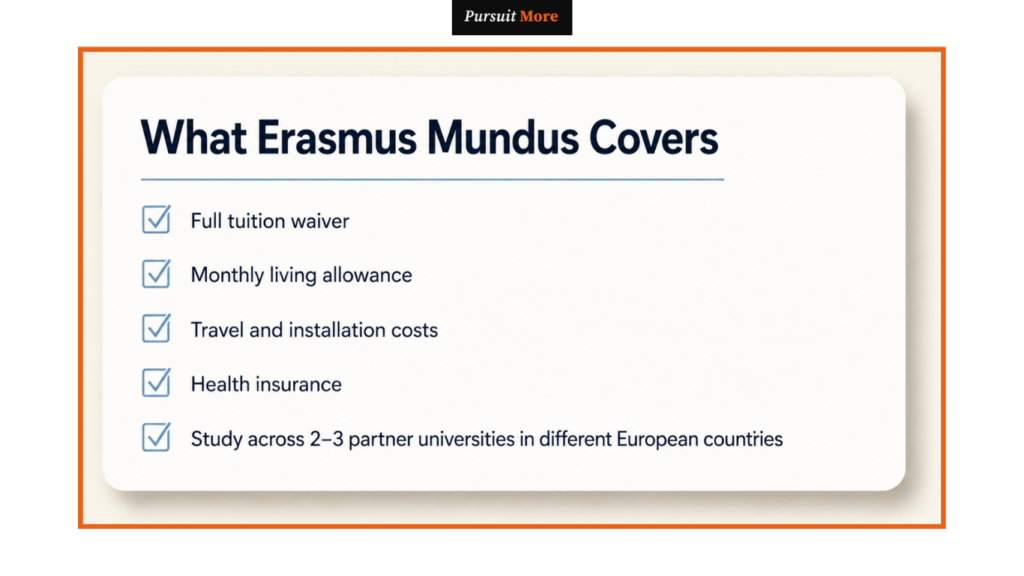
An Erasmus Mundus Joint Master (EMJM) is a two-year integrated study program offered by at least three higher education institutions in at least three different countries. By applying to a particular EMJM, you are not applying to a university, but rather a consortium, which will see you studying in two or more of its affiliated countries over the course of your degree.
In return, you’ll graduate with a double or multiple degree. Some notable examples of EMJMs include Education, Migration and Diversity (EDU_MIG), Artificial Intelligence (EMAI), Journalism (Mundus Journalism), Health (EACH), and Global and Local Development (GLOCAL).
Scholarships for all EMJM programs offer similar benefits, including a full tuition waiver, a monthly stipend of €1,400 for up to 24 months totalling €33,600, health insurance, and a mobility grant of up to €3,000 for students travelling from more than 4,000 km away, a bracket that covers all of Africa essentially.
It is important to understand that while most EMJM programs offer similar benefits, the differences lie in what field of study they cover, the universities involved, the number of available scholarships, and whether they explicitly state a preference for African students.
Erasmus Mundus Consortia Comparison
In terms of explicit African student preference, EDU_MIG is the only consortium on this list which has publicly stated its preference for Sub-Saharan African and Middle Eastern students for its limited, competitive number of scholarships. For artificial intelligence and computer science, EMAI is a better option, offering around 19 total scholarships per intake, with no stated preference for Africans but open to all Partner Country students.
For journalism and media, Mundus Journalism at Aarhus University is the best option, with a low number of scholarships (between 10 and 15 total per year) and no stated African preference. EACH, focused on public health and based at the University of Tartu, offers standard Partner Country scholarships, which vary per intake and have no stated regional preference. GLOCAL at the University of Glasgow offers several specialisations (designated by A-I) for global and local development, as well as standard Partner Country scholarships, and several fully self-funded tracks for students who don’t need funding but still wish to study in Glasgow.
This is a crucial distinction to make between scholarships explicitly limited to Africans and those open to other regional categories as well.
The Takeaway on Preference vs. Eligibility
To summarise, while there are several EMJM programs which accept African students, very few of them (EDU_MIG being one) have explicitly stated a preference for them over other regional categories. In general, most EMJMs have an open, equal policy towards all applicants from the Partner Countries, which are eligible to apply for the Erasmus Mundus scholarships.
Keep this in mind when shortlisting EMJM programs: applying to a less competitive program which has no special preference for African students will be no easier than applying to a program with a special scholarship fund for Africans, since you will compete with other African applicants for the same number of seats.
Eligibility and Application Process for Erasmus Mundus Scholarships (2027)
Eligibility
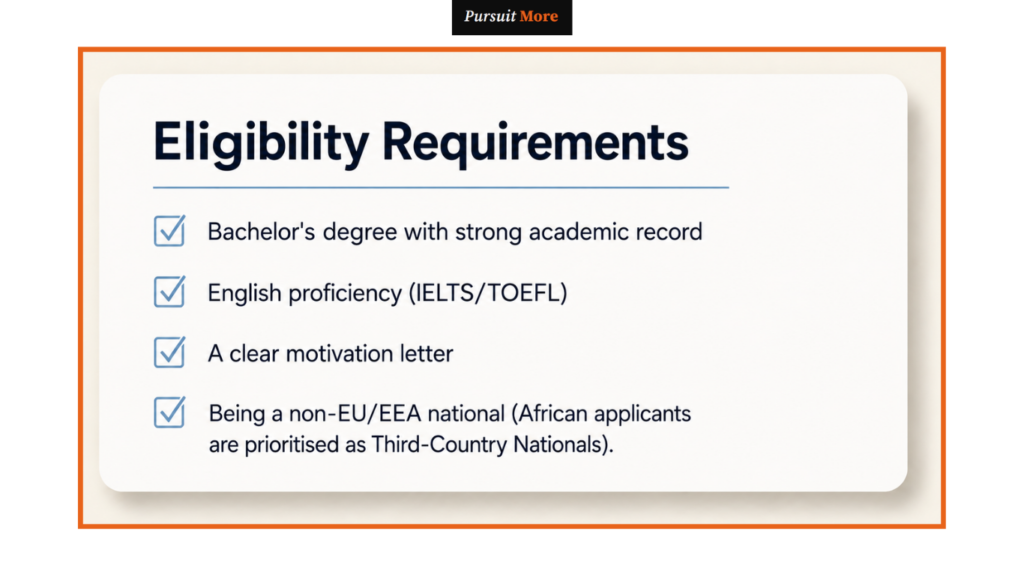
There are a number of general eligibility requirements for the Erasmus Mundus scholarship which apply to all EMJM programs:
- At least a bachelor’s degree, or about to graduate with one before the start of the program.
- An English proficiency certificate or an equivalent institutional attestation, usually an IELTS score of at least 6.5 or a TOEFL score of at least 90.
- No previous Erasmus Mundus scholarships.
- No more than three applications per intake cycle.
Applying
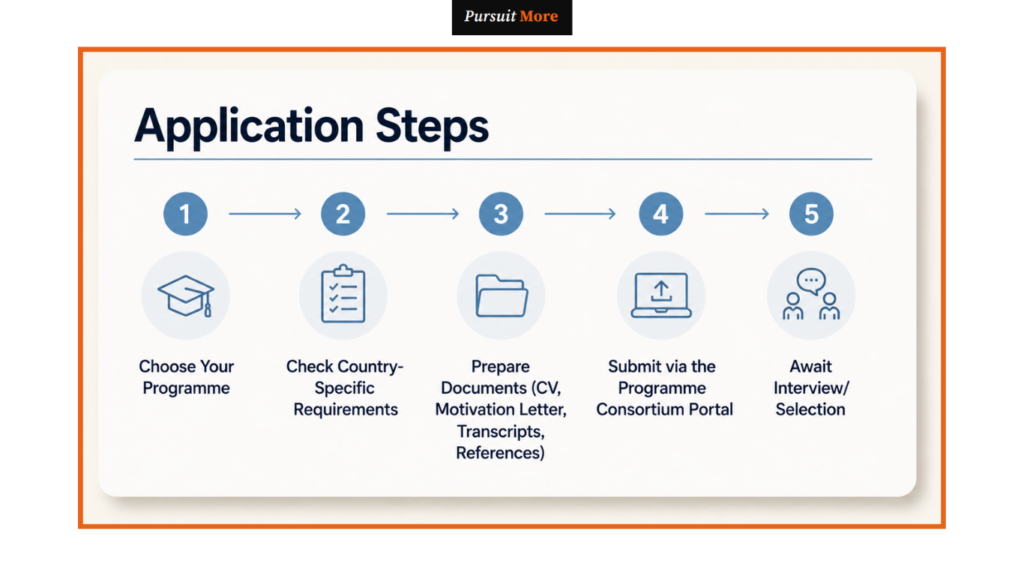
The application process, broadly speaking, follows a few steps. First, you may wish to review the EACEA catalogue of EMJM programs and shortlist three courses which appeal to you the most. You will need to research their official websites individually to determine their application deadline and requirements, which you may apply for directly on the portal of your chosen EMJM program.
When applying, make sure to specify your interest in the scholarship, which most EMJM programs offer on a rolling basis and require a ranked shortlist of programs you are interested in. Most programs will inform you of their selection decision two to four months after the deadline for applications has passed.
Deadlines for the 2027 Intake
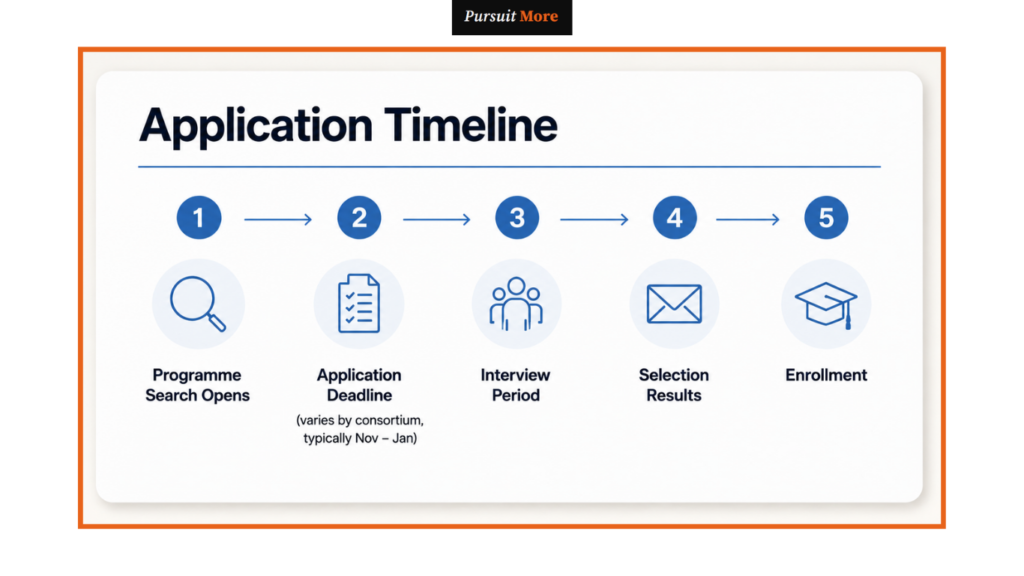
The 2027 intake for the Erasmus Mundus Joint Master Degree Program has a fairly simple timeline. First, the EACEA directory of EMJM programs, which includes all of the currently recruiting consortia, updates with new programs between July and September 2026. The individual EMJM programs, which include detailed information about eligibility and application requirements, will begin accepting applications from October and November 2026, with most closing between December 2026 and February 2027, and some as early as December and as late as March 2027.
Most programs will announce their offers by March-May 2027, with the courses commencing in September 2027. This fairly wide window means that, having shortlisted three EMJM programs you are interested in, the first task is to confirm their deadlines individually on their official websites, rather than relying on a third-party guide such as this one.
How to Select the Best EMJM Program for You
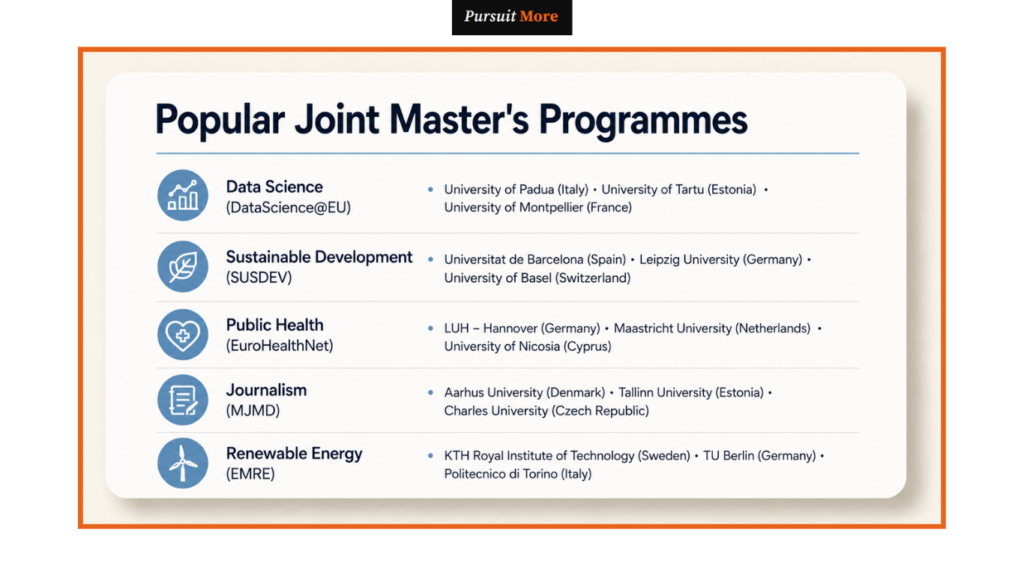
Selecting the EMJM program which suits you best should be done on a case-by-case basis, but there are a few general guidelines:
- Fit first. Consider your level of interest in a given field and how well your application fits the Erasmus Mundus Joint Master Degree program’s expectations – a moderately strong application to a suitable program will fare better than a stronger application to an unsuitable one.
- Competition. Consider the competition for the EMJM program: smaller programs, such as Mundus Journalism, which only offer between 10 and 15 total scholarships per year, are more competitive than larger programs with upwards of 40 scholarships per year.
- Mobility. Consider the mobility component of the EMJM program: while some EMJMs only require you to study in two EU countries, others require you to complete exchanges in up to five different countries.
- Stated preferences. Consider any specific preferences the EMJM may have: while most EMJM programs list eligibility criteria and requirements to apply for the scholarship, few list their preferences, such as EDU_MIG’s stated interest in Sub-Saharan African and Middle Eastern candidates.
- Your finances. Consider your own financial situation: while most EMJM scholarships cover living costs, you will be responsible for covering the costs of the first few months before the EMJM scholarship begins to cover your living costs.
The Bottom Line
The 2026 round of applications for Erasmus Mundus has already concluded, and the 2027 round of Erasmus Mundus applications is set to begin this October. Having identified the field of study which interests you the most, you may wish to shortlist three EMJM programs which align with your own requirements and research their deadlines individually on their official websites.
If you wish to identify the EMJM programs which would benefit you personally before submitting three full applications, you may also consider a personal application audit.
If you want to explore another prestigious, zero-tuition option, check out our step-by-step guide on how to Study in Germany Free: DAAD Scholarship Guide for Nigerians 2026.