CSC Scholarship Requirements For Nigerian Students: Complete Guide For Applicants
Meeting the CSC scholarship requirements for Nigerian students starts with knowing that you are not limited to a single application track. Most online guides make it seem like you have to choose between Type A, Type B, or Type C. In reality, you can apply through multiple pathways at the same time to boost your chances.
You need to understand how each option works for applicants in Nigeria:
- Type A (Bilateral Program): You apply through the Nigerian Federal Scholarship Board (FSB). Nigeria receives 100 to 150 slots every year, which is the largest national allocation in Africa.
- Type B (University Program): You apply directly to individual Chinese universities that accept independent CSC candidates.
- Type C (Special Programs): You apply through specific institutions or international organizations, though you still list your university choices on the main portal.
Fulfilling the CSC scholarship requirements for Nigerian students usually means submitting applications through both Type A and Type B routes simultaneously. The following breakdown walks you through how to navigate both pathways successfully.
Type A vs Type B CSC Scholarship Application
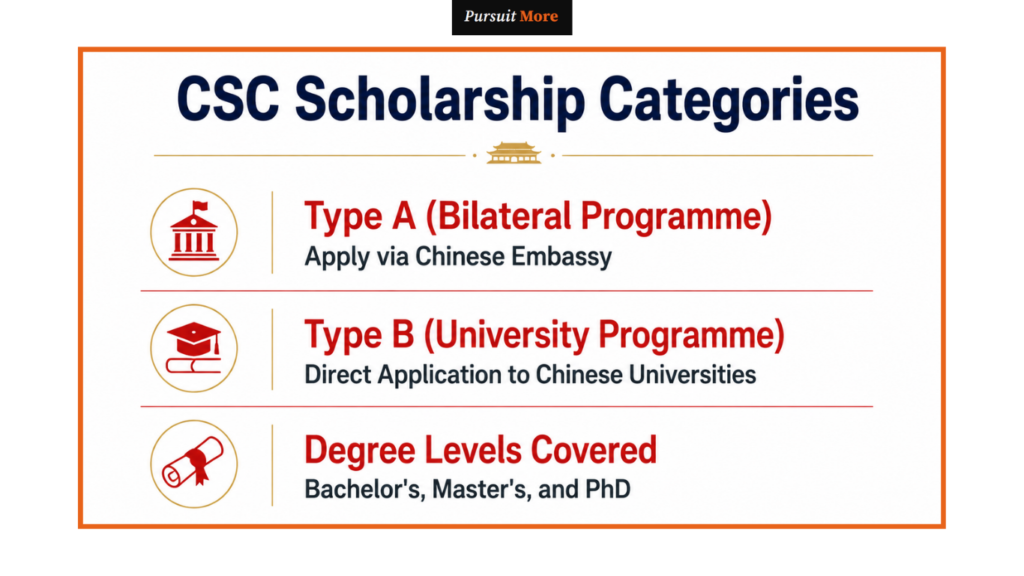
The major difference between Type A and Type B lies in who receives your application. For Type A, your application goes through the Nigerian Government first, following the bilateral Education Agreement route.
You submit through the Federal Scholarship Board under the Nigerian Ministry of Education, which screens candidates and forwards the list of qualified names to China. China then works with the Chinese embassy to complete the scholarship selection.
Nigeria receives 100 to 150 slots per year, which is the largest allocation among African countries. However, meeting the CSC scholarship requirements for Nigerian students under Type A remains highly competitive because many qualified Nigerians apply annually. One benefit of Type A is that you can choose two or three universities on your application, giving you flexibility if your first choice does not accept you.
For Type B, the route of application is different. You apply directly to the international admission office of a Chinese University.
If the university considers you to be a strong candidate, it recommends you to the China Scholarship Council, which gives the final approval. Unlike Type A, this route is not country-fixed, meaning you compete on a global scale against international applicants worldwide.
The two routes do not cancel each other out. Fulfilling the CSC scholarship requirements for Nigerian students across both pathways is completely valid because a rejection on Type A does not mean a rejection on Type B. The application goes through different people, different selection criteria, and different timelines.
One important detail on Type B applications is the Agency Number. It tells the CSC online system which university is to receive and review your application. Entering a wrong Agency Number means that a different university receives your application file entirely.
Nigerian Eligible Universities Under the CSC Silk Road Scholarship
A fully funded Master’s in China for Africans in 2026 starts with picking the right university. Many students assume that because a university offers CSC scholarships, they can automatically apply for the Silk Road program.
This is not true. The Silk Road Program has its own eligibility rules, including a specific list of countries that can apply.
Reviewing the CSC scholarship requirements for Nigerian students for each institution is essential, because if Nigeria is not on the list for that university, applying there is going to be a waste of time and effort. Currently, three universities explicitly name Nigeria among their eligible countries.
Central South University
It is located in Changsha and has a small, highly specialised Silk Road scholarship intake. It offers scholarships mainly in technical and engineering-related courses. Some of the programs currently available are: Geological Resources, Geological Engineering, Civil Engineering, Computer Science and Technology, Traffic and Transportation Engineering, Control Science and Engineering.
Confirming the CSC scholarship requirements for Nigerian students at Central South University is straightforward, as Nigeria is explicitly named among eligible Belt and Road countries alongside Pakistan, Yemen, Ethiopia, and Bangladesh.
If you are applying through the Type B route, the Agency number is 10533.
Tianjin University
This university offers one of the widest ranges of English-taught programs among the universities on this list. According to the University, there are 29 English-taught Master’s Programmes and 55 English-taught Doctoral programmes (PhD). Like the Central South University, Nigeria is specifically listed on the published list of eligible countries.
If you are applying through Type B, the Agency number for this university is 10056.
Chongqing University
The Silk Road Scholarship for Chongqing University is mainly for engineering programmes. Some of the programmes currently eligible for the Silk Road Scholarship are Electrical Engineering, Mechanical Engineering and Energy and Power Engineering.
Chongqing University does not specifically mention Nigeria as part of its eligible countries. Instead, it says the Applicants should come from Belt and Road countries, so confirming current-cycle eligibility directly with the University’s International Students Office is worth an email.
If you are applying through the Type B route, the Agency number is 10611. This is worth noting because there is a different university named Chongqing University of Posts and Telecommunications with its own CSC scholarship and an Agency number of 10617.
CSC Scholarship Requirements for Nigerian Students: Eligibility for CSC Silk Road Scholarship
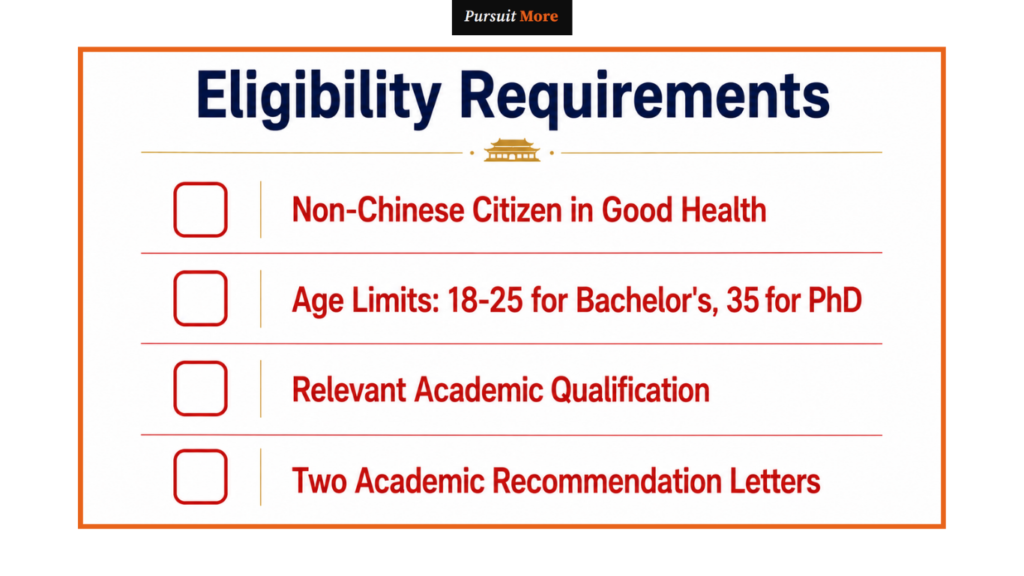
This is a quick self-check list that contributes to your success when applying for the CSC Silk Road Scholarship
Age Requirement
The age limit for this scholarship depends on the level of study you are applying for. For a Master’s degree, you must be less than 35 years old. For a Doctoral degree, you just have to be less than 40 years old. For an undergraduate degree, you must be less than 25years.
It’s important to note that your age is not measured on the day you submit your application but against the start of the academic year.
Academic Record
To be eligible, there is a minimum academic standard set for all applicants. Applicants should have either a 3.0 GPA on a 4.0 scale or have 80% on a 100- point grading scale. Central South University and Chongqing University both have identical eligibility lists, which suggests it’s closer to a Silk Road program floor than a university-specific preference.
Language Requirement
This depends on the language your programme will be taught in. If it is taught in Chinese, you need an HSK level 4 Certificate with a score of 260 or above.
At Central South University, if your HSK level 4 score falls between 180 and 259, you may be considered, but you will be required to complete a one-year Chinese language preparatory programme.
If your programme is straight in English, you don’t need HSK, but you need to improve your English proficiency with either IELTS with a score of 6.0 or higher or TOEFL with a score of 80 or higher.
A compulsory entrance examination called China Scholastic Competency Assessment (CSCA) for international undergraduate applicants applying to CSC-affiliated Universities was introduced during the 2026/2027 admission cycle. This information doesn’t apply to Master’s or PhD applicants.
University Selection Matrix
| University | Agency Number | English – Taught Option | Field Strength | Route |
| Central South University | 10533 | Available in select majors | Geological resources, Geological Engineering, Civil Engineering, Computer Science and Technology, Traffic and Transportation Engineering, Control Science and Engineering. | Type B |
| Tianjin University | 10056 | 29 Master’s and 55 PhD programs are fully taught in English | Engineering, Science, Management. | Type B |
| Chongqing University | 10611 | Available in select majors | Mechanical Engineering, Energy and Power Engineering, Electrical Engineering. | Type B |
Step by Step Application Checklist

Here is how to apply for the Chinese Government Scholarship from Nigeria:
1. Decide which route you plan on using; it can either be Type A, Type B or both. Type A means applying through Nigeria’s Federal Scholarship Board and the Chinese Embassy in Abuja. Type B means applying directly to the Chinese University of your choice.
These two routes are independent, and applying to one doesn’t prevent you from applying to another.
2. Register on the CSC portal
After deciding on the route you wish to apply through, register on the CSC portal at studyinchina.csc.edu.cn
This is the official application system used by the China Scholarship Council. Both application routes eventually go through this stage, but it is entered differently. For type A, it goes through the Federal Scholarship Board before reaching the CSC system. For type B, you submit your application directly through the CSC portal using your chosen University’s Agency Number.
3. Gather your documents immediately after application because many require notarization. This can take several weeks in Nigeria. Your documents should include:
- Your highest academic degree certificate
- Your academic transcripts
- A study plan or research proposal: Central South University and some Silk Road Universities require this to be at least 1000 words.
- Two recommendation letters written by professors or associate professors.
- A police Clearance Certificate that clears you of any criminal record
- A medical Examination test form.
For Nigerian applicants, there are two documents that mostly cause delay: your NYSC certificate (or exemption letter, if applicable) and your WAEC result. Both documents need to be notarised by the Nigeria court or a Notary Public before they’ll be accepted. Because courts in Lagos and Abuja take an average of two to three weeks to process a batch during their busy periods, it’s best to start the process when you decide to apply, not after the document is ready.
4. Get an Acceptance letter from your supervisor. This is not a compulsory requirement for some universities, but universities like Central South University, Tianjin University and Chongqing University see it as something that makes an application stronger.
5. Submit your application before the Deadline.
For Type A, submit it to the Federal Scholarship Board
For Type B, submit it to the Chinese University
6. Wait for the review process and result. Initial assessment windows run through April and May. The final admission scholarship result is released between June and late July. Sometimes, it extends to August.
2026 CSC Scholarship Application Timeline for Nigerian Students
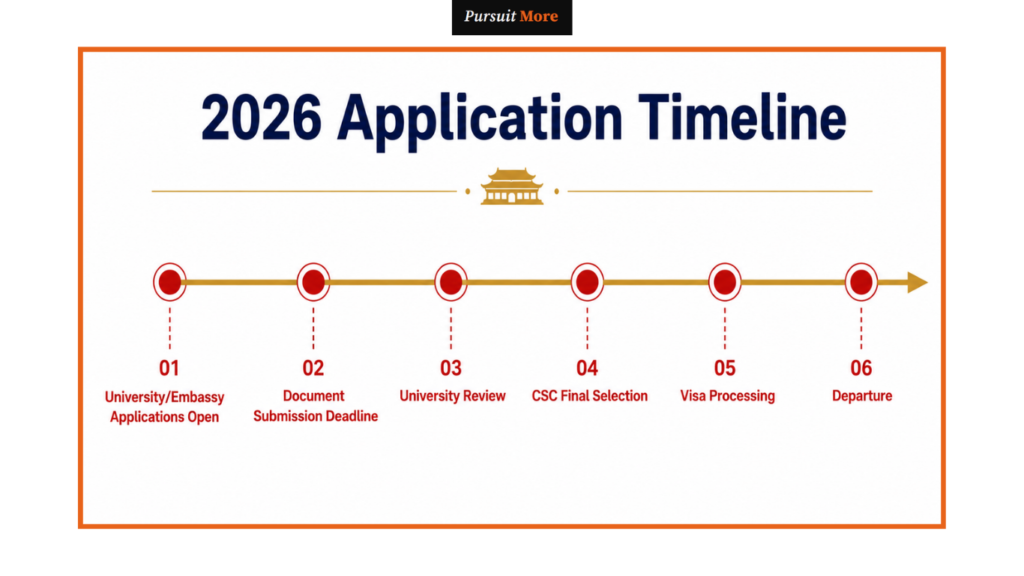
Navigating the application schedule is just as critical as preparing your academic documents. Missing a target deadline by even a day will lead to an automatic disqualification, regardless of how impressive your academic portfolio is.
The annual cycle follows a multi-phase schedule across both Type A and Type B application pathways:
- November – December: Research participating universities, contact prospective faculty supervisors for acceptance letters, and schedule your Foreigner Physical Examination.
- December – January: Complete registration for the CSCA exam if applying for undergraduate programs. Begin notarizing your WAEC results and NYSC discharge certificates locally.
- February 14: Standard submission deadline for Type A applications handled by the Nigerian Federal Scholarship Board (FSB) and Chinese Embassy.
- January – April: Individual university deadlines for Type B direct applications. Closing windows vary by school portal.
- April – May: Initial application review, document authentication, and academic scoring by host universities and the China Scholarship Council.
- June – July: Official selection results are published. Selected scholars receive their official Admission Notice and JW201 or JW202 visa forms.
- August – September: Visa processing at the Chinese Embassy in Abuja, international travel booking, and physical campus registration.
Understanding this schedule ensures you fulfill all CSC scholarship requirements for Nigerian students without running into last-minute document delays. Starting your notarization and medical checks early gives you a buffer against administrative delays in Nigeria.
What Happens After You’re Selected
Being selected is not the end of the journey. After selection, the host university issues an official admission notice alongside a JW201 or JW202 visa application form.
These visa documents are required by Chinese immigration when applying for a student visa. Meeting the CSC scholarship requirements for Nigerian students post-selection also involves completing a Foreigner Physical Examination Form at an accredited medical facility.
Organizing your educational and national service records is equally essential. Your NYSC certificate or exemption letter plays a major role during secondary screening and may require formal notarization.
Fulfilling all post-selection CSC scholarship requirements for Nigerian students can take several weeks, so you should avoid waiting until the final deadline. Once your complete document folder is verified, you can submit your entry visa application at the Chinese Visa Application Center or Embassy in Abuja.
Universities generally expect international scholars to arrive on campus for physical registration between late August and early September. Selected candidates must move quickly to complete visa processing, secure international flight tickets, and pay initial accommodation deposits within this narrow window.
An Alternative Scholarship for Those Who Don’t Fit the Standard CSC Profile

If you are a graduate who has been working for several years, the MOFCOM Scholarship is worth considering. It still runs under the CSC umbrella, but the Silk Road track is handled through the Ministry of Education network. MOFCOM is administered by China’s Ministry of Commerce. The programme operates at roughly two dozen partner universities including Peking University, Tsinghua University, Beijing Normal University and Renmin University of China.
To qualify for this, you must:
- Be less than 45 years old
- Have at least three years of professional experience
- Preferably hold a position in government senior management or a university.
For MOFCOM, you will be given a higher stipend than the standard Silk Road Scholarship
¥36,000 per year for a master’s degree
¥42,000 for a PhD degree.
The master’s program lasts for one or two years, but the PhD program lasts for three years. All courses are taught in English.
A MOFCOM application can feel like Type B because you are dealing with an institution directly, but it is processed as Type A. You still need to register on the CSC portal and select Agency ñnumber 00010. Submit your application through the Economic and Commercial Counselor’s office of the Chinese Embassy, not directly through the University.
The Difference Between a Good File and a Funded One
The document that makes the biggest difference in your scholarship outcome isn’t your transcript. According to reviewers at CSU, Tianjin and Chongqing, reviewers can tell within the first paragraph if you understand the field you are applying to. If you want someone to review and improve your research, you can use the website’s full application Audit and coaching service. For a broader list of local and international opportunities, explore our guide on Postgraduate Scholarships in Nigeria 2026: Masters & PhD Guide.
Frequently Asked Questions (FAQ)
What are the main CSC scholarship requirements for Nigerian students in 2026?
The core CSC scholarship requirements for Nigerian students include being a non-Chinese citizen in good health, holding an accredited academic degree, meeting age thresholds (under 35 for Master’s, under 40 for PhD), and providing notarized transcripts, study plans, and language proficiency scores.
Can I apply for both Type A and Type B scholarships at the same time?
Yes. Meeting the CSC scholarship requirements for Nigerian students across both Type A (Federal Scholarship Board/Embassy) and Type B (Direct University) pathways simultaneously is allowed and increases your chances of selection.
Do Nigerian applicants need IELTS for Chinese university scholarships?
If you apply for an English-taught program, fulfilling the CSC scholarship requirements for Nigerian students typically requires an IELTS score of 6.0+ or TOEFL 80+ unless your target school explicitly provides a waiver based on prior English instruction.
Are NYSC certificates mandatory for the CSC scholarship application?
Yes. For postgraduate applicants, satisfying the CSC scholarship requirements for Nigerian students requires uploading a notarized copy of your NYSC discharge certificate or official exemption letter during document verification.