It is important to know how to write a business plan in Nigeria, particularly when you want to turn an idea into a fundable business. You don’t prepare a business plan only because you wish to get a grant. It is a document that explains what your business does, who will buy from you, how you will operate, how much money you need, and how the business can become financially sustainable.
Another reason why your business plan has to contain detailed information is that different funders assess different things. SMEDAN’s ICSS and GROW Fund pathway, NANSInnovate, the NNPC/Renaissance JV Enterprise Development Programme, iDICE, and Bank of Industry financing do not necessarily use identical application requirements. This means that your business plan for grants and loans in Nigeria should be adapted to the funding opportunity.
This guide breaks down the structure, financial planning approach, funding requirements, and sectors to consider before submitting your plan.
Why Your Business Plan Matters
A good business plan gives the investor the information required, to know if your business idea is commercially realistic.
It should answer five basic questions:
- What problem does the business solve?
- Who will pay for the solution?
- How will the business operate?
- How much funding is required?
- How will the business generate enough value to remain sustainable?
A course code at a Nigerian university, NOUN’s GST302, is a Business Planning course that requires entrepreneurs to describe their business, customers, marketing, management, employees, finances, legal requirements and regulatory obligations.
When applying for a loan, it is crucial to include all financial information.
For example, BOI’s Business Advisory Services aims particularly at SMEs to help them create bankable business plans and proposals for financing. It also made it clear that businesses can enter into direct contact with BOI, without the participation of a BOI Business Development Service Provider.
This means that your business plan should be more than just an idea you got but an understanding of the business aspect of the concept.
The Nigerian Business Plan Structure
Nigerian funders don’t need you to write your business plan using a particular template. However, to make it a strong plan, it must contain the following core sections.
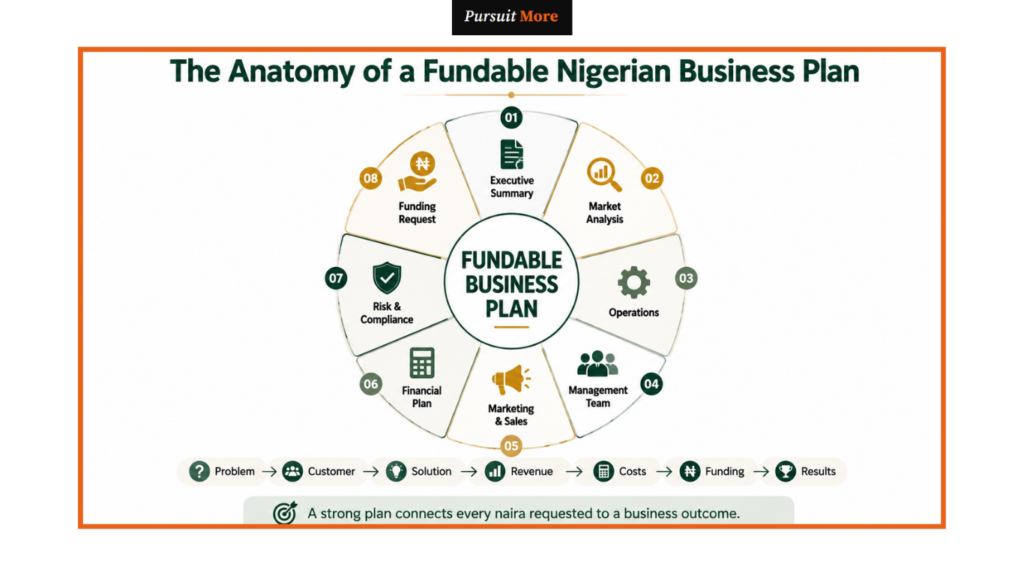
1. Company or Business Overview
It is important to start by explaining what the business does which includes:
- Business name.
- Location.
- Ownership structure.
- Product or service.
- Business stage.
- Problem being solved.
- Target customers.
- Current traction.
- Funding requirement.
Ensure you keep this section concise. Your business should be easy to understand from the first few paragraphs.
Example
Instead of writing:
“We are a fashion company committed to providing quality fashion products.”
Write:
“We produce affordable ready-to-wear work clothing for young professionals in Lagos and sell through our online store and selected retail partners.”
The remodified statement communicates to the reviewer what you sell, who you serve, and where you operate.
2. Market Analysis
In this category, you should be able to demonstrate that customers actually exist.
Identify:
- Target market.
- Customer demographics.
- Customer needs.
- Market size.
- Competitors.
- Pricing.
- Distribution channels.
- Buying behaviour.
Dont be vague by writing “the market is large.” But instead explain how you know or have come to discover.
For example,If you are into food business, the plan should describe the customer that you have the intention to target. Then describe the number of prospective customers that you can realistically reach.
Also create a segment where you compare competitors.No funder expects you to have no competition. But the reviewer is more interested in why your customers would choose your business.
3. Operations Plan
This category gives detailed explanation of how the business will function after receiving funding.
Cover:
- Suppliers.
- Production.
- Equipment.
- Premises.
- Staffing.
- Inventory.
- Distribution.
- Technology.
- Quality control.
- Power and internet requirements.
You also need to know that in Nigeria, operating costs can suddenly change. For example, if your business requires unlimited access to electricity, you need to account for alternative power in your financial plan.
So, a digital business should also account for internet subscriptions, cloud services, devices, cybersecurity, and backup connectivity in its financial plan.
4. Management Team
Address the personnel or professionals responsible for executing the plan.
For each founder or key employee, explain:
- Relevant experience.
- Education or training.
- Current responsibility.
- Business role.
- Relevant achievements.
Do not list irrelevant qualifications in this category.
Having an employee that has a degreee in accounting does not qualify him for a founders role or be a key employee. Just as not all business owners are necessarily experienced in running a retail busines.
So instead discuss transferable skills and any additional skills the business may require.
External advisors, consultants, suppliers or strategic partners can be identified, where appropriate.
5. Financial Projections
Many business plans lose the investors’ interest at this point because of the absence of the financial information. Your financial section should normally include:
- Startup costs.
- Operating expenses.
- Revenue assumptions.
- Cost of goods sold.
- Gross profit.
- Operating profit.
- Cash-flow projections.
- Break-even analysis.
- Funding requirement.
- Use of funds.
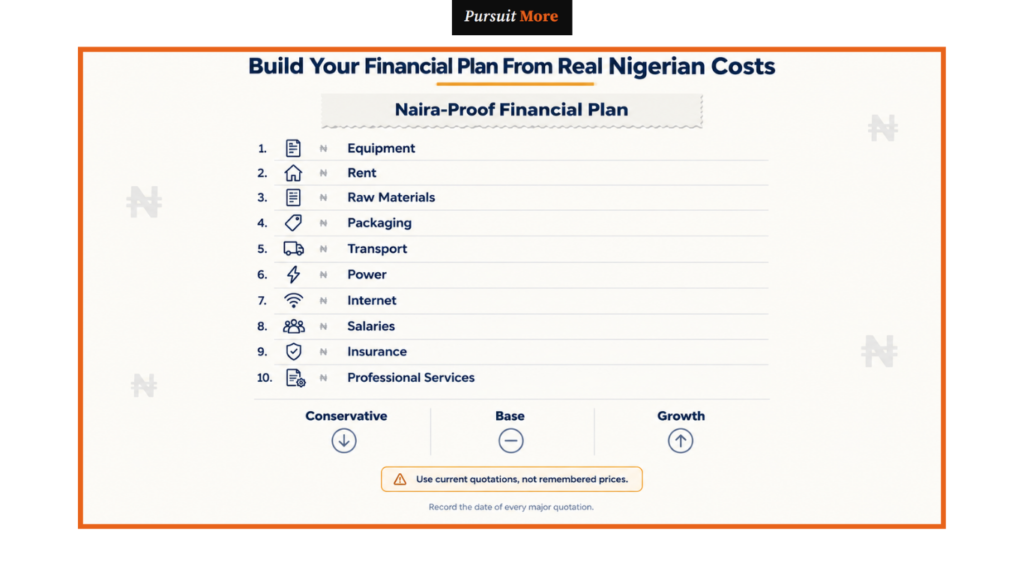
The “Naira-Proof” Financial Plan
The Nigerian business plan 2026 should not be based on any fixed textbook conditions.
This is because prices may fluctuate, imported products can be affected by exchange rate and companies may have to supply their own facilities.
The National Bureau of Statistics now employs its new CPI methodology to report headline inflation. Its headline inflation series for 2026 indicates that price pressures are still a key consideration for businesses.
So, it is wise to make allowances for flexibility in your estimates.
Start With Current Prices
It is best not to estimate expenses from prices you remember from last year.
Obtain current quotations for:
- Equipment.
- Rent.
- Raw materials.
- Packaging.
- Transportation.
- Electricity.
- Internet.
- Software.
- Salaries.
- Insurance.
- Professional services.
Then record the date of each quotation.
Include Infrastructure Costs
A startup in Nigeria may need to budget for:
- Generator fuel.
- Inverter or solar equipment.
- Backup internet.
- Transportation.
- Water supply.
- Security.
- Equipment maintenance.
These are costs that the business depend on to operate. So don’t hide this part simply because they are not part of the traditional textbook model.
Explain Your Funding Request
Never write:
“We need ₦10 million to grow the business.”
Instead, break it down.
For example:
| Use of funds | Amount |
| Equipment | ₦3,000,000 |
| Initial inventory | ₦2,000,000 |
| Power backup | ₦1,000,000 |
| Marketing | ₦1,000,000 |
| Working capital | ₦2,000,000 |
| Contingency | ₦1,000,000 |
| Total | ₦10,000,000 |
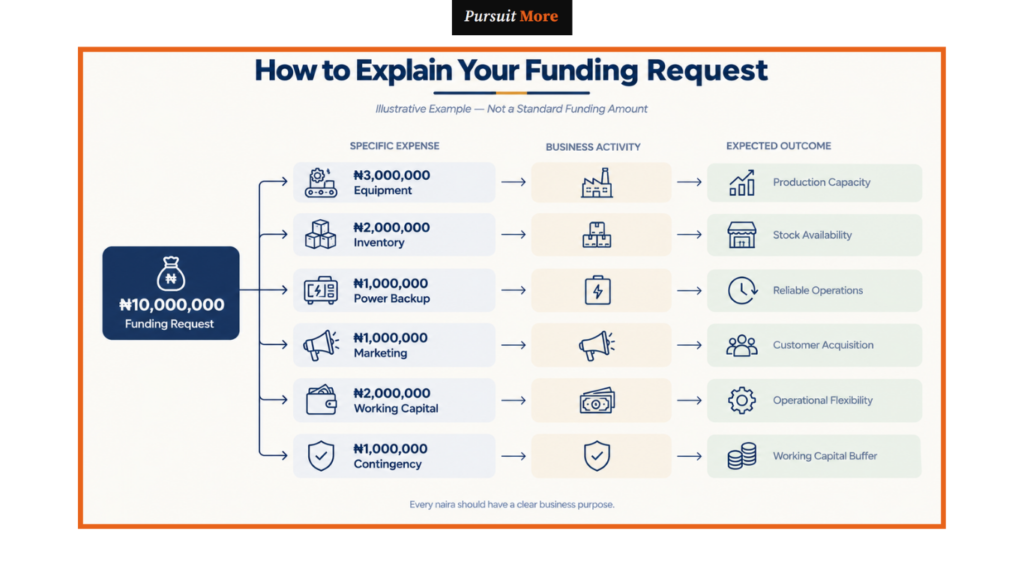
The figures above are illustrative. Your numbers should come from actual quotations and realistic operating assumptions.
Collateral and Security Schedule
This section becomes particularly important when you are applying for a loan.
A grant provider may focus on impact, feasibility and use of funds. A lender, however, may also examine repayment capacity and security.
Therefore, if the application requires collateral, clearly list:
- Asset description.
- Ownership.
- Estimated value.
- Existing obligations.
- Location.
- Supporting documentation.
Do not claim that an asset is worth a particular amount without evidence.
Also, understand that collateral requirements differ between lenders and products.
For example, BOI’s current financing documentation lists different security requirements depending on the facility and loan amount.
Match the Business Plan to the Funding Programme
This is where you need to engage strategy. Don’t use the same document and send it everywhere.
| Programme | What to prepare | What to emphasize |
| SMEDAN ICSS/GROW Fund | Business plan and supporting business information | Business readiness, viability and use of financing |
| NANSInnovate | Business proposal and short pitch | Problem, solution, market, business viability and funding use |
| NNPC/Renaissance JV Enterprise Development Programme | Viable business plan and programme application materials | Business viability, entrepreneurship potential and execution |
| iDICE Startup Bridge | Business plan, pitch materials and evidence of progress where applicable | Technology, problem, solution, market, MVP and execution |
| BOI financing | Bankable business plan, financial information and supporting documents | Cash flow, repayment capacity, project viability and compliance |
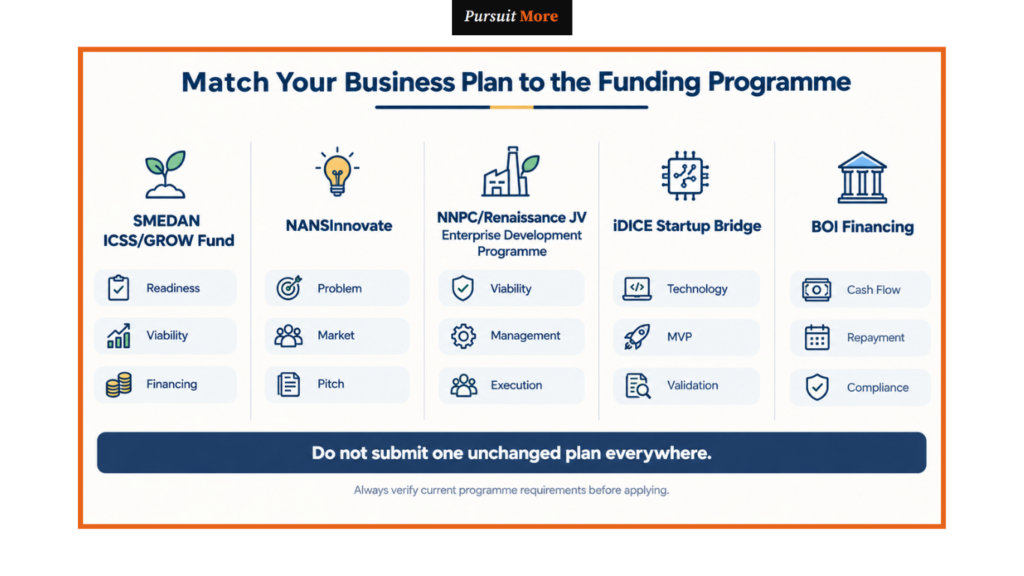
It is, however, important to always check recent information as they may change between cohorts.
SMEDAN ICSS and GROW Fund
SMEDAN’s ICSS programme has four stages: Inspire, Create, Start and Scale. Its current registration portal allows applicants to select their location and module.
The GROW Fund is linked to the ICSS pathway. In 2026, SMEDAN announced financing through Jaiz Bank for entrepreneurs who completed the relevant training.
So if you wish to receive funding through this pathway, your business plan should reflect the stage of your business.
Don’t make assumptions about being an established business seeking expansion finance if you are just an idea-stage founder.
NANSInnovate
NANSInnovate 2026 is for Nigerian students in the university who are running businesses or developing viable business ideas.
The application page currently requests a Word document format with a maximum of about 10pages. The applicants also submit a short pitch giving explanations about the business, its importance, and the intended use of funding.
Therefore, student applicants should make the proposal easy to understand.
It should be easy for the reviewer to quickly discover
Problem → Solution → Customer → Revenue → Funding need → Expected result.
NNPC/Renaissance JV Enterprise Development Programme
The 2026 NNPC/Renaissance JV Enterprise Development Programme focuses on young entrepreneurs at unique areas in Niger Delta states.
This funding programme is based on assessing business planning, management skills, mentorship, and startup support. The programme information also states that outstanding and viable business plans can receive startup funding.
iDICE Startup Bridge
iDICE Startup Bridge’s Founders Lab is intended for those who have an idea, prototype, or early MVP for technology-enabled business startups. The programme is centered on customer validation, product, business model, and initial business planning.
According to current programme information, eligible participants can be eligible for non-equity funding up to N6 million, as may be required by the programme and assessed.
Hence, a tech startup’s business plan should be tied to product development and tangible progress.
Don’t just pay attention to the quantity you desire.
Describe the project or product they intend to create with the funding.
BOI Loans
You need to be able to differentiate the process and the mindset of acquiring a loan to acquiring a grant.
Although a grant application may focus heavily on impact, innovation, job creation, or social value, a lender wants to know how you will be able to repay the loan.
BOI provides SME financing and business advisory services, including support with business planning and financing proposals.
Therefore, your loan plan should clearly explain:
- How much you want to borrow.
- What you will use it for.
- How the investment will generate revenue.
- Expected cash flow.
- Repayment capacity.
- Existing obligations.
- Available security or collateral where required.
Adapt Your Business Plan to Your Industry
A business plan should reflect the regulatory and operational realities of the sector.
Fintech: Make Regulation Part of the Plan
If you are building a fintech business, do not describe technology and customer acquisition while ignoring regulation.
Your plan should identify the relevant regulatory pathway.
Depending on the business model, this may involve CBN, SEC, data-protection, consumer-protection, AML/CFT, or other requirements.
You should therefore explain:
- Which regulated activity you perform.
- Which licence or approval may apply.
- Whether you will partner with a licensed institution.
- Your compliance responsibilities.
- Data-security measures.
- Customer-protection procedures.
Do not claim that you can operate a regulated financial service without the required approval.
Food and Beverage: Include Regulatory Compliance
Food businesses should also treat regulatory requirements as part of operations.
Where applicable, include NAFDAC registration or approval requirements in your plan.
Explain:
- Product category.
- Production facility.
- Quality-control process.
- Packaging.
- Labelling.
- Regulatory pathway.
- Expected approval timeline.
This demonstrates that you understand what must happen before commercial expansion.
A Simple Business Plan Template for Nigerian Startups
If you are writing your first plan, use this structure:
1. Executive Summary
Explain the business, problem, solution, market, traction, funding request, and expected outcome.
2. Company Overview
State ownership, location, business stage, products, and objectives.
3. Market Analysis
Describe customers, market demand, competitors, pricing, and distribution.
4. Operations Plan
Explain production, suppliers, staffing, technology, premises, logistics, and infrastructure.
5. Management Team
Present founders, managers, advisers, and relevant expertise.
6. Marketing and Sales
Explain customer acquisition, pricing, promotion, sales channels, and retention.
7. Financial Plan
Include startup costs, revenue projections, expenses, cash flow, break-even analysis, and funding requirements.
8. Risk and Compliance
Identify major risks and explain how you will manage them.
9. Funding Request
State exactly how much you need and how each naira will be used.
10. Implementation Plan
Give specific milestones for the first 12–24 months.
This structure can form the basis of a business plan template Nigeria startup founders can adapt to different funding applications.
The NOUN GST302 Template and Mini Business Plan
Students can also study the National Open University of Nigeria’s GST302 materials for guidance.
NOUN’s official entrepreneurship framework includes GST302, Business Creation and Growth, while its current GST302 portal requires students to prepare and submit business plans as part of the course process.
Its course material covers business description, marketing, management, employees, finance, legal considerations, licences, premises, and other planning questions.
However, an academic template should not automatically be submitted unchanged to a funder.
A funding application needs to reflect the funder’s specific assessment criteria.
For founders who are still testing an idea, a one-page mini business plan can be useful before developing the longer version:
Problem: What problem exists?
Customer: Who experiences it?
Solution: What are you offering?
Market: How many potential customers can you reach?
Revenue: How will you make money?
Costs: What will it cost to operate?
Funding: How much do you need?
Use of funds: What exactly will the money buy?
Milestones: What will you achieve within 6–12 months?
Once these answers are clear, expanding them into a full business plan becomes considerably easier.
Business Plan Review Checklist
Before submitting your plan, ask yourself:
- Is the business idea clearly explained?
- Have I identified a specific customer?
- Do I have evidence of market demand?
- Have I identified my competitors?
- Are my prices based on current market information?
- Have I used current supplier quotations?
- Have I included power and internet costs where relevant?
- Are my revenue assumptions realistic?
- Have I prepared conservative, base, and growth scenarios?
- Does my funding request match my budget?
- Can I explain every major expense?
- Have I identified regulatory requirements?
- Does the plan match the funding programme?
- Have I checked the latest application requirements?
- Have I proofread the document?
- Can I defend every figure during an interview or pitch?
Final Thoughts
A well-crafted business plan does not guarantee funding; rather, it serves as tangible proof that you thoroughly understand the commercial mechanics of the venture you are asking investors or lenders to back.
Crucially, your document must be tailored to the specific capital provider you are targeting. Grants and loans serve fundamentally different financial purposes, and a one-size-fits-all approach inevitably leads to rejection:
- Grant Applications (e.g., iDICE, NANSInnovate): Focus heavily on the core problem, market opportunity, social impact, execution capacity, and clear allocation of funds.
- Loan Applications (e.g., Bank of Industry, SMEDAN): Place primary emphasis on cash flow stability, debt service repayment capacity, business viability, and risk mitigation.
Institutional programs across Nigeria—whether from SMEDAN, BOI, NNPC/Renaissance JV, or iDICE—operate with distinct mandates and evaluation criteria. To build a convincing funding proposal, begin with a clearly defined business model backed by real-time Nigerian operating costs, factoring in current inflation and infrastructure overheads. Finally, tie every requested Naira directly to a measurable commercial outcome.
Market Insights & Recommended Next Steps
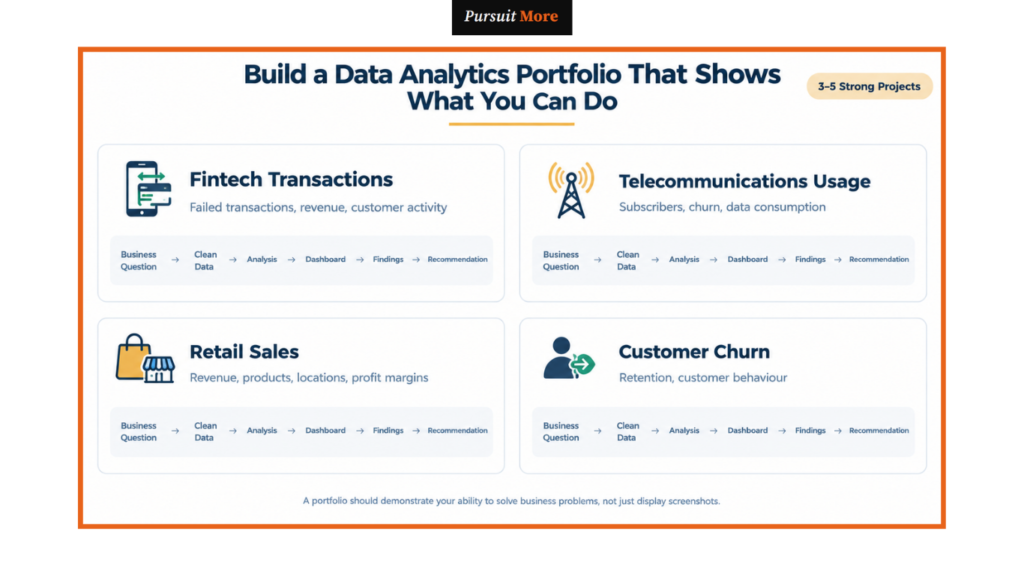
Understanding how to collect, clean, and analyze transaction data gives your enterprise a distinct competitive edge in the local market.
For a complete breakdown on essential tech skills, salary benchmarks, and a practical learning roadmap, read our comprehensive career guide on data analytics in Nigeria. Combining business strategy with actionable data insights ensures your organization stays agile, customer-focused, and profitable.