Many graduates, career switchers, and young professionals find Data analytics in Nigeria an attractive career to pursue. However, a lot of beginners are confused about the first step to be taken, how long the learning process will take, and what employers expect.
To start, you don’t have to be a software engineer. Usually, entry-level roles begins with tools like Excel, SQL, and a business intelligence tool. You can learn Python later when you need to deal with technical work.
You will receive full information on how to become a data analyst in Nigeria from this guide. Also, the skills you need to place priority on, the expected salary, and how to build a quality portfolio within four to nine months.
What Does a Data Analyst Do?
A data analyst is someone who collects, cleans, examines, and presents data to help organizations make better decisions.
Data questions, which include:
- Which products generate the most revenue?
- Why are customers leaving?
- Which marketing campaign performs best?
- Which locations have the highest sales?
- What factors are increasing costs?
- Where are unusual transactions occurring?
Data analysis is not just about creating dashboards; knowing the business behind the numbers is very important.
For example, a fintech company might need the services of an analyst to look into why there has been customer decline. And to discover that, the analyst uses SQL to pull transaction data. Work with a spreadsheet to look for patterns, and then share the results in Power BI.
But it’s a mix of technical and business thinking that employers are looking for now. Job postings placed by companies like FairMoney and Moniepoint have sought SQL, spreadsheet, dashboarding, database, and analytical problem-solving skills in the Nigerian job market.
How to Become a Data Analyst in Nigeria: The 4–9 Month Roadmap

You do not need to learn every data technology at once. Build your skills in stages:
| Period | Main skill | What you should achieve |
| Weeks 1–4 | Excel/Google Sheets | Clean, analyse, and summarise datasets. |
| Weeks 5–12 | SQL | Query databases and answer business questions. |
| Weeks 13–18 | Power BI/Tableau | Build interactive dashboards. |
| Months 5–7 | Portfolio | Complete three to five practical projects. |
| Months 7–9 | Applications | Practise assessments and apply for roles. |
Going through this progress is not a guarantee that you will get employment.
Factors such as your previous experience, learning speed, portfolio quality, and market conditions will affect your progress.
Month 1: Learn Excel or Google Sheets
Start with spreadsheets. Focus on:
- Formulas and functions.
- Sorting and filtering.
- Pivot tables.
- Data cleaning.
- Conditional formatting.
- Charts.
- Lookups.
- Basic descriptive statistics.
Months 2–3: Learn SQL
SQL allows analysts to retrieve and manipulate information stored in relational databases. Learn:
- SELECT
- WHERE
- GROUP BY
- ORDER BY
- JOIN
- CASE
- Aggregate functions.
- Subqueries.
- Common table expressions.
- Window functions.
You need to have an understanding of primary keys, foreign keys, and basic database structures.
SQL is often listed as a requirement for a Nigerian data analyst. Examples of such is FairMoney and Moniepoint, both of which have requested strong or advanced SQL alongside spreadsheet and business intelligence skills in their listing.
This means that you need to treat knowledge of SQL as mandatory and not an option if you want to compete seriously for analyst positions.
Months 3–5: Learn Power BI or Tableau
Learn to communicate findings visually after mastering data manipulation. Power BI is the first choice that will make sense.
Focus on:
- Data loading and cleaning.
- Data modelling.
- Relationships.
- Measures.
- DAX fundamentals.
- Dashboard design.
- Filters.
- Interactive reports.
- Data storytelling.
Focus on creating a dashboard that provides answers to business questions instead of trying to master every feature.
What About Python?
While Python is useful and a good first language to learn, it is not the only language. You may also get knowledge in the use of Excel before studying SQL and a BI tool. Python is a good alternative to consider if you are interested in working with larger datasets or automating tasks, if you want to progress towards data science, or if you do more in-depth analysis.
Learning the Python language is a skill that will set you on an edge at entry-level jobs.
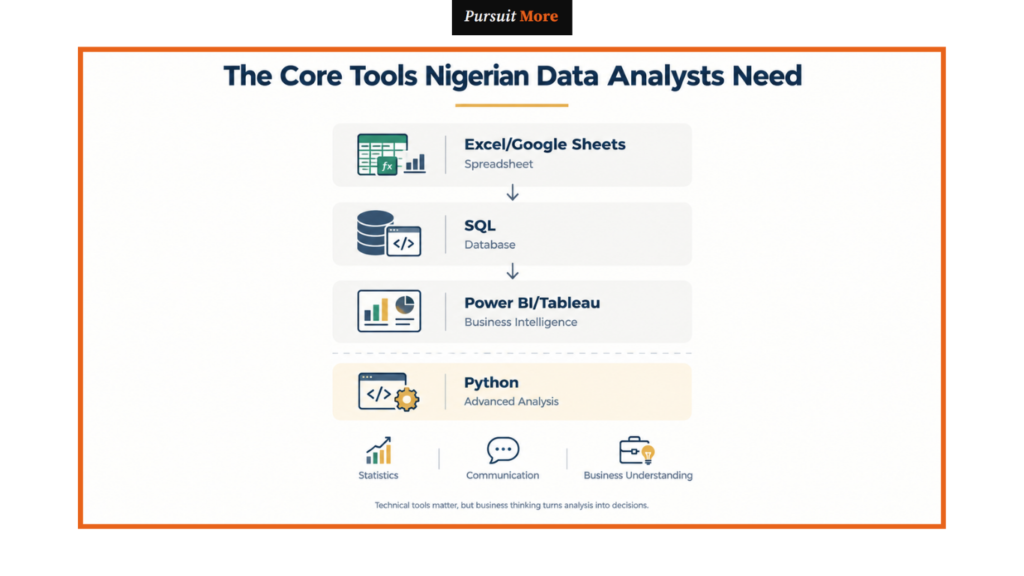
Skills Nigerian Employers Request
| Skill | Importance | Why it matters |
| Excel/Google Sheets | Essential | Data cleaning and reporting. |
| SQL | Essential | Database querying. |
| Power BI/Tableau | Essential | Dashboards and visualisation. |
| Communication | Essential | Explaining insights. |
| Business understanding | Essential | Connecting analysis to decisions. |
| Statistics | Important | Interpreting patterns. |
| Python | Optional initially | Automation and advanced analysis. |
| Git | Useful later | Version control. |
| Cloud tools | Useful later | Larger data environments. |

If you carry out thorough research, you will discover companies requesting candidates that have the knowledge of Excel or Google Sheets, Power BI or Tableau, and basic SQL, and accepting candidates with 0–2 years of experience.
This listing gives a clue that you don’t need to have many years of professional experience before applying for junior roles. However, you need to be convinced beyond doubt that you can perform the work.
Data Analyst Salary in Nigeria 2026
A data analyst is subjected to the employer, city, industry, experience, and technical ability. Therefore, there is no official data analyst salary figure as of 2026 in Nigeria.
A practical planning benchmark is:
| Career stage | Indicative monthly range |
| Entry level | ₦150,000–₦350,000 |
| Mid-level | ₦350,000–₦650,000 |
| Senior | ₦700,000–₦1.5 million+ |
These salaries are not guaranteed but rather a market benchmark. Some companies pay less for entry-level roles, while Lagos-based roles, bank, oil-and-gas company, or international employer positions, and positions in fintech or multinational companies may pay more.
What influences these are location, portfolio quality, industry knowledge, technical depth, and negotiation ability. It is better, however, if you focus on gaining credible knowledge or experience to increase your market value instead of choosing your first job solely because another analyst earns more.

Who Is Hiring Data Analysts in Nigeria?
Data analytics is important in companies that generate large volumes of customer and transaction data, including:
- Fintech and banking.
- Telecommunications.
- E-commerce.
- Insurance.
- Logistics.
- Healthcare.
- Oil and gas.
- Professional services.
Many companies have advertised data roles involving dashboards, reporting, SQL, product metrics, risk, operations, and business decision-making.
This shows that you need to have business analysis knowledge alongside technical tools. This is because after analysing the data, your employer will need the analyst to explain what the data means and recommend what the organisation should do next.
Build a Portfolio Before Applying
A certificate shows that you completed training. A portfolio shows what you can do.
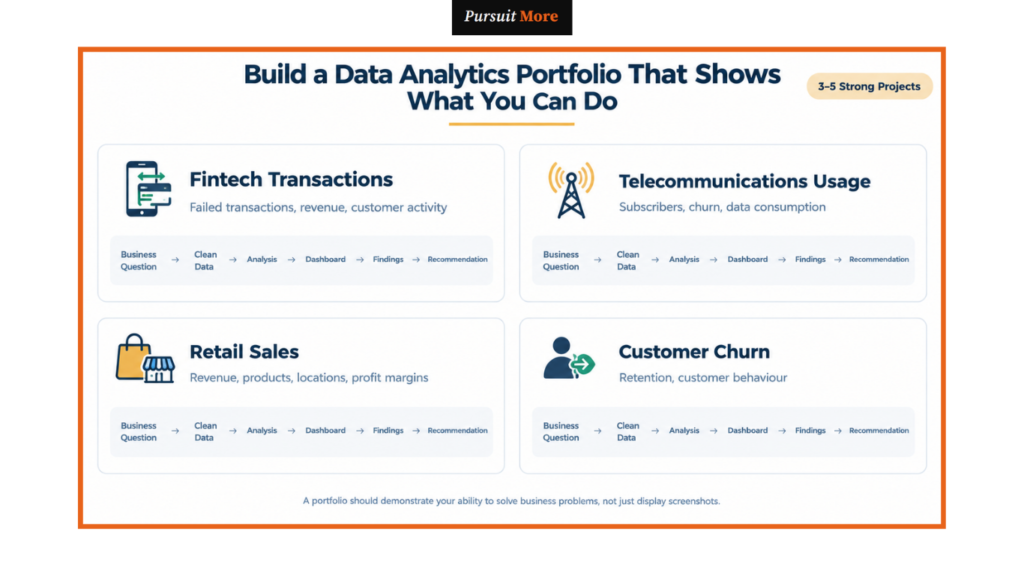
Aim for three to five strong projects rather than ten unfinished ones. Each project should include:
- A clear business question.
- The dataset.
- Data-cleaning steps.
- Analysis.
- Visualisations.
- Key findings.
- Business recommendations.
Useful project ideas include:
Nigerian Fintech Transactions
Analyse transaction volume, failed transactions, customer activity, revenue, peak periods, and regional performance. Present the results in a Power BI dashboard.
Telecommunications Usage
Examine subscriber data, data consumption, churn, call activity, revenue per customer, and usage patterns.
Nigerian Retail Sales
Create a dashboard showing monthly revenue, product performance, location, profit margins, and customer segments. Add three recommendations for management.
Public Health Data
Use an open dataset to examine trends by age, location, condition, or treatment outcome. This demonstrates that you can work responsibly with unfamiliar data.
Customer Churn
Identify customers most likely to leave and explain the factors associated with their behaviour. This is particularly relevant to telecom, subscription, and fintech companies.
Before applying, confirm that:
- You have at least three completed projects.
- Each project answers a business question.
- You cleaned the data properly.
- You can explain your SQL queries.
- Each dashboard has a clear purpose.
- You included recommendations.
- Your work is available online.
- You can defend every number in an interview.
Do not fill your portfolio with screenshots alone. Explain the problem, method, findings, and conclusion.
Data Analytics Training in Nigeria 2026
You don’t have to attend a costly bootcamp to get started. Programmes and courses that are supported by the government and public sector have included training in Excel, SQL, dashboards, business intelligence, and Google Data Analytics.
NCDMB and its partners have also delivered short courses on data cleaning, data visualisation, predictive analytics, and cloud computing. LearnSmart offers digital-skills learning, including an introduction to data analytics.
Programmes are subject to change; please verify eligibility, deadlines, location, fee, and current status of programmes before relying on them.
How to Prepare for Interviews
Employers may test your ability to apply your skills through take-home assessments, technical interviews, and behavioural interviews.
Practise questions such as:
- Write an SQL query using GROUP BY.
- Explain INNER JOIN and LEFT JOIN.
- Find duplicate records.
- Calculate monthly revenue.
- Explain how you would handle missing data.
- Design a dashboard for management.
- Explain an unexpected KPI change.
- Present a recommendation from a dataset.
Also, practise explaining technical findings in simple language. An analyst who understands the numbers but cannot communicate them may struggle to influence decisions.
For technical preparation, Pursuit More’s Interview Coaching can help you practise SQL, analytical questions, and interviews.
Final Thoughts
You don’t have to learn all the programming languages before your first application on your way to a career in data analytics in Nigeria.
Begin with Excel, then move on to SQL and Power BI, and get hands-on experience in creating real-life projects. Once you have some experience, add Python, statistics, cloud technologies, and advanced methods.
You become employable when you can take up a dataset that is messed up, analyse it, be able to interpret the answer to your employer, and also make a sensible recommendation for action.
- Start with Excel.
- Move to SQL.
- Learn Power BI.
- Build your portfolio.
- Then apply.