Best Tech Jobs in Africa 2026: Ultimate Salary & Career Guide
If you are looking for tech jobs in Africa 2026,there are a lot of opportunities– but it isn’t quite so easy as opening a job board and applying to anything that is posted.
The technology landscape in Africa is evolving and continues to provide opportunities in software engineering, fintech, data, cybersecurity, product, cloud and digital services. However, the vast majority of career advice leaves job seekers with the same questions: What career should I pursue? What skills do employers really need? How much does it pay? So what is the best tech hub in Africa to target? So how can I apply for interviews?
This guide has been created to answer those questions.
As a final-year STEM student or recent graduate or early career professional, you will learn how to get started in pursuing a fintech career for African graduates, how to assess tech opportunities in key African cities, know what to be expecting in terms of compensation, and create a job search strategy beyond just applying for a position.
The Africa Tech/Fintech Landscape
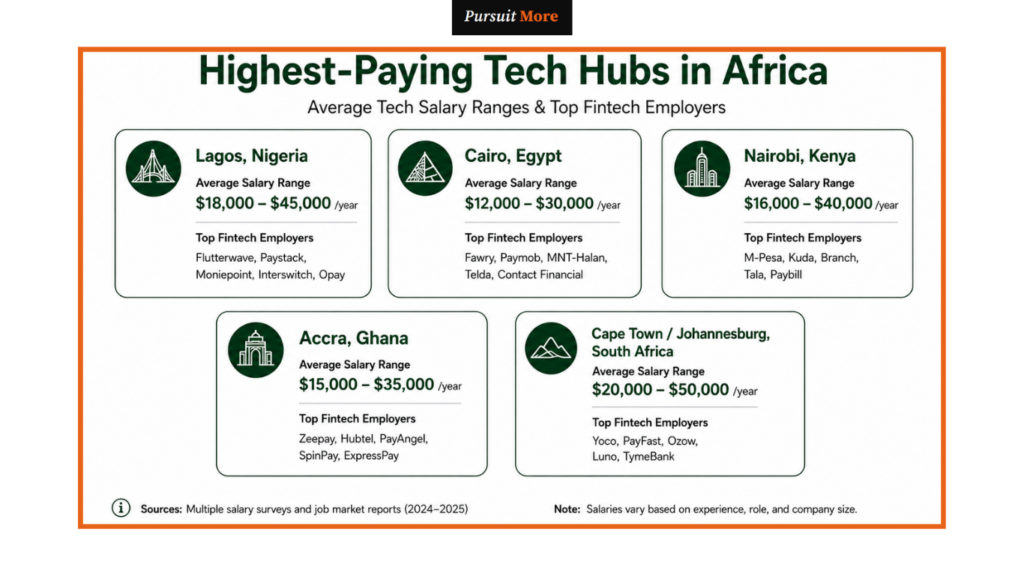
Salary Note: Salaries quoted in this guide are references and guidelines for the market, and do not constitute a firm offer. Pay and benefits are generally quite different across employers, experience, geography, technical skills, remote and benefits. Use the most up-to-date anonymised and aggregated community salary data where indicated, from Pursuit More’s proprietary data.
The future of the tech job market in Africa in 2026 is promising and full of opportunities
Now, technology is embedded in banking, payments, telecom, logistics, healthcare, retail, insurance and professional services. There is a growing demand for the expertise to create, operate, evaluate and protect the technology in more and more businesses as those businesses become digital.
This opens two main avenues for career transition for job seekers.
The first one is traditional tech: Software engineering, data, cyber security, cloud, product management, UX/UI and technical operations.
The second is fintech—which are technologies used in the context of financial services. This encompasses payments, digital banking, lending, financial infrastructure, fraud prevention, compliance and financial and risk data.
These tracks are similar, but not the same.
It’s not very difficult for a software developer to transfer between industries. A fintech professional gains further insights into payments, regulation and financial risk and customer trust.
Removing the confusion from the job search process can save you months of time that you could be using more productively by knowing the difference before you start applying.
The Major African Tech Hubs
Your place of work is not your fate; especially in the era of remote working. But some cities are doing it in particular with technology and fintech opportunities.
Lagos: Fintech and Software Engineering
Lagos is still a leading technology and financial-services market in Africa.
The city’s ecosystem comprises fintechs, banks, payment companies, e-commerce enterprises, logistics companies and technology start-ups and telecommunications companies.
If you’re looking for software engineering jobs in Lagos for 2026, some of the most popular paths to take are:
Frontend engineering
Backend engineering
Full-stack development
Mobile development
DevOps and cloud
Data engineering
QA engineering
Cybersecurity
Fintech is particularly significant.
Engineers are needed to build reliable payment processing, digital banking, lending and merchant systems, which requires them to deal with financial data and sensitive information.
So, if you have a keen interest in financial services, Lagos is a good place to look at, if you are also technically skilled.
Fintech, Data And Digital Finance in Nairobi
Nairobi has emerged as one of the top technology hubs in Africa, especially in the fintech and digital financial services sector.
The Kenyan market is particularly interesting for candidates who are interested in lending, mobile money, payments, financial inclusion, analytics and risk.
Opportunities to the city’s technology ecosystem also exist in the software engineering and product management, data and operations sectors.
It’s a good idea to look for companies looking to hire people anywhere in Africa, and not just in your city.
Cairo: Engineering and Technology Services
Another big technology hub is Cairo, especially software development, outsourcing, technology services and technology product engineering.
There are opportunities for engineering candidates in various technical roles including frontend, backend, mobile, cloud, data etc.
For those in their early careers, Cairo is particularly appealing because they can build up experience with international clients or globally-distributed technology teams.
Cape Town and Johannesburg: Enterprise Tech and Fintech
South Africa has one of the most well established technology and financial-services economies on the continent.
Cape Town’s startup and software scene is strong, and so is the banking, financial services and enterprise technology and cybersecurity sector in Johannesburg.
In this regard, candidates should take into consideration both cities by keeping in mind their specialisation.
Regional Hiring Heatmap
Rather than see the African job market as “one big pool” see it as “several pools connected together.
Lagos: fintech, payments, software engineering, banking technology, product and data.
Nairobi: Fintech, mobile financial services, lending, data, product and software.
Cairo: Software Engineering, Tech Services, Product Development + Data.
Cape Town: SaaS, software, startups, product, cloud and data.
Johannesburg: Banking technology, enterprise systems, cyber security, data and financial services.
Remote Africa: software engineering, product, data, design, cloud and other jobs that are effective for distributed teams, employers are encouraged to help out distributed teams.
The best place would be dependent on your career path.
A payment professional may have a better reason for favoring Lagos or Nairobi. The geographic market for a software engineer could be much wider. Large financial institutions and enterprise technology companies are areas that a cybersecurity candidate may be interested in, as they are likely to offer relevant opportunities.
One of the first things you should do then is to consider the role first, location second.
Salary Benchmarks
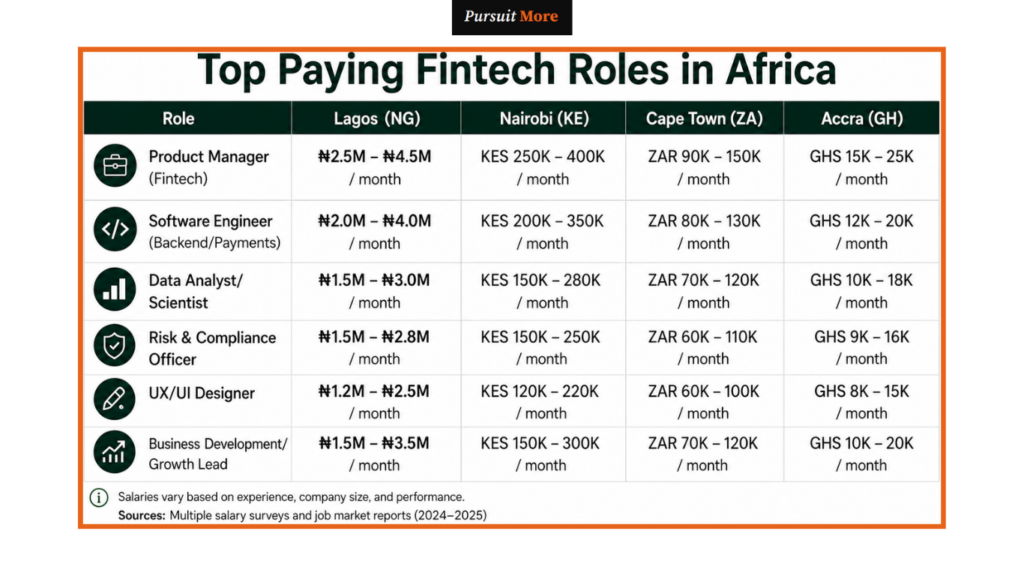
One of the most challenging generalisations to make in Africa is in regard to salary.
The compensation package of a junior engineer working in Lagos can vary from that of a junior engineer working in Nairobi, or even in another country for an international company.
Experience and size of employer, and technical specialisation and exposure to currency can be significant.
In the case of software engineers, for instance, public salary guides in Nigeria have them earning anywhere between about ₦150,000 and ₦600,000 per month as junior software engineers, and much more than this as experienced software engineers. Other salary estimates, using active listings, have even narrower ranges, illustrating the dependence of salary estimates upon sample choice.
While the lesson isn’t that one number is “the Nigerian software engineer salary,” it is certainly that these numbers aren’t important enough to be treated as if they are.The lesson is that salary ranges are more useful than averages.
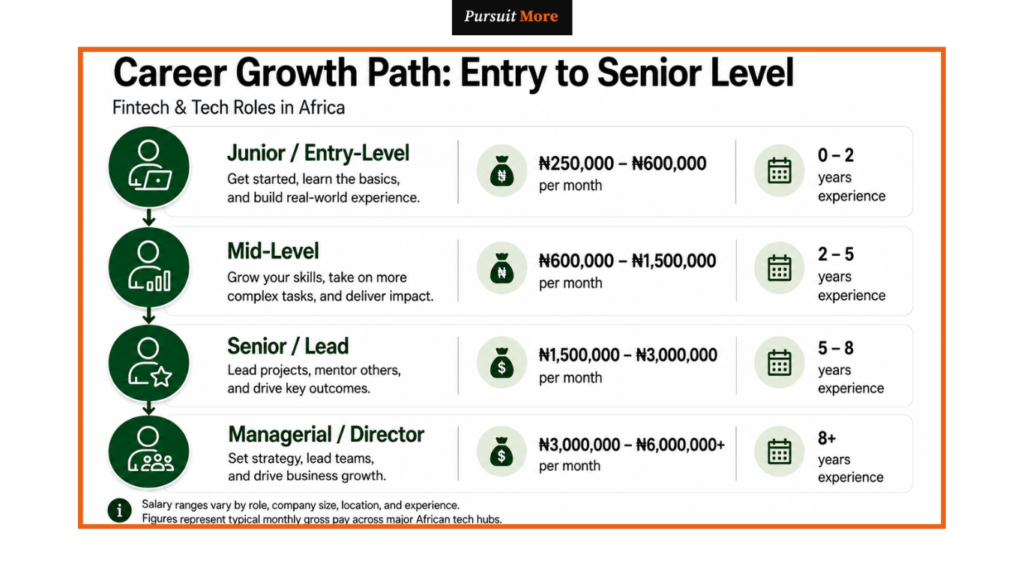
Pursuit More Community Salary Benchmarks
This is Pursuit More’s most recent anonymised data from communities with the new data by:
Role
Experience level
Major city/country
Qualification of Local or foreign employers.
Work from home vs. at the office
For example:
Junior Software Engineering
North America / Remote: $75,000 – $115,000
Europe / Remote: €45,000 – €65,000
Mid-Level Software Engineering
North America / Remote: $110,000 – $165,000
Europe / Remote: €65,000 – €95,000
Junior Data Roles
North America / Remote: \$65,000 – \$90,000 (e.g., Junior Data Analyst, Junior Data Engineer)
Europe / Remote: €38,000 – €55,000`
Product Roles
North America / Remote: $130,000 – $185,000 (Senior Product Manager / Senior Product Designer)
Europe / Remote: €75,000 – €115,000
Fintech Operations / Risk Roles
North America / Remote: $100,000 – $155,000 (Mid-to-Senior Compliance, Risk, & Settlement Functions)
Europe / Remote: €60,000 – €95,000
The following may be included in an offer:
Health insurance
Equity
Bonuses
Equipment
Transport support
Training
Remote flexibility
Note: An increase in a monthly salary does not necessarily mean a better offer.
Entry-Level Requirements Checklist for Tech Jobs in Africa 2026
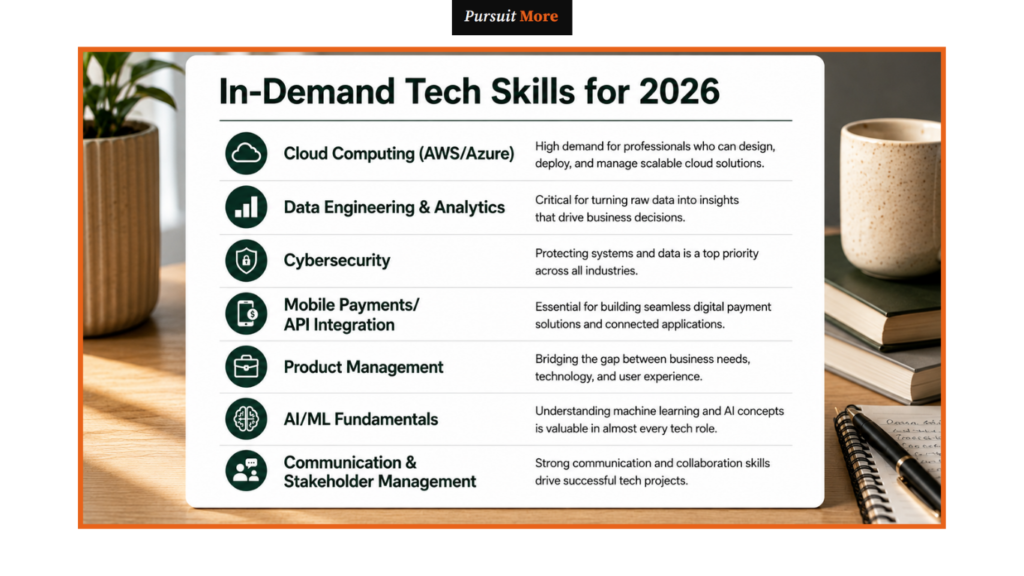
The biggest error of young job seekers is confusing learning with proof.
Courses are completed to show that a course has been studied.
A project is a real-world case where it is employed.
Use this checklist as a check to see if you’re ready to apply.
Technical Skills
You have an understanding of the basics of your career choice.
You can complete a task without a step-by-step tutorial.
You are familiar with the tools included on your CV.
You can make technical decisions and provide an explanation.
You will be able to resolve a simple issue.
Portfolio
At least one major project to work on.
The project addresses that problem
The meaning of your contribution is clearly explained.
Your work can be accessed for review as appropriate.
If you had more time and could make improvements you can say what they are.
Optimizing Your Professional Assets
Your CV is specific to the job you are applying for.
Your CV is not just about tasks and responsibilities, it’s about results.
Your LinkedIn profile is a part of your business narrative.
You will be using your portfolio to link work.
Fintech Candidates
You are familiar with the company’s product.
Knows the customer problem it is solving.
Have a grasp of the terminology of financial services that is appropriate to the job.
Discuss security, risk or compliance as appropriate.
It is possible to relate technical skills to a business outcome.
The difference between wishing for a tech job and proving that you are ready for this tech job.
Do Certifications Matter?
Yes, but not as much as lots of candidates believe.
Certification may be useful for laying a foundation of knowledge, particularly as a newcomer to a field.
Cloud certifications can be helpful for cloud-oriented individuals. Cybersecurity certifications are useful to boost cybersecurity portfolios. Data portfolios can be complemented by analytics certifications.
However, certificates should be related to your career plan.
Avoid sitting around for six months getting qualifications without doing any work.
If you do have to choose between another introductory certificate and developing a project that illustrates the skill that is constantly asked for by employers, the project could be more beneficial.
The goal is NOT to have the longest list of qualifications.
Fintech vsTraditional Tech Career Path
There are usually more opportunities for mobility for traditional technology careers.
Also a software engineer can switch between the roles of fintech, healthcare, logistics, e-commerce and SaaS.
The data analyst has a diverse range of industries he can work in.
Fintech offers more in-depth specialisation.
You gain an understanding of financial systems, regulations, risk and payments as well as your core Professional skill.
If you are undecided on the industries you would like to pursue or have the greatest flexibility, then opt for a traditional technology path.
If you’re particularly interested in banking, payments, financial products, or how technology can help to solve financial issues, then you should consider a career in fintech.
There is no need either to make it a permanent decision.
It’s not necessary to specialise in a particular field at the beginning; you can instead become a software engineer first, and then learn about fintech.
This can make for a very powerful combination.
How to Get Software Engineering Jobs in Lagos
If Lagos is your target, stop applying indiscriminately.
Divide vacancies into three categories.
High-fit Jobs
You meet most of the important requirements.
Get your CV in as soon as possible, and customize it accordingly.
Stretch Jobs
You meet core requirements, but are missing one or two desired skills.
Apply if it is a reasonable gap.
Use the listing to come up with what you want to learn next.
Low-fit Jobs
A low-fit job has a lot of experience to gain or technologies that have never been used.
Avoid spending the majority of your time at this site.
Rather, take advantage of these empty spots for market research.
When dozens of engineering positions at Lagos are asking for SQL, Docker, cloud experience, testing and an ecosystem of a specific programming language, listen up.
The market is providing you with a roadmap!
How to Create a Portfolio that will Catch Attention
A lot of projects are not required for a portfolio.
It needs evidence.
The best of your projects should show that:
You can build something that actually works.
You can solve Problem(s),make decisions and explain trade-offs.
You can show the outcome and share your learning.
If you are looking to get into fintech, construct on a monetary difficulty, You can build a transaction-monitoring dashboard, a budgeting app, a credit-risk analysis or a financial-data project, and a simulation of the payment API. The point is not to boast about expertise in the field of finance technology. It is to show that you comprehend the type of problem you want to solve.
The Google Rejection Success Story
Between 2021 and 2024, the author went back to Google four times, each time applying for a position in backend engineering, but being rejected on each attempt. Every time he got rejected, he discovered a basic problem with the way they conducted their interview:
Attempt 1: Solves a problem without considering edge cases, scale, or race conditions.
Attempt 2: Overengineered a system, with an unneeded too many microservices and tools, for a simple problem rather than begin with a practical system design.
Attempt 3: Memorized LeetCode implementations without comprehending how the code will behave, scale or fail in a real production environment.
Attempt 4: Data-driven decision making and collaborative problem solving were not used, instead relying on intuition and future features.
The author spent 4 months changing his mindset instead of learning more syntax before obtaining the L4 Backend Engineer in March 2024.
what changed between the failed attempt and the successful one
Asking Constraints Before Solving: he began asking important clarifying questions before he could jump to immediate answers – such as questions about the volume of traffic, latency, R/W ratios, and failure boundaries.
Starting Simple and Scaling Incrementally: He didn’t come up with a complex distributed system design the first day, but instead started with the simplest functional design, and clearly identified the limits and how/when to scale it up.
As Peer Design Reviews: He moved away from the monologue of a performance to a conversation between himself and the interviewer
Prioritizing Architectural Trade-offs Over Rote Memorization:He moved away from rote memorization of LeetCode problems and started reading the tech blogs of companies like Netflix, Uber, Stripe, and other real-world companies to gain insight into their trade-offs, metrics, and failure modes.
Intellectual Honesty: he no longer claimed to know something that he didn’t, and also openly named his level of experience and what he would do when he encountered an unfamiliar concept.
That is how you should Interpret Rejection
If you don’t pass the technical interview, ask yourself if you had some issues with the technical basics.
If you don’t pass a behavioural interview, consider how clearly you communicate your experience.
If you fail a system-design discussion, list the system-design concepts that you could not explain.
If you have trouble answering questions about your projects, enhance your project stories.
How to Apply Strategically
The process of looking for jobs should be a cycle.
The first step in finding 20-30 employers is to determine which employers are a good fit for your career trajectory.
Study their vacancies.
Record recurring requirements.
Then you can update your CV and portfolio accordingly.
Submit applications for pertinent positions.
Track what happens.
If you are sending out 30 job applications and not getting any interviews, then perhaps you don’t have a position.
If you are getting invited to an interview and are not passing the technical skills test, it is likely that you did not work on your preparation.
Don’t get more jobs to solve all of your problems.Identify the problem.
Use Job Listings as Market Research
You can determine what employers are buying by reading a job listing.
If you are aspiring to become a backend engineer, then study 20 backend jobs.
Identify other things that keep reoccurring.
Perhaps you repeatedly see:
Python or Node.js
SQL
REST APIs
Git
Testing
Docker
Cloud
Database design
This is a much more valuable learning regimen than simply following programming tutorials at random.
Do the same for ‘fintech’.
If the offer keeps using the term KYC, Fraud, Reconciliation, Risk or Payments, find out what they are.
You should prepare for your target jobs!
When Interview Coaching Can Help
1.Interview coaching is most useful when you’re aware of how your job search is going astray.
2.If you don’t manage to get some interviews, revisit your CV and positioning.
3.If you don’t pass technical screens, enhance your technical preparation.
4.For those who find themselves challenged by behavioural questions, develop your skill in “telling your story.
5.Should you be consistently getting to the final stages of the interview process and not getting offers, evaluate the entire interview process.
Your 30-Day Tech Job Search Plan
Week 1: Test your moveability.
Choose a primary career path.
Select target markets: 2 or 3.
Read and learn 20 or more job descriptions that are relevant to the job.
Determine ongoing technical and professional needs.
Week 2: make more evidence.
Tailor/reshape your CV to the job you are applying for.
Enhance LinkedIn profile.
Clean up in your portfolio or GitHub.
Finish a good project or enhance an existing project.
Put together succinct descriptions of projects and experience.
Week 3: Apply strategically
Start to submit applications specifically for jobs.
Give precedence to jobs whose requirements are closest to your abilities.
Customise your CV for suitable opportunities.
Utilize networking and referrals, if applicable.
Week 4: Diagnose the results.
Go over the number of applications.
If you don’t have interviews, work on positioning.
If technical assessments are not successful, then more technical practice.
If you have poor behavioural interview responses, rehearse your structured responses.
At the end,if you don’t receive offers, ask for feedback and review it in detail and/or request coaching in the interviews.After that, repeat the process.
Mistakes to Avoid
1.Applying for everything: It can be very successful to do a scattergun approach without necessarily doing a progress approach.
2:Choose a direction: Learning is useful, but the evidence is better.
3.Ignoring smaller employers:It doesn’t need to be a well-known company, it is your first chance.If you work for a smaller fintech or tech firm, you can expect to receive a lot of production experience and responsibility.
4.Ignoring business knowledge:Technical professionals always have to learn about the issues that their employers address.This is even more important in the field of fintech.
5. Giving up After being rejected:Rejection can show you just what you need to work on.Use it to work on your self
How to Discover Tech Jobs in Africa 2026 & Career Opportunities
Doing research is worthless unless it culminates in action.
Once you’ve prepared, check out the Pursuit More Jobs card for opportunities and research positions that are aligned with your desired career path. Avoid applying for jobs that you are attracted to by the position title.
Before submitting, ask:
1.Do I have the foundation that is essential to being a successful student at this school?
2.Will there be a way to prove the necessary skills?
3.Do my CV and cover letter convey that evidence?
4.Am I able to discuss projects that are relevant in a confident manner?
5.Am I moving closer to what career I want to be in by doing this role?
If the answer is yes, then apply
Final Takeaway
While the opportunities in the African technology market in 2026 are great, there is no guarantee of job security.
Top candidates don’t necessarily have to be the most technologically literate.
When looking for tech jobs in Africa 2026, first start with a career track and a target market.
If you’re considering a career in fintech as an African graduate, gain financial-services expertise as well as your professional skill.
To get software engineering roles in Lagos in 2026, learn the most common requirements in the Lagos job postings and prepare accordingly.
But if your applications aren’t converting, then come off that guessing.
Find the gap.
Fix the gap.
Apply again.
The goal isn’t to apply to as many jobs as possible.
It’s to be the candidate that gets the job!