Rhodes Scholarship Africa 2026: Complete Guide to West Africa, East Africa, Kenya, Southern Africa & Zambia
One of the most competitive opportunities for young graduates who wish to study at Oxford University is the Rhodes Scholarship Africa 2026. It is one of the most prestigious postgraduate scholarships because it covers many expenses for students. Expenses include tuition, living expenses, flights, visa costs, and leadership development.
Africa is not a single Rhodes constituency; instead, they have different constituencies for West Africa, East Africa, Kenya, Southern Africa, Zambia, and Zimbabwe. And each constituency has its own rules for eligibility, application timeline, selection committee, and number of scholarships. You need to understand what applies to the constituency you are in to have a successful application.
What Is the Rhodes Scholarship Africa 2026?
The Rhodes Scholarship is one of the world’s oldest international postgraduate scholarships. It was established in 1902 through the will of Cecil Rhodes. The Rhodes Trust selects exceptional young students from about 50 countries to pursue their postgraduate studies at the University of Oxford in the UK.
The Rhodes Scholarships focus on students with commendable academic achievement. Achievements such as leadership, integrity, character, and a genuine commitment to serving others instead of just dwelling solely on people’s grades. Today, over 8,000 Rhodes Scholars are forming a global network that includes presidents, judges, Nobel Prize winners, scientists, entrepreneurs, journalists, academics, and social innovators.
The successful applicants will have the opportunity to undertake most full-time master’s and doctorate programmes at Oxford, both taught and research master’s and DPhil (PhD) degrees, as long as they satisfy the Conditions of Tenure of the Rhodes Trust.
What Does the Rhodes Scholarship Cover?
The Rhodes Scholarship is a fully funded program. So candidates are not required to pay for the cost of studying at Oxford.
The scholarship covers:
- The full fee for the University of Oxford.
- College fees
- A Living Stipend (around £20,400 per year) to cover accommodation and living expenses.
- Airline economy fares from your home nation to the UK.
- UK student visa fees
- Immigration Health Surcharge (IHS)
- Allowance for moving into Oxford when you first move in.
- Leadership programmes, networking and a lifelong membership of the Rhodes Scholar community.
Depending on your programme, the total value of the scholarship can exceed US$50,000 per year.
Who Can Apply?
Applicants generally must be:
- Citizens of a Rhodes constituency.
- Meet the constituency’s residency requirements.
- As of the specified eligibility date, be within the age range of 18 and 24 years of age (some professional programmes may have a wider age limit).
- Must already have, or just be about to complete, an undergraduate degree before starting studies at Oxford.
- Must have an academic record that meets the academic criteria of Oxford University, typically a First Class Honours degree or an outstanding GPA.
- Must meet Oxford’s English language requirements where applicable.
Academic achievement is not enough; it is only a prerequisite, plus Rhodes selection looks beyond academic excellence but also looks at the candidate’s leadership, integrity, service, courage, and ability to make a positive difference in their career.
West Africa Rhodes Scholarship
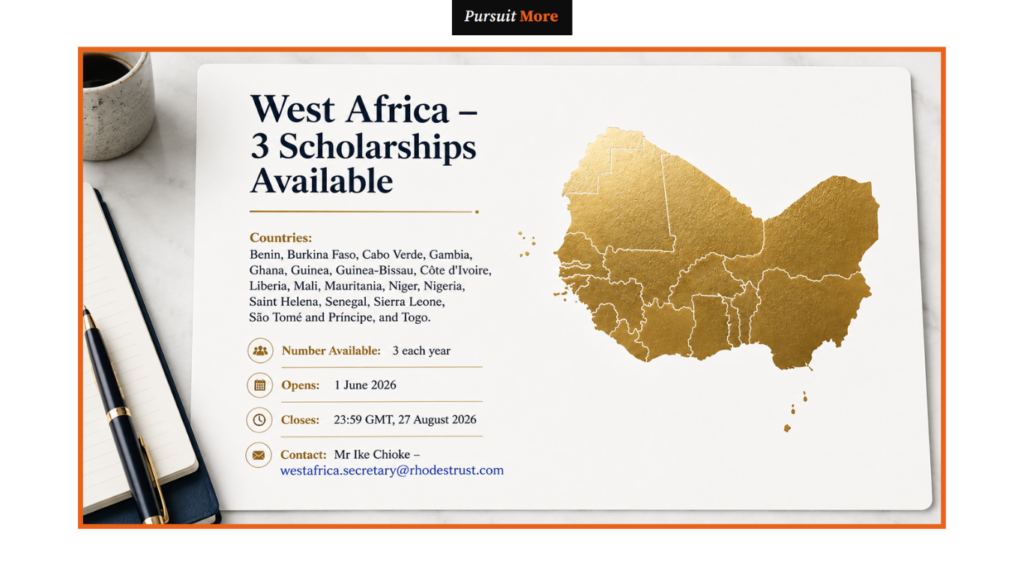
West Africa – 3 Scholarships Available.
One of the largest constituencies is in Africa. Also making it one of the most competitive. The eligible applicants come from:
- Benin
- Burkina Faso
- Cabo Verde
- Côte d’Ivoire
- Gambia
- Ghana
- Guinea
- Guinea-Bissau
- Liberia
- Mali
- Mauritania
- Niger
- Nigeria
- Saint Helena
- Senegal
- Sierra Leone
- São Tomé and Príncipe
- Togo
- Ascension and Tristan da Cunha
Three scholarships are awarded at this constituency every year. The application for the year 2026/2027 has opened from the 1st of June and will close on 27th of August 2026.
The Oxford-Morland-West Africa Graduate Scholarship
Partnering with the Oxford-Morland-West Africa Graduate Scholarship is one of the features that has made West Africa unique among others. This scholarship is similar to the Rhodes Scholarship because it also supports West African graduates with outstanding abilities who are pursuing postgraduate study at Oxford. The eligible candidates are considered within the broader Rhodes application process, and this creates additional opportunities for outstanding applicants from the West Africa region.
What the West Africa Committee Looks For
Candidates applying at the regional level are expected to portray more than just their strong academic results.
Successful candidates demonstrate:
- Leadership in University or Community projects
- Solving real problems with evidence
- A dedication to community service.
- Long-term development plans that involve participation in Africa’s development.
- Good rationale for selection of course and institution/location
Candidates who reveal ambition that goes beyond their environment often tend to stand out during interviews.
East Africa Rhodes Scholarship
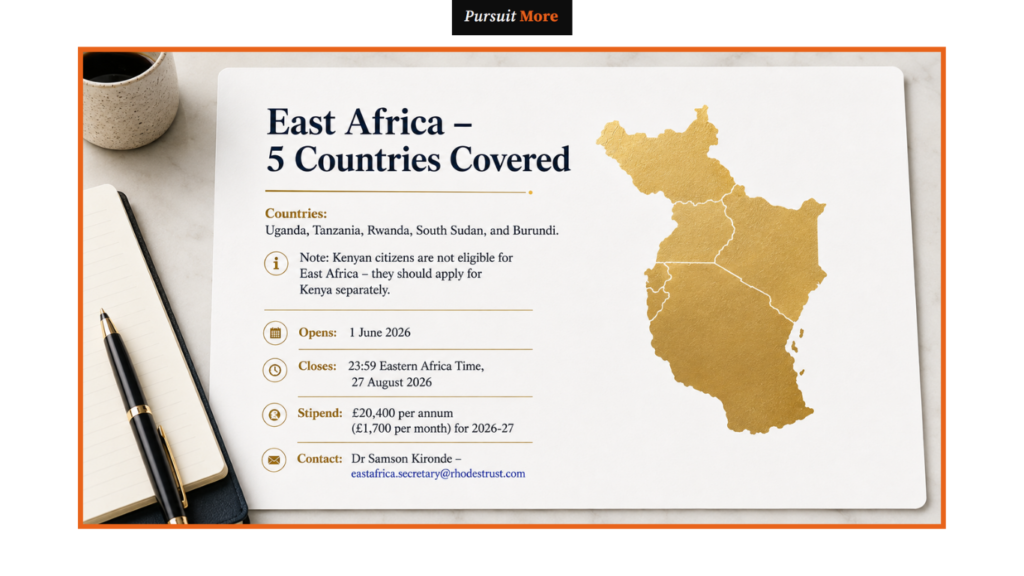
East Africa – 5 Countries Covered.
The East Africa constituency is for applicants from:
- Uganda
- Tanzania
- Rwanda
- Burundi
- South Sudan
Candidates from Kenya are not eligible for this scholarship because Kenya has its own dedicated Rhodes Scholarship programme. It started in East Africa in 2019, and this makes it one of the new Rhodes constituencies.
The application for 2026 opened on the 1st of June and will close on the 27th of August. (23:59 East Africa Time).
It is important for applicants to review the information of the constituency, as they differ by region.
Selection Focus
Candidates are selected by the committee in line with the Rhodes Trust criteria. They also take into account the potential of the candidates and their abilities to become a leader in the future in East Africa and beyond.
The candidates must possess the following:
- Excellent academic achievement
- Leadership in education, business, health, technology, or civil society
- Integrity and resilience
- A commitment to improving their communities
- Well-defined academic goals linked to Oxford
It is important that applicants attend official sessions where information is given before they go ahead to submit applications.
Kenya Rhodes Scholarship

Kenya – 2 Scholarships Each Year.
Kenya has its own standalone Rhodes constituency. It is one of the few African countries that stands alone. Their constituency only awards two scholarships every year, and this gives Kenyan graduates a dedicated selection process separate from the wider East Africa competition. The application for 2026 closes on the 27th of August (23:59 EAT).
Why Kenya Has Its Own Constituency
There has been a long history of producing Rhodes Scholars from Kenya, and it has maintained its own National Secretary, interview panel, and selection committee. This has enabled the committee to closely be able to consider candidates in the Kenyan academic and leadership arena while still maintaining the global standards set by the Rhodes Trust.
What Makes Strong Kenyan Applicants
Kenyan candidates are distinguished through:
- Outstanding university performance
- Leadership in student organisations
- Entrepreneurship
- Public policy engagement
- Research achievements
- Community development initiatives
Their interviews are always to discover hw the applicants intend to use the educational privilege they get from Oxford to address the national and continental challenges instead of them focusing solely on their personal career ambitions.
Applicants are therefore urged to show in their letter detailed knowledge of their intended programme of study in Oxford and to explain why they wish to pursue this study in Oxford in the longer term in relation to their leadership aspirations.
Southern Africa Rhodes Scholarship
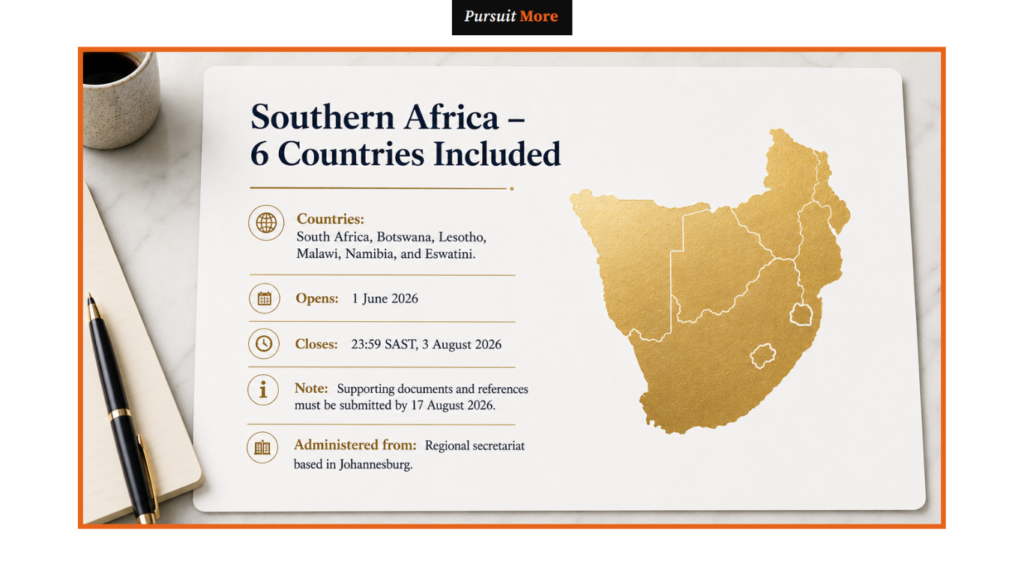
Southern Africa – 6 Countries Included.
It is the largest and the oldest constituency, and it covers:
- South Africa
- Botswana
- Lesotho
- Malawi
- Namibia
- eSwatini
The Rhodes Trust awards 10 Rhodes Scholarships annually to candidates.
The 2026 Interim Scholarships
The 2026 interim scholarship is distinguished as a result of the addition of four new Rhodes Scholarships for South Africa. This was announced to increase access until longer-term constituency programmes develop.
Any interested candidate should apply through the Rhodes application system and also ensure they read the information carefully, particularly the “ Information for candidates” document, to see which regional selection committee applies.
A Scholarship With a Complex History
The scholarship has been in South Africa for a long time because it was founded through the estate of Cecil Rhodes, and this history is a controversial one.
For a long time, people have often asked questions about the colonial origin of the scholarship. What the scholarship represents, and the access. So as to respond to this question, the Rhodes Trust introduced reforms that are aimed at broadening participation and ensuring the scholarship reflects contemporary values of inclusion, diversity, and equal opportunity.
The selection process is done without taking into consideration the race, gender, religion, socio-economic background, university attended, or field of study of any candidate, with the main focus being on academic excellence, leadership, character, and commitment to service.
What Southern Africa Selection Panels Value
To be able to affirm an excellent performance by a student, they should demonstrate;
- Outstanding academic achievement.
- Sustained leadership over several years.
- Evidence of solving meaningful problems.
- Strong ethical judgement.
- A clear vision for contributing to Southern Africa after Oxford.
Applicants will have a better understanding of what the interview entails and the process of the interview when they network with the former Rhodes Scholar.

Zambia’s constituency awards two Rhodes Scholarships each year, and this gives Zambian graduates the opportunity to compete at national level instead of going across to other countries to apply. Zambia has its own dedicated Rhodes constituency.
To get accurate information about the 2026/2027 process, applicants are advised to monitor the official Rhodes Trust website for the confirmed deadline. This is because the constituency timelines may vary per year
However, the selection still rests on the same principles;
- Academic excellence
- Leadership
- Integrity
- Service
- Energy to make a lasting contribution
Some applicants with strong potential demonstrate their abilities both inward and outwardly when they carry out research, entrepreneurship, public service, student leadership, or community development.
Zimbabwe Rhodes Scholarship
Zimbabwe is also an African nation with an independent Rhodes constituency and has its own selection committee. It usually awards two scholarships annually. It is therefore important to check the official information page for the application deadlines and eligibility criteria.
What Makes a Strong Rhodes Scholar?
Academic excellence is not enough to be a strong Rhodes Scholar. Committees are looking for candidates with exceptional intellectual curiosity, independent thinking and academic achievement. They also appreciate leadership that makes a difference, being involved in community service and change. The candidates should also demonstrate character and integrity, characterised by being honest, resistant, humble, mature, reasonable and responsible in making decisions.
Navigating the Rhodes Scholarship Africa 2026 Process
Securing a Rhodes Scholarship Africa 2026 award demands rigorous preparation across every constituency. Candidates targeting a Rhodes Scholarship Africa 2026 must understand that competition is fierce throughout the continent.
Every successful applicant pursuing a Rhodes Scholarship Africa 2026 must align their academic record and leadership portfolio with global standards. Because selection committees evaluate candidates holistically, preparing your Rhodes Scholarship Africa 2026 application documentation early ensures your submission stands out.
Ultimately, achieving a Rhodes Scholarship Africa 2026 victory validates years of academic dedication and community service.
African Rhodes Scholars Worth Learning From
To understand the standard better, let’s assess some previous scholars:
Fatima Yunusa
Fatima Yunusa is well known for having academic excellence together with strong leadership and public service. This portrays Rhodes’ emphasis on how education can be a great tool to create practical impact rather than pursuing academic success alone.
Aniaba N’Guessan
Aniaba N’Guessan focused on community development through his strong leadership activities, and he also built a strong academic profile. Selecting him reveals that the Rhodes Trust preferred applicants who have measurable impact together with excellent academic performance.
Aminat Yusuf
Aminat Yusuf excelled academically and as a consistent leader. Her journey demonstrates that successful candidates typically have a clear narrative related to their educational background, leadership experiences, and aspirations.
How to Build a Competitive Rhodes Scholarship Application
Most of the other scholarship applications are different from the Rhodes Scholarship. The committee doesn’t just want to know if you need funding for your academic pursuit but wishes to know if you possess the ability to become an influential leader over the next several decades.
- Start your personal statement early
In your personal statement, you may explain:
- In your personal statement, explain:
- who you are,
- what you have done,
- why it matters,
- Why Oxford is the place for your next step,
- and what you want to do after this.
Don’t just make a list of accomplishments. Think about how you can learn from them.
- 2. Choose referees carefully
The people you choose as your referees should be well informed about your work and should be able to write a detailed recommendation for you. Having a good letter from someone who supervised your research or leadership project is usually stronger than a generic letter from a senior official who barely knows you.
- 3. Research your Oxford course
Some applicants make the mistake of focusing so much on the scholarship instead of Oxford itself.
You should clearly explain:
- why you chose your programme,
- why Oxford is uniquely suited to your goals,
- how the degree connects to your long-term plans.
- 4. Prepare thoroughly for interviews
Interview panels often ask questions about:
- current affairs,
- ethical issues,
- leadership experiences,
- failures,
- your future ambitions,
- and why Oxford is necessary for achieving them.
Common Reasons Strong Applicants Are Rejected
There are lots of students with good academic grades who don’t get in. And some of the weaknesses that made them fail are:
- Personal statement with only achievements
- No clear explanation of future goals.
- General or generic reasons for selecting Oxford.
- Referees who give ambiguous recommendations.
- Poor interview preparation.
Final Thoughts
The Rhodes Scholarship Africa 2026 is one of the prestigious postgraduate scholarships that is made available to African graduates. It gives students access to Oxford university world class leadership development and also a global community of scholars who continue to shape public policy, business, science, education, and social impact. And this goes beyond the financial support that it offers.
Therefore, you need to choose the correct African constituency when applying, as this is the foundation of a successful application. And after that, you can work on building a compelling personal statement, strong references with recommendations that will secure you. You also demonstrate meaningful leadership and show the committee how an Oxford education will help you to contribute to your country and the globe.
Need Expert Help With Your Rhodes Application?
To get custom advice on selecting the appropriate constituency, sharpening your essays, or improving your overall application approach in general, you might want to schedule the Pursuit More Application Strategy Session for individual attention before the application deadline. If you are looking to pursue postgraduate education abroad, explore fully funded scholarships for African students.