GKS Scholarship Requirements for Nigerian Students 2026: Application Guide + Korean Language Strategy
Every year, hundreds of Nigerian graduates discover the Global Korea Scholarship (GKS) as a gateway to fully funded Master’s and PhD programs at top South Korean universities. However, many applications fail during the selection process because candidates overlook critical GKS scholarship requirements for Nigerian students, such as track-specific document legalization and mandatory preparatory language study.
Understanding the full scope of GKS scholarship requirements for Nigerian students is essential whether you choose the Embassy Track or the University Track. This guide walks you through the 2026 application process, document authentication rules, and strategy choices needed to secure your fully funded degree in South Korea.
Embassy Track vs. University
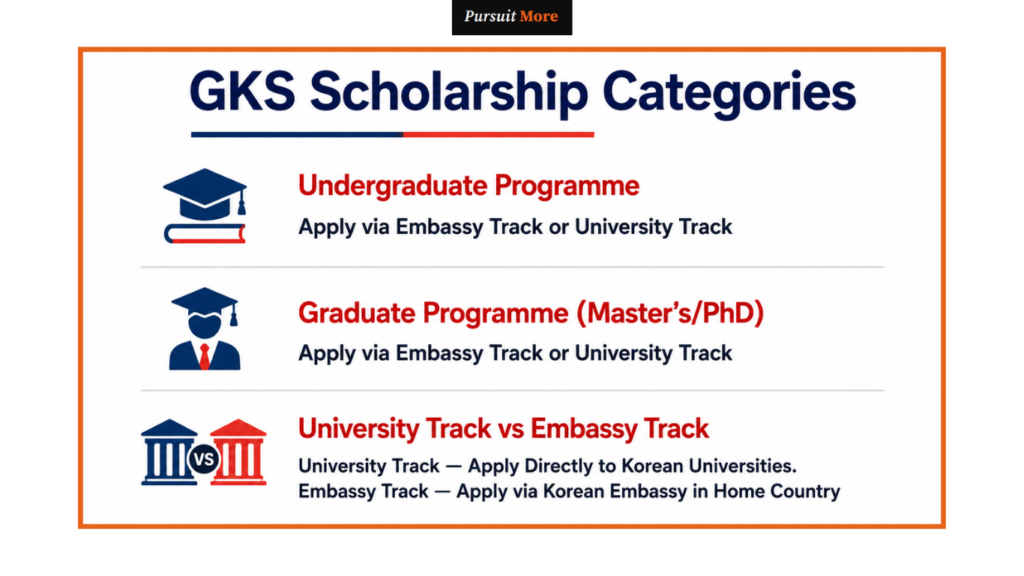
For all Nigerian applicants, the initial strategic considerations are whether to go with the two pathways of applying to GKS. Your selection will affect your university selection, your competition level and even your timeline.
Embassy Track: Wider Choice, Higher Competition
The Embassy Track is a procedure whereby the application is made to the Embassy’s cultural arm (Korean Cultural Centre Nigeria), and not to individual universities. The biggest benefit is the flexibility; you can name up to 3 universities, and if accepted, NIIED (the National Institute for International Education) will place you at one of the universities that fits you best and is available.
The track suits candidates who have a competitive academic record (top 20% of their class), desire to attend prestigious universities such as Seoul National University, KAIST or Yonsei, are not afraid of high-level competition and are willing to follow the specific timeline set by the Nigerian embassy.
The compromise is intensity. The Embassy Track attracts more people than the Korean Cultural Centre Nigeria, and from the Korean Cultural Centre Nigeria, only 4-6 candidates for all of Nigeria are forwarded to NIIED for final selection.
University Track: Narrower Path, Lower Competition
The University Track is an application to one of the participating Korean universities. No Alternatives are allowed. When that university rejects you, your application for GKS ends.
This is for those who already have a specific Korean university identified where there is a strong program for their area of interest, can do some background research on professors and get in contact with them before applying, would like a smaller number of applicants to apply, and have time to follow the different university deadlines (which vary).
Decision Framework: Embassy Track will empower you to have the best of both worlds if you have three realistic universities in mind and can put together a strong, generalist application. University Track could be a more likely choice if you have a clear idea of which university you want to go to, and you’ve identified the supervisors you want to work with there, and can design your study plan very specifically to fit your goals at that school.
Nigeria-Specific Embassy Track Timeline
Applicants frequently create generic application schedules that fail to match official local timelines. The Korean Cultural Centre Nigeria (KCCN) operates on strict administrative deadlines set by NIIED. Late or incomplete submissions are automatically rejected, regardless of applicant qualifications.
To meet all GKS scholarship requirements for Nigerian students, graduate applicants (GKS-G) must align their planning with the official 2026 cycle schedule:
- Program Announcement: The Korean Cultural Centre Nigeria issues the official call for applications in early February 2026.
- Online Submission Window: The online application portal opens on February 12 and closes strictly on February 25, 2026. Fulfilling all GKS scholarship requirements for Nigerian students requires uploading complete, verified digital documents before this deadline.
- Embassy Interview Stage: Candidates who successfully satisfy initial GKS scholarship requirements for Nigerian students advance to interviews conducted by the Korean Cultural Centre Nigeria on March 6, 2026.
- Selection Rounds: First-round Embassy nominees are announced on March 16, 2026. NIIED then evaluates candidates during the second and third selection rounds, publishing final scholar selections in late June or early July 2026.
Eligibility and Quotas
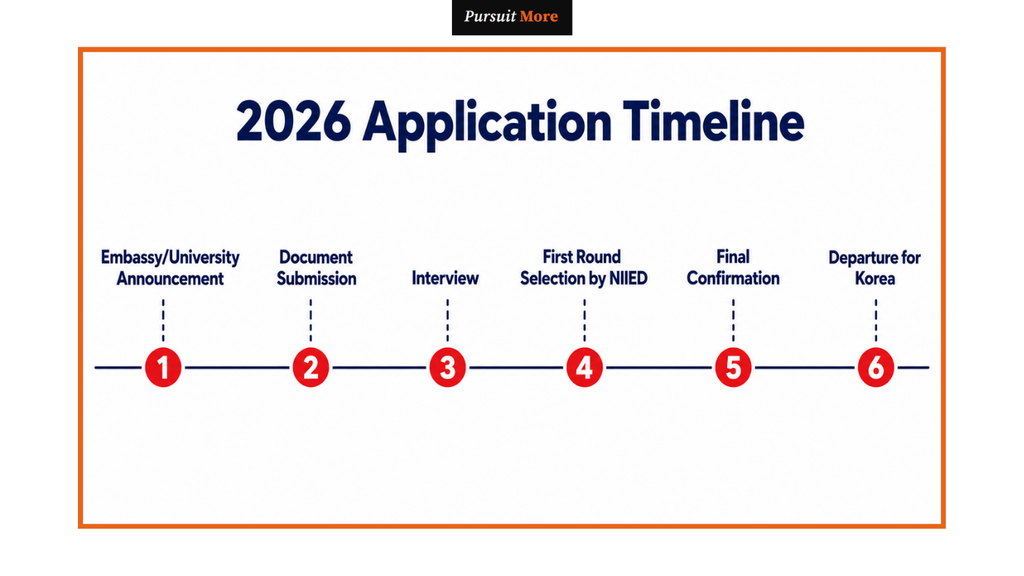
2026 Application Timeline.
Knowing your competition better enables you to put your real estate application in the right place.
Global and Regional Quotas
In 2026, NIIED intends to choose about 1,300-2,000 GKS scholars all over the world in both tracks. About 800 graduate-level positions are awarded to nationals of a total of 143 countries in the Embassy Track. There are designated positions for African students in Korea, and Nigerians have been getting in on the final selections each year for the last few years, though the exact Nigerian number has fluctuated from year to year and is generally small (usually 4-8 final selections).
GKS Scholarship Requirements for Nigerian Students: Academic and Age Requirements
Some of the eligibility criteria for Nigerian students applying for a GKS scholarship are: Age of the candidate (born after March 1, 1986 for the 2026 cycle) and Grade level (10th through 12th). Must possess an overall grade point average of 80% or higher (top 20% of class) from their last degree. To do the program, one has to be physically and mentally fit.
The Mandatory Korean Language Year
This is the nitty-gritty that will come as a surprise to successful candidates who have just been awarded the scholarship: Most GKS scholars don’t attend their degree university in Korea but attend a language institute designated by NIIED. They do not enter into their actual Master’s or PhD studies until after that year (and passing TOPIK Level 3).
The Structure
The Master’s Track includes three years in total, which are divided into one year of Korean language and two years of degree program. The PhD Track is a four-year course (3 years of degree coursework + 1 year of Korean coursework). The Research Program (for shorter research visits) is 6 months or 1 year long and does not require a language requirement.
The Only Exemption
To waive the language year requirement, you must be at least TOPIK Level 5 or 6 when you apply. Not Level 3. Not Level 4. A level 5 or above, with an official certificate, dated prior to the set deadline for the application.
After six months of language studies, if you reach the level of 5 or 6, you can accelerate your language development by 6 months and start your degree program sooner. However, make plans for the entire year. The vast majority of applicants from Nigeria are new to TOPIK and do the whole language course.
Why This Matters for Your Planning
The language year makes a difference to all things. Your timeline lengthens; your Master’s is three years, not two. Your base moves; your first year is at a language school – usually not at your university – outside Seoul. Your budget runs on—it is a language year budget; you’ll need to budget for moving between locations. If you have dependents, they must be familiar with this structure before getting in.
What Separates Winning Applications
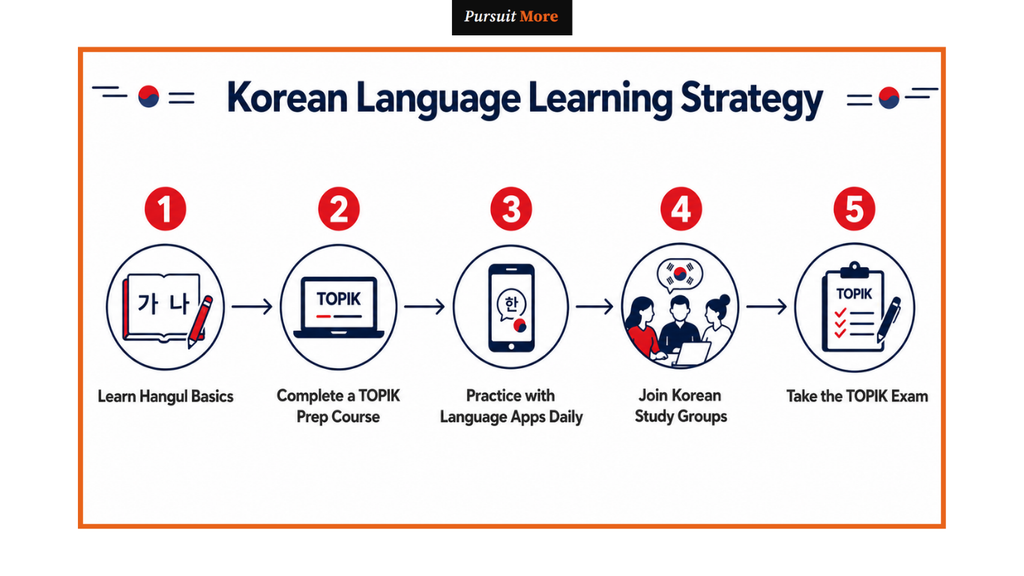
Korean Language Learning Strategy.
It isn’t enough to be technically qualified for Nigerian slots, because there are very few. The winning applications have two key characteristics: they are precise in academic planning, and they clearly show an interest in Korea.
The Study Plan that Gets Noticed
You should include specific target universities, possible supervisors, and specific course modules you want to study in your study plan. It is a generic statement, such as “I want to study engineering in Korea”, that puts you out. Competitive applications look like this:
As I have studied the EE curriculum at KAIST, I am interested in specialisation in VLSI Design (EE570) and Advanced Digital IC Design (EE572), and I have written to Professor [Name] to discuss potential research interests related to this and to his current projects.
This is specificity, and you have done your homework; you know what the program is, and you’re not just using Korea as a catch-all.
The TOPIK Advantage
Here’s a stat that you should get motivated about when learning your language: about 80% of those who apply for TOPIK Level 1 or below have a lower level. For most of the applicants in the Chinese section, they do not have any knowledge of the Korean language at all. A verified TOPIK level (any level) is a good sign of your genuine interest in the program and gives your application a boost.
If you have six months until 18 February, you can study TOPIK I (Level 1-2), and it is a good strategy. If you have more time, then work towards Level 3 or above.
The Personal Statement Differentiator
Your personal statement should relate your personal experience with Nigeria and Korea in particular. Why Korea, instead of Canada or the UK? What about industry or research methodology in your field or bilateral relations with Nigeria? The winners frequently mention the existence of Korean companies in Nigeria (Samsung, LG, Hyundai), Korea’s position as a leader in certain sectors (shipbuilding, semiconductors, K-beauty, etc.) or existing educational and research ties between Korea and Nigeria.
Document Authentication Process
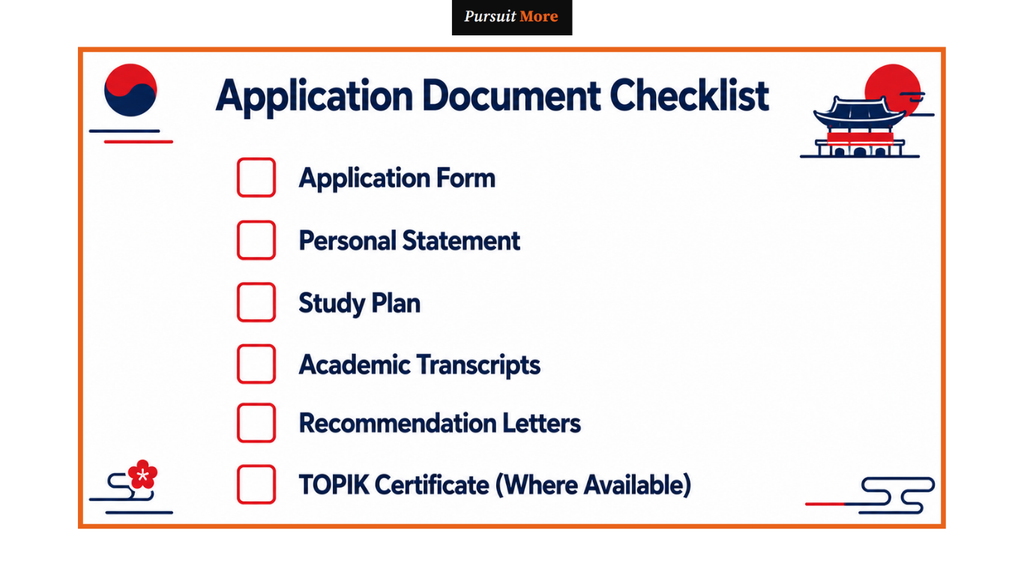
Application Document Checklist.
Many Nigerian apps run poorly here. GKS has authentic academic document requirements, and there are different procedures in Nigeria as opposed to apostille countries.
Step-by-Step Authentication
Step 1:
Get your original degree certificate(s) from your university and your official academic transcript(s) sealed directly from your university.
Step 2:
Educational documents (Original Degree and Transcripts) should be submitted to the Federal Ministry of Education, Abuja, for attestation. Seek verification and confirmation of educational attainment. This would certify that the documents are authentic and from reputable institutions in Nigeria.
Step 3:
Take the documents which are attested by the Ministry of Education to the Ministry of Foreign Affairs. Get authentication and legalisation for Korean use. This step establishes the validity of the stamps and signatures of the Ministry of Education.
Step 4:
If any documents are not in English, have them translated into English. In general, Korean universities will accept documents in English, but please check with your prospective university for details.
What GKS covers
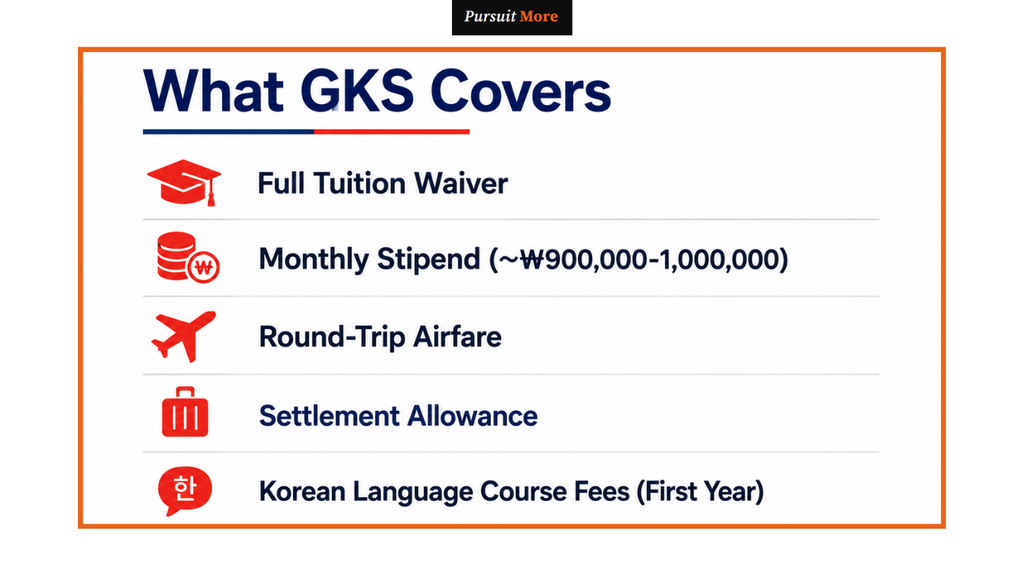
What GKS Covers.
GKS is a fully funded scholarship. These are some of the things that successful Nigerian scholars get:
Full Tuition Coverage: The scholarship will provide admission fee and full tuition to your degree university, without limit.
Recent increase for the 2026 cycle: graduate students will receive ₩1,380,000 a month (about $1000 USD). The amount is enough to afford students a comfortable living in Korea.
Settlement Allowance: A one-off payment of ₩200,000 when you arrive in Korea for initial set-up expenses.
Round-Trip Airfare: Economy class airfare from and to Korea at the beginning of the program and return to Nigeria upon completion of the program.
Korean Language Training: Full coverage of the one year Korean Language program fees, which include tuition and materials.
National Health Insurance: Coverage of national health insurance during your stay in Korea.
Research Support: Printing of thesis and research funds for completion of a degree.
Monthly stipend for shared housing, food, travel and some personal costs of ₩1,380,000. The stipend varies according to the city, with Seoul being the more expensive city. One of the most generous scholarship packages to Nigerian students worldwide.
Coaching Tie-in
Distinguishing between a standard application and a successful submission often comes down to personal statement clarity and strategic interview preparation. To fully satisfy competitive GKS scholarship requirements for Nigerian students, applicants should take advantage of targeted preparation services:
Embassy Interview Coaching: The final stage in fulfilling GKS scholarship requirements for Nigerian students under the Embassy Track is passing the Korean Cultural Centre Nigeria interview. Professional coaching prepares candidates for questions regarding post-graduation goals, bilateral relations, and high-pressure scenario questions.
Full Application Audit: Beyond meeting basic GKS scholarship requirements for Nigerian students, your study plan and personal statement must connect your Nigerian background directly to specialized research opportunities in South Korea. A comprehensive review ensures your profile aligns with faculty supervisors and target university programs.
African students in Nigeria can find more scholarship opportunities on Scholarships Directory.
Final Checklist: Before You Submit
Please ensure that you fulfil all the requirements before sending your application via the Korean Cultural Centre Nigeria (KCN) to be considered for the programme of General Knowledge Students (GKS). State that your age is under 40 (after March 1, 1986). Maintain an academic average of 80% or better (or in the top 20%). Through the Federal Ministry of Education, have your degree certificate attested, and then authenticated by the Ministry of Foreign Affairs. For the Embassy Track, choose three universities and for the University Track, contact one university.
Make a study plan with a list of specific professors and courses. Prepare your own personal statement explaining “Why Korea” in detail. Write down a TOPIK score (any score is good!) Fill out a health certificate. Make sure that recommendation letters are sealed and signed.
Conclusion
The Global Korea Scholarship (GKS) provides fully funded undergraduate and graduate opportunities for Nigerian students to study at top South Korean universities. However, succeeding in the application process requires a clear understanding of all GKS scholarship requirements for Nigerian students.
Your overall strategy depends on whether you choose the Embassy Track or the University Track, as well as how early you initiate Ministry of Education (MOE) and Ministry of Foreign Affairs (MOFA) document authentication in Abuja.
Furthermore, fulfilling the GKS scholarship requirements for Nigerian students involves planning for the mandatory 1-year Korean language foundation program, which extends your total timeline before degree study begins. Successful applicants approach the selection process as a structured campaign: conducting deep university research, securing early consular attestation, and submitting study plans with a strong Korea-specific motivation.
With the application cycle launching in February for graduate tracks and September for undergraduate tracks, candidates must align their document prep immediately with all official GKS scholarship requirements for Nigerian students.
Related Resources & Application Services
Preparing your application package for South Korean universities? Explore our Scholarships Directory for additional funding opportunities, or get expert guidance on your study plan and embassy interview prep through Pursuit More Coaching Services.