EdTech Careers in Nigeria: Jobs, Salaries & How to Get Hired
EdTech careers are one of the least explored areas in the Nigerian Tech ecosystem. If you ask an aspiring young Nigerian tech entrepreneur about the field he/she intends to branch into, you will most likely get answers that revolve around Fintech, Merchandise, and other career paths such as B2B SaaS. Despite the fact that EdTech is rarely mentioned in the mainstream, in the background it is quietly absorbing thousands of tech engineers.
EdTech is one of the most stable, impact-driven and remote-friendly sectors in the Nigerian digital economy. The problem with this sector is that the ecosystem is so fragmented that finding a single structure that will point you to a definite salary scale or a list of active employers is virtually non-existent. A web search for the term “EdTech Jobs Nigeria” would show a list of a limited number of openings mostly concentrated in education technology careers in Lagos.
An in-depth search for edtech salary in Nigeria will leave you with more questions than answers, as there is no structured salary expectation as in other tech fields. With this article, we will bareface the companies that are employing and what their salaries look like, as well as help you position your applications to secure these roles.
EdTech Salary Nigeria
One of the biggest hurdles for job seekers is the lack of a transparent salary structure. This problem is prevalent in many tech careers; it is more pronounced in the Nigerian edtech ecosystem. When applicants cannot benchmark the expected salary, they tend to either leave money on the table or ambitiously overstate their expected starting pay.
Another problem is that most firms tend to benchmark their starting salaries based on the location of their offices. That is why some states might report higher starting salaries than other states. Based on current market data and active placements, here is what you should expect to earn across different seniority levels in the edtech sector.
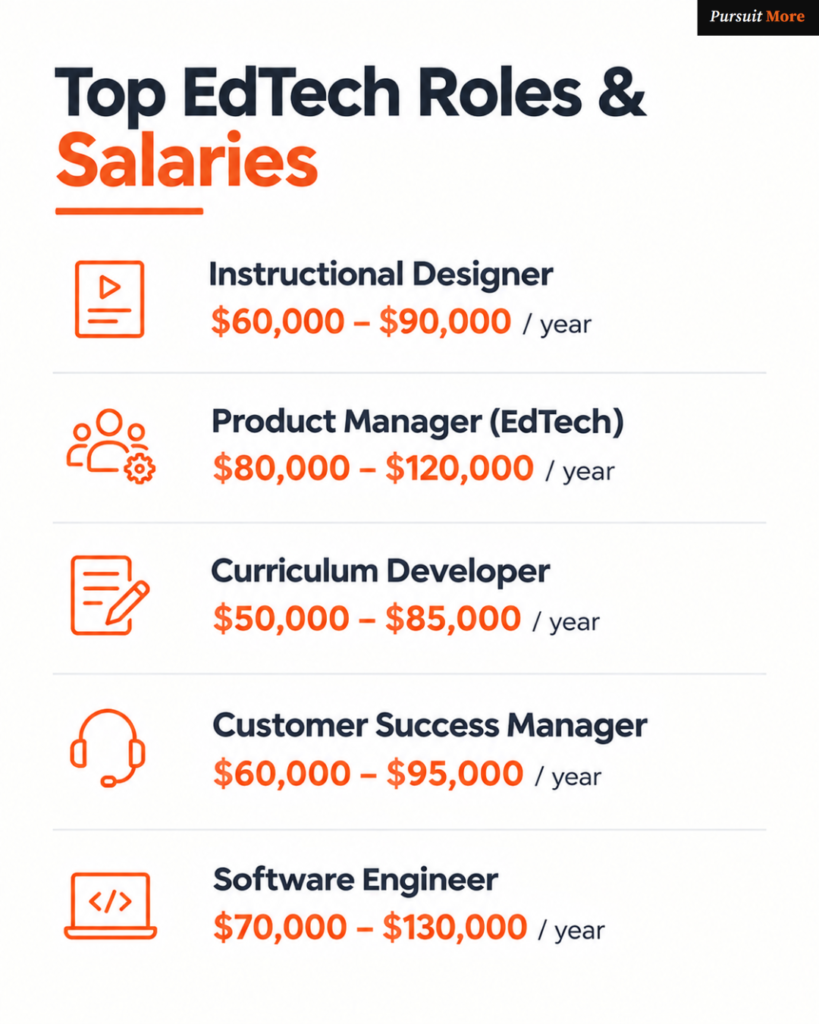
EdTech Careers: Entry-Level Roles (N100,000 – N150,000/month
Firms employing entry-level roles in the edtech industry usually pick those who are the bridge between traditional education and hardcore digital skills. These positions do not necessarily require hard coding skills; instead, they require a deep understanding of how students learn and a surface knowledge of tech.
The roles you can look for while aiming for an entry-level career in edtech include: EdTech Educator, who would handle the teaching of basic tech skills. Content creators also find a fit in entry-level roles when they have to work on editing educational content, both video and audio content.
At the entry level, most intakes are usually frontline workers who would answer student queries and connect directly with students. It is the perfect entry point for recent graduates and traditional teachers who are looking to transition into the edtech or general tech ecosystem.
Mid-Level Roles (N250,000 – N400,000/month)
The mid-level edtech roles are where the bulk of the technical and specialised hiring happens in this industry. Professionals who are hired at this tier are the ones who build platforms and design the apps that enhance he learning experience.
The roles that are usually seen here include web developer, UI/UX Design and Quality Assurance (QA) Tester. Roles such as curriculum developer are also seen in this tier.
Senior-Level Roles (N500,000+/month)
The senior-level roles in EdTech careers are usually the managerial roles of the industry. Individuals employed here are usually dictating strategy, managing large teams or closing high-value institutional contracts. The roles here include EdTech sales managers, senior Backend engineers and product managers.
Nigerian EdTech Company Directory: Who is Actively Hiring?
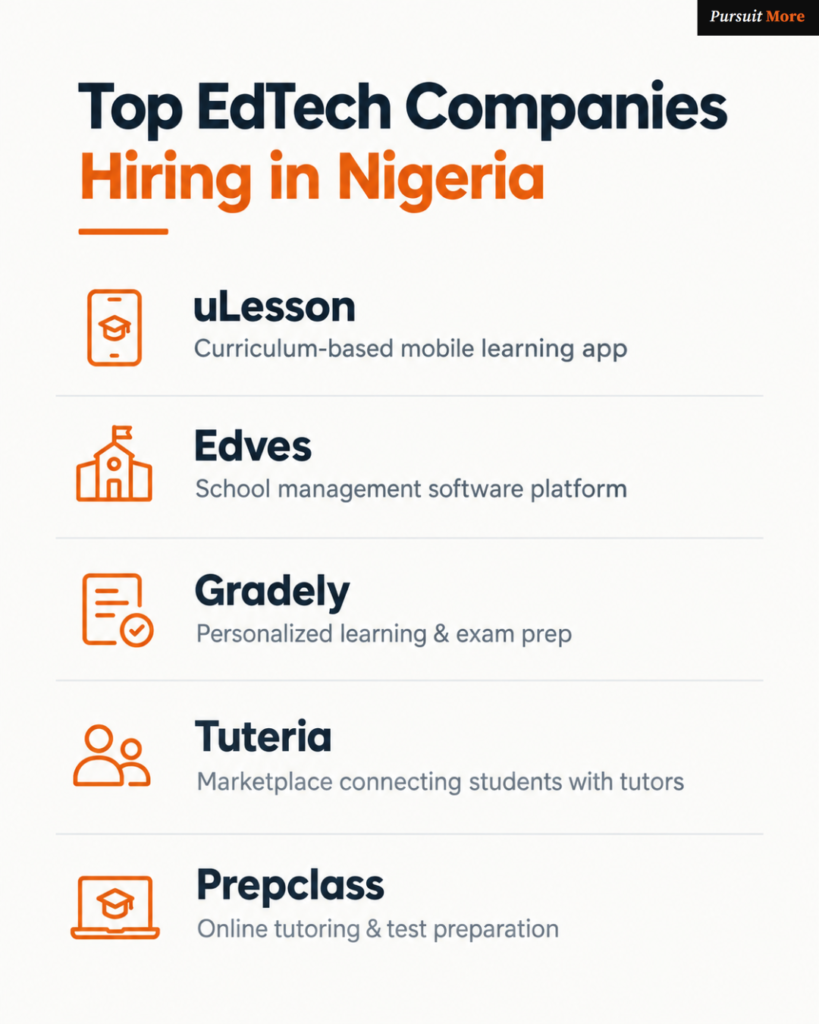
One of the most important pieces of information an applicant or tech worker should know is a list of the companies that are employing and can absorb them for their skills. EdTech is not a monolith; companies specialise in different niches, from backend AI solutions to interactive gamification. Here is a directory of active edtech employers in Nigeria and the specific types of talent they are known for hiring:
Darsel
Darsel is a highly innovative player in the edtech space. The company is actively hiring Backend Engineers, and they have a strong focus on Generative AI. If you are a developer looking to build intelligent and adaptive learning algorithms, Darsel is a prime target.
IOT Academy
This firm is focused heavily on operational excellence and scaling tech education. IOT Academy frequently hires for structural roles. They are a great company to watch if you are targeting HR and Operations positions within the edtech ecosystem.
Iris Edutech
This company focuses heavily on the user experience and platform stability. Iris Edutech is known for hiring Web Developers, QA Testers and UI/UX Designers. If your expertise lies in making learning platforms bug-free, intuitive and visually engaging, then you will be a natural fit in this firm.
Neominds EdTech
Neominds is focused on growth. They are aggressively expanding their market footprint and are known for hiring expert Sales and Business Development professionals who can sell SaaS to educational institutions. If you are an expert salesperson, Neominds EdTech will be a place for you.
Alfred & Victoria Associates
While technically a broader firm, their edtech hiring wing represents one of the most exciting frontiers in the industry. They recruit for cutting-edge experiential learning roles, specifically Gaming Engineers and AR/VR Developers.
Education Technology Careers in Lagos and Beyond Are Surging
Despite the fact that the headlines in the tech ecosystem centre on fintech and e-commerce, edtech is quietly transforming how millions of students are learning and upskilling. From K-12 supplementary learning platforms to corporate training modules and generative AI tutoring, the scope of the industry is massive.
For professionals, education technology careers in Lagos and across the country offer a unique value proposition. The ability to build highly lucrative tech careers while working on products that deliver tangible social impact.
Furthermore, edtech is leading the charge in workplace flexibility. Digital learning companies inherently understand remote collaboration. Many edtech roles now offer remote and hybrid work arrangements. The flexibility in this sector is a major draw for professionals weighing edtech against traditional on-site corporate sectors.
Career Pathways in EdTech
It is a mistake to treat edtech hiring as identical to general tech hiring. While a software engineer at a fintech company and an edtech company use similar coding languages, the end users usually require a completely different product approach.
Here are the distinct pathways into the sector:
Engineering and Product Development
These are the builders in the edtech ecosystem. Engineering in this sector isn’t just about making a fast app; it’s about making an accessible one. The platforms built here must work seamlessly on low-bandwidth connections, which is a reality for many Nigerian students. The apps should also be intuitive enough for a primary school student or a non-tech-savvy teacher to navigate.
The transition from other tech sectors to the edtech industry requires a shift in mindset toward accessibility and scalable cloud architecture to support video hosting and live classes.
Instructional Design and Curriculum Development
This is the pedagogical core of edtech and what truly separates it from generic tech. You cannot simply drop a PDF onto a website and call it an edtech platform. Instructional designers are tasked with mapping out how a human brain digests information digitally.
Transitioning into Curriculum Developer or Instructional Designer roles typically requires a formal degree in Education Technology or a closely related field. Candidates must understand learning theories, cognitive load and how to structure assessments that actually measure knowledge retention. Former teachers often pivot into these roles by upskilling in digital authoring tools.
Sales, Business Development and Growth
Concluding an EdTech sale is usually complex. If you are engaged in this career, you will rarely just sell to the end-user, the student. Instead, you will be navigating the murky waters of a B2B (Business-to-Business) or B2G (Business-to-Government) sales cycle.
Professionals who do well in this field often transition from standard SaaS sales, educational publishing or institutional administration. Success here requires immense patience and stakeholder management, as you must convince school proprietors, principals or corporate HR directors to allocate large budgets toward new software.
The Skill Requirements Matrix for EdTech Jobs Nigeria
To get hired in the EdTech Career, you need to align your resume with the specific competencies that hiring managers are looking for. You can use this scannable matrix to assess your own fitness and identify skill gaps you may need to close before applying.
For Engineering and Tech Roles
If you intend to get into the edtech industry as an engineer, here are some of the most important skills you must master:
- Proficiency in core stacks such as JavaScript, Python, React, and Node.js
- Experience with cloud hosting and scaling video/audio streaming platforms such as AWS and Azure.
- Understanding of Generative AI integration tools like LLMs and API integration for adaptive learning.
- Knowledge of data compliance and privacy laws regarding student information.
For Instructional Design and Curriculum Development Roles
This role usually requires candidates who are experienced in traditional curriculum development or classroom teaching. Some important skills that will advance you in this role include;
- Formal background in education such as a degree in EdTech, Instructional Design or Education.
- Mastery of digital authoring tools such as Articulate Storyline, Adobe Captivate and Camtasia.
- Deep understanding of pedagogical frameworks and curriculum mapping.
- Ability to translate complex, dry academic subjects into engaging multimedia storyboards.
- Experience with Learning Management Systems and administration tools such as Moodle, Canvas and Blackboard.
For Gamification Roles (UI/UX, AR/VR, Gaming)
- Learner-centric UX design for different age brackets and cognitive levels.
- Proficiency in 3D modelling and game engines such as Unity, C# and Unreal Engine
- Expertise in gamification mechanics
- Expertise in high-fidelity prototyping tools such as Figma and Adobe XD
For Sales and Business Development Roles
To be able to excel in the sales and business development roles in Nigerian EdTech, you need to demonstrate
- Experience in B2B SaaS sales cycles, specifically within the education sector.
- Proficiency in CRM software, Salesforce and HubSpot
- Exceptional presentation skills for pitching to school boards and corporate executives.
- Understanding of school academic calendars
- Ability to conduct product demos that translate technical features into educational benefits.
How to Land an EdTech Job in Nigeria
The Nigerian edtech space is highly competitive, and any attempt to switch careers into it from other fields of endeavour will need careful strategy. Aspiring individuals need to tailor their application profile to meet the highly specific criteria that ensure acceptance. Things such as generic tech resumes simply will not cut it. You must frame your experience to show that you understand the intersection between technology and education. Here are some steps you can take to get into this career line
Find the Open Opportunities
Finding open positions and opportunities is the natural first step. You can learn of opportunities by checking specialised job boards or the career pages of companies wherein you intend to work. You can also head over to our Opportunities/Jobs card to find vetted roles that match your skill set.
Sharpen Your Application
If you are transitioning from traditional teaching, general SaaS sales or corporate IT roles, your current CV likely highlights the wrong metrics, so you need to ensure that your CV captures the relevant keywords and skills in the right places. Before you send out another application, you can contact our team for CV Review and Interview Coaching services, which will help align your profile to the specific role you are applying for. We can also help prepare you for the nitty-gritty of a successful interview.
You can further consider our Full Application Audit service that covers everything from optimising your professional LinkedIn profile to building a portfolio that aligns with the skill matrices we have outlined in this article.
The edtech sector in Nigeria is no longer a sidelined career option; it is a primary career destination offering strong salaries, profound societal impact and immense upward mobility. Whether you are an engineer looking to integrate AI into virtual classrooms, an instructional designer shaping the minds of the next generation or a sales executive closing enterprise software deals, the time to position yourself in this market is right now. Outline your pathway, upskill where necessary and step into the future of learning.
Take the Next Step with Pursuit More:
- Find Your Next Role: Browse vetted, high-growth career openings on our Jobs Board.
- Land More Interviews: Stand out to recruiters by getting an expert CV Review & Interview Coaching Session.
- Accelerate Your Startup: Get a line-by-line breakdown of your YC deck and pitch with our Full Application Audit.