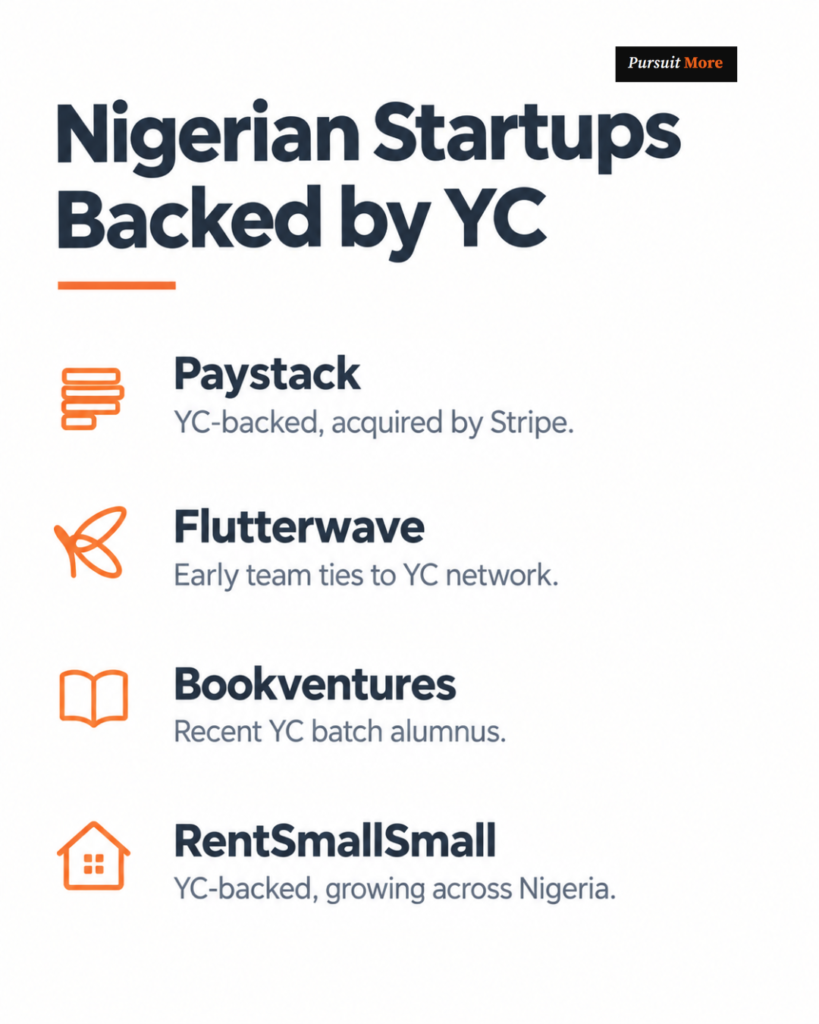
How to get into Y Combinator from Nigeria is one of the most important questions ambitious founders are asking right now. Nigerian founders today carry a level of confidence that simply did not exist twenty years ago. That confidence was earned through results, not given. It was built by the founders who came before them in the Y Combinator pipeline, including Flutterwave, Paystack, Kobo360, Chowdeck, Bamboo, Helium Health, and Cowrywise.
If you are serious about learning how to get into Y Combinator from Nigeria, know this: the question is no longer whether Nigerian founders can succeed in the program. They already have, time and again, in conference rooms in San Francisco and on Demo Day stages across the United States. The real challenge is how you position yourself to follow the same path. This guide will show you how.
Nigeria’s Y Combinator Track Record
Let’s start with the track record, because it is important.
Nigeria has had the highest number of Y Combinator accepted startups of any African nation, year after year, since Paystack was one of the earliest Nigerian companies to go through the program. Flutterwave and Paystack, both fintechs, solved vexing problems in money movement in a fragmented continent and went on to become some of the most recognizable names in African tech to come out of Y Combinator.
Kobo360 took on the logistics headache of Nigerian freight shipping and made it easier to move goods around the continent. Bamboo made capital markets accessible to everyday Nigerians who would not otherwise be able to buy shares in Apple or Tesla from their phones, while Helium Health made sense of the incomprehensible Nigerian medical records system. Cowrywise made saving money a little less painful.
And then there is Chowdeck, which we will spend some time talking about because its story is the most immediate endorsement of all of the above.
The pattern is not an accident, and it is not an outlier. Nigerian founders are building companies and products that possess a certain resilience that investors have taken notice of, even if they are coming at it from a unique angle. But that is not an exception; it is the rule.
Why Nigerian Founders are a Good Fit for Y Combinator
There is a reason why Y Combinator has had such a seemingly consistent appetite for Nigerian founders, and it has less to do with mood than it does with perspective. Value chains in Africa, particularly Nigeria, represent a frontier for innovation. In the U.S., a payments company is likely to be solving for an existing need but with a better mousetrap. In Nigeria, a payments company is likely to be building the mousetrap, the market, and the cheese all at the same time, for a population of 200 million people. That is the type of opportunity that investors like to describe as whitespace.
This is why the best Nigerian applications do not waste time groaning about Nigeria as a series of challenges to be overcome before the “real business” can begin. The best applications are those that recognize opportunity in Nigeria’s challenges, an opportunity compounded by a local founder’s understanding of them and a product-led solution that will disrupt an economy. If you are building for Nigeria or building from Nigeria, you are not asking Y Combinator to make an exception for you; you are inviting them to invest in the next frontier of technology markets.
Chowdeck’s Success Story: A Nigerian Example, In-depth
If you want to understand what Y Combinator can do for your company beyond the funding, it’s helpful to look at Chowdeck’s story.
Chowdeck was founded in October 2021 by Femi Aluko, Olumide Ojo, and Lanre Yusuf, who noticed a simple but persistent problem in Lagos: that ordering food could take up to a couple of hours in a city where people did not have that much time to spare. They built a food delivery directory service and got accepted to Y Combinator’s S22 cohort as one of the few African companies in the class.
The founders of Chowdeck have since found themselves in an enviable position, because Y Combinator did not simply give them a nice big check and send them on their way. The three months spent in the program helped discipline Chowdeck’s growth in a way that would have proved difficult to manufacture on their own. Office hours with the partners who have seen thousands of companies come and go, a founder network solving similar problems at the same intensity, and an uncompromising focus on growth and unit economics have made Chowdeck a stronger company.
It has grown from Lagos to Port Harcourt, Ibadan, and Abuja, with a rider network of more than 20000, and begun operations in Ghana. Chowdeck has raised a $2.5 million seed round, and it reached its first profitable month before going on to close a $9 million Series A in 2025, led by Novastar Ventures with participation from Y Combinator again as a return founder. It has acquired Mira, a restaurant POS startup founded by Flutterwave and Paystack alumni, to expand its inventory and payment offerings and serve more than a million customers in two countries and eleven cities.
That is what Y Combinator can do for a Nigerian founder, because beyond the investment that matters enormously to early-stage companies, it provides a kind of apprenticeship to building a company that can survive first contact with the market. Chowdeck did not walk into Y Combinator with a complete understanding of what it was building, and it walked out three years later with a company that investors continue to return to. That is the type of founder education that every Nigerian founder should seek.
When to Apply to Y Combinator
Y Combinator, which used to admit two classes per year, now admits four, meaning that there is likely an opening or a soon-to-open slot for you, wherever you are reading this. Each class typically starts in January, April, July, and October, and each has its own deadline several months earlier: for a January start, that’s around early November of the prior year; for April, early February; for July, early May; and for October, late July. Decisions tend to come out four to five weeks after the official deadline has passed.
The practical implication is that you should not feel tied to a particular season for applying to Y Combinator, because they accept applications for future slots all year round under the rubric of Early Decision, and the faster you get a response, the sooner you can begin preparing for the next one if you are not selected. Think of it as having multiple doors to knock on, rather than a single window, and treat each deadline with the respect and time it is due.
What the Application asks for
If you are researching how to get into Y Combinator from Nigeria, understanding the application form is one of the most important steps. The Y Combinator application is shorter than most first-time founders expect, and for good reason. Every question is designed to cut through surface-level answers and reveal what the founder and the company are truly made of. Below are the areas where you need strong, clear responses.
What your company does. Explain it in a way that a stranger on a Lagos danfo could understand. Avoid complex language such as “we are building a fintech infrastructure layer for SME liquidity optimization.” A clearer version would be: “We help small shop owners in Nigeria get paid instantly instead of waiting days for transfers to clear.”
Your built-and-launched timeline. Y Combinator wants to see that you can execute quickly. Share what you have shipped and how long it took to get the product in front of real users.
Your team background. Be direct about who you are and why your team is well positioned to solve the problem. Highlight relevant domain experience, previous founding experience, or a deep understanding of the market.
Traction evidence. Present the numbers you have, even if they are still small. Show growth wherever possible. A founder with 50 paying customers growing at 20 percent week-over-week is often more compelling than one with 5,000 unpaid users and no retention.
A demo, if possible. A short, simple video showing your product in action can strengthen your application significantly.
The question about the biggest risk. Many first-time applicants struggle with this. It is not a trick question. It tests honesty and your ability to recognise real challenges in the business.
For founders focused on how to get into Y Combinator from Nigeria, preparing clear and specific answers in each of these areas is essential. If you want a second opinion before submitting, a full review of your application can help identify weak points you may have overlooked. Getting this stage right is a critical part of improving your chances of success with how to get into Y Combinator from Nigeria.
The Interview
If you are serious about how to get into Y Combinator from Nigeria, understanding the interview stage is critical. Applicants who make it past the first round are invited to interview, and many are caught off guard by the format. There is no traditional interview. Instead, you face about ten minutes of rapid-fire questions from partners who have reviewed thousands of applications and can quickly identify weak points.
They will ask detailed questions about your numbers, and you must know them without hesitation. Calculating on the spot is not an option. They will also rephrase the same question in different ways to test how clearly you think under pressure. What they look for is not polished delivery but sharp, consistent reasoning — the same clarity you will need later when speaking with investors.
Founders who perform well at this stage are usually those who prepare specifically for it. Simply rehearsing an elevator pitch is not enough. If you want to improve your chances of learning how to get into Y Combinator from Nigeria, dedicated interview preparation is highly recommended. Some services focus only on Y Combinator interviews and help founders become comfortable with the fast, intense format.
Practising under pressure until the questions no longer unsettle you can make a real difference. For Nigerian founders aiming to master how to get into Y Combinator from Nigeria, strong interview performance is often the final decisive step.
What it means to be Accepted to Y Combinator
The terms of admission to the Y Combinator accelerator are standard and publicly available, for the most part: a $500,000 investment, structured as $125,000 for 7 per cent equity through a post-money SAFE, plus another $375,000 through an uncapped SAFE with a most-favoured-nation guarantee.
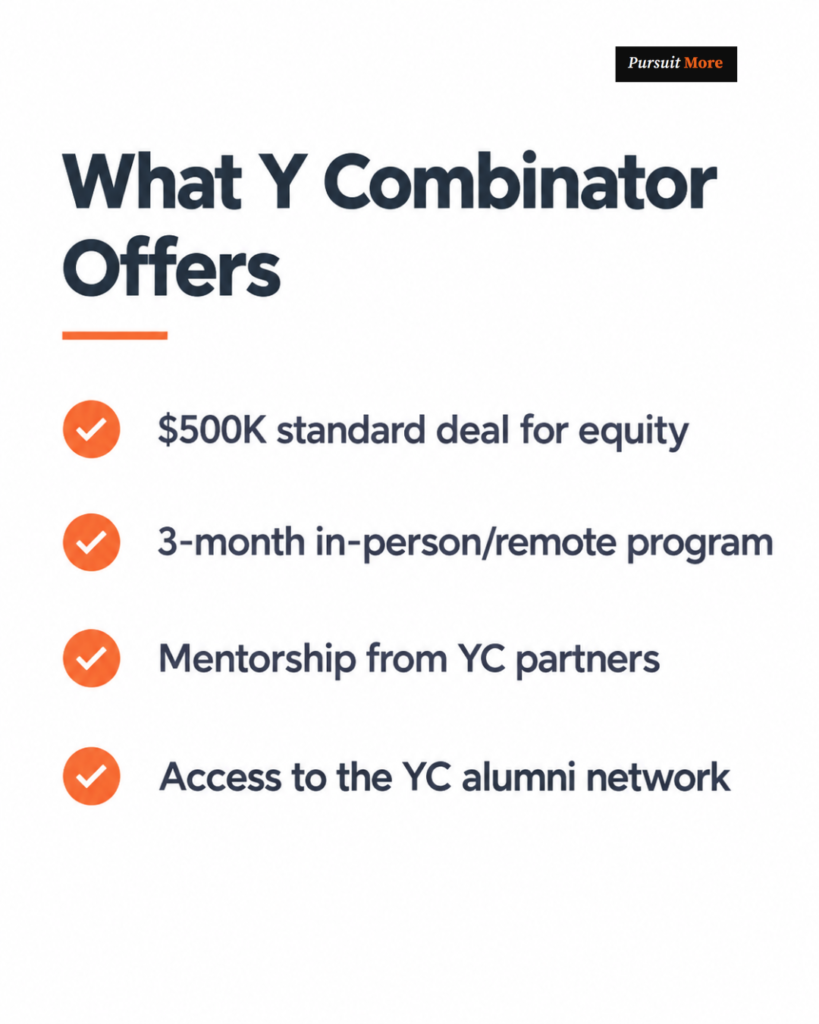
What Y Combinator Offers.
The programme itself is three months, in person, at the YC campus in San Francisco, with a three-day retreat at the beginning, and a Demo Day at the end.
It involves regular founder meetups, talks from successful entrepreneurs, and extensive one-on-one mentorship with your assigned partner at YC. Demo Day itself is an event where you will pitch to investors who have flown in from across the globe, because a Y Combinator endorsement is, rightly or not, an assurance of quality.
What comes after Demo Day is an entirely different conversation, and one that deserves equal if not more preparation, around term sheets, the art of valuation, and choosing which investors from the room to let into your cap table. Nigerian founders, take heart: the path to Y Combinator is not an exception, it is an entitlement. And the trail that Chowdeck has blazed is one you can follow, too.
Maximize Your Y Combinator Application Odds
Don’t leave your YC submission to guesswork. Get tailored support at every stage of the application and fundraising pipeline:
- Application & Pitch Review: Have your form line-by-line audited before submitting with our Full Application Audit.
- 10-Minute Interview Prep: Practice rapid-fire partner questions through our dedicated Interview Coaching Sessions.
- Post-YC Capital Strategy: Plan your term sheets and valuation models using our guide to the post-YC funding landscape.
- Ecosystem Insights: Explore how top founders navigate the broader Nigerian startup ecosystem.