AfDB Internship 2026 for Nigerians: Application Guide + Stipend Breakdown
If you are a Nigerian master’s student looking for a serious development-finance credential, the AfDB internship 2026 for Nigerians was one of the strongest options on the table this year. Session 1 shut on 14 November 2025, and Session 2 closed in early April 2026, which means the intake windows have been closed, but the programme runs on a predictable pattern over the years, and the next window is the one you should be planning for.
This guide covers what the African Development Bank actually requires, how to get yourself to the right department (most applicants get this wrong), how the application process works step by step, the difference between remote and on-site placements, and what the Bank does and does not pay.
Why the AfDB Internship Is Worth The Effort
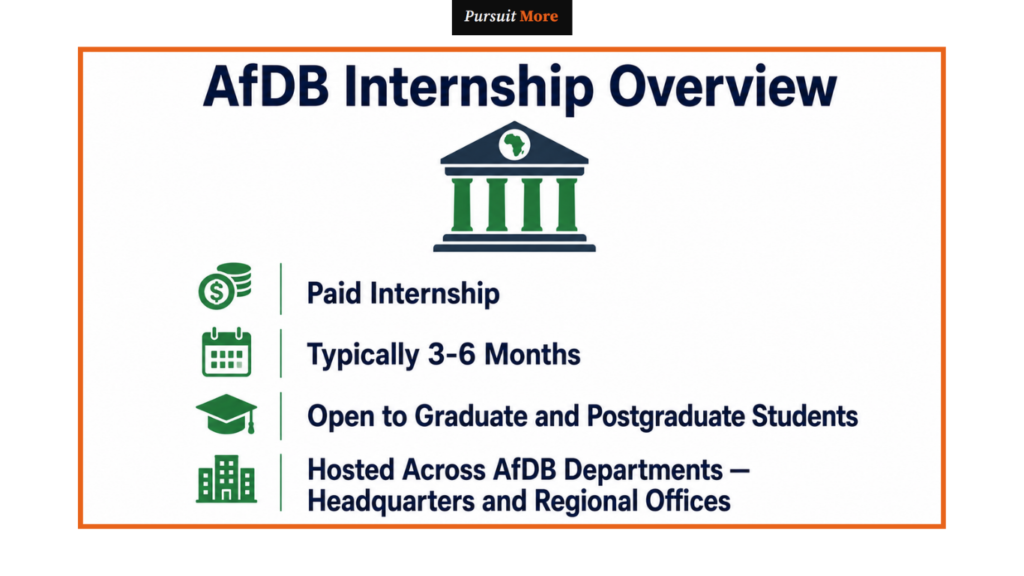
The African Development Bank was established in 1964 and is the premier pan-African development institution, with 81 member states including 54 in Africa. Nigeria is a regional member country, so Nigerians are eligible.
The Bank is clear about its own motives: this internship exists to give students professional and practical experience, and to give the Bank many potential candidates for future employment. It is also clear about the limited assurance that applicants should not expect the internship to lead to immediate employment.
This is not a guaranteed job offer. You are to see it as an opportunity to grow, an additional experience to your CV that might give you the opportunity you need in any other development finance.
The programme is part of the Bank’s wider Talent Management Framework, which explains its ten-year strategy from 2023 to 2032. That strategy is planned around four important skills: unlocking capital at scale, reforming Africa’s financial architecture, harnessing demographic transformation, and building climate-resilient infrastructure and value addition. Anchoring your application to one of these is a genuine advantage, and we will come back to it.
The programme aligns directly with the goals outlined in the African Development Bank Group Ten-Year Strategy, which focuses on driving green growth, climate resilience, and economic transformation across Africa
AfDB internship 2026 for Nigerians: Eligibility Criteria
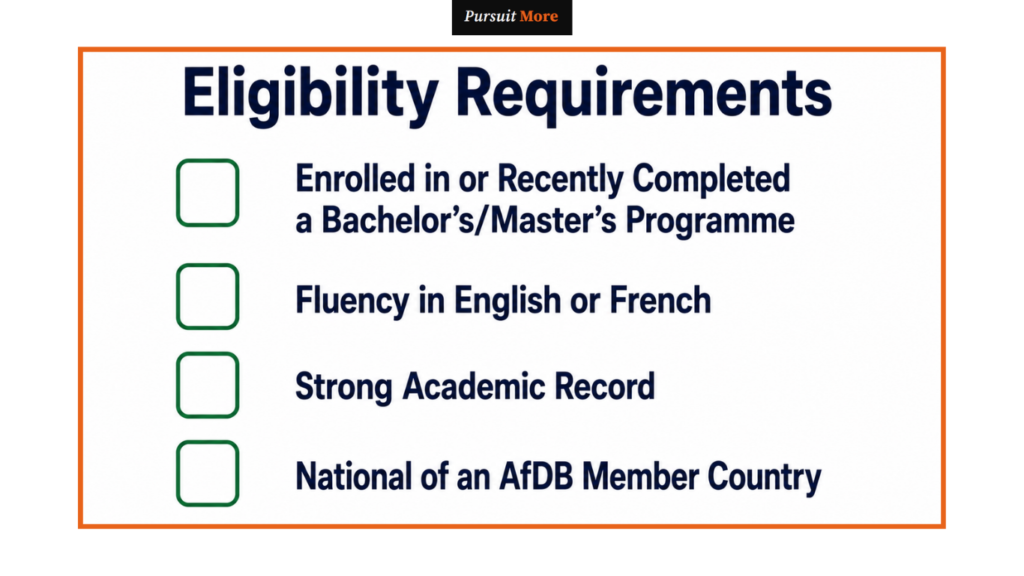
The Bank publishes its eligibility criteria before the application even starts:
- Be under the age of 30: You must have attained the age of majority in your country of nationality and be under 30 years of age at the time the internship commences.
- Be a master’s-level candidate: Undergraduates are not eligible. You must be currently enrolled in a master’s degree programme at a recognised public or private institution. If you have already finished, you may still apply within one year of obtaining that degree.
- Be a national of an AfDB member country. Nigerians are qualified for this. The Bank does not accept dual nationality. You must declare the single nationality you want to be considered. You’re to upload a government-issued ID, either a passport, national identity card or certificate. You must hold single citizenship in an eligible regional or non-regional state, as listed on the official AfDB Member Countries Directory.
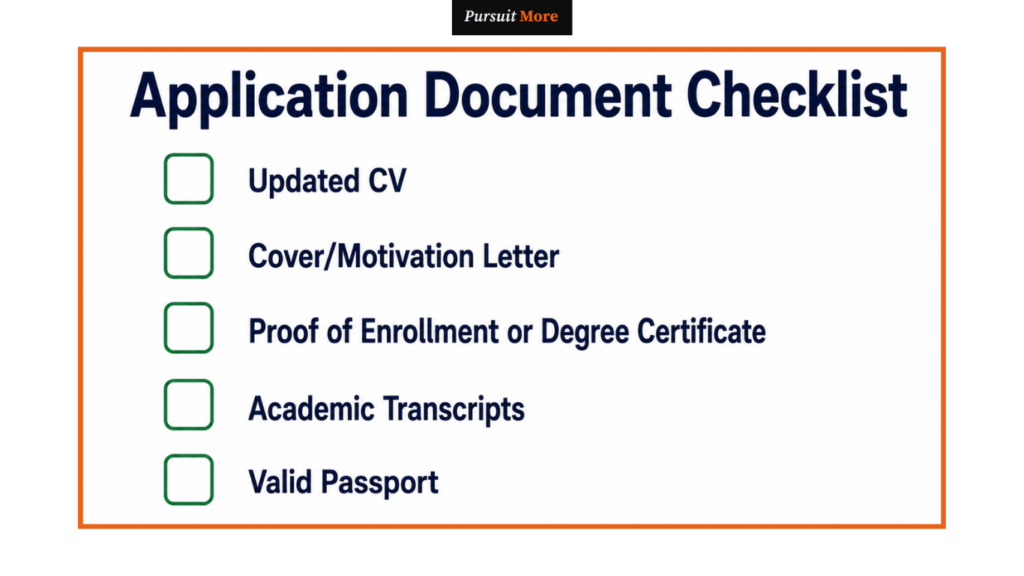
- A Recommendation Letter from School to prove that you are a Student: A letter from your school confirming enrolment, or a copy of your completed degree certificate.
- Be fluent in English or French. One of the Bank’s two working languages is enough. Working French is not required for Nigeria
- You should have some skills: you must be able to use the Bank’s standard software packages like Word, Excel, PowerPoint and Access, and knowledge of SAP is desirable. If you have touched SAP through coursework or a previous role, put it on the CV.
Departmental Matching
This is where most Nigerian applications quietly fail. Some Candidates apply as smart master’s students rather than as candidates qualified specifically for a particular field. The Bank selects interns competitively based on the business needs of the Bank, and the fields of study it draws from must fall within its job families.
Those job families and strategic focus areas are:
- Agriculture
- Human Capital
- Engineering
- Investment
- Operations management and programming
- Sustainability
- Procurement
- Delivery and Performance Monitoring
- Risk Management
- Finance
- Capacity Development
- Governance, Natural Resource and Knowledge Management
- Economics, Statistics and Data Management
- Human Resources Management
- Information Management Technology
- Real Estate Management and Services
- Translation and Interpretation
- Communication
- Legal
- Corporate Governance and Advisory Functions
The Bank also allows any other field it deems relevant to its operations, so the list is a guide rather than a wall. But you should be able to name your target department in one sentence.
How to Match Properly
- Start with your degree, not your ambition: An MSc in Agricultural Economics from Ibadan can choose Agriculture as the primary course, and second to Economics, Statistics and Data Management. An LLM can choose Law and possibly Corporate Governance and Advisory Functions. An MSc in Data Science can choose Economics, Statistics and Data Management or Information Management Technology; this depends on if your work is analytical or systems-focused. First, pick the primary department, then choose a credible secondary.
- Then consider one of the four skills: Remember the four important skills we mentioned earlier. A civil engineering candidate should plan towards climate-resilient infrastructure. A finance or economics candidate should be looking forward to unlocking capital at scale or reforming Africa’s financial architecture. A public health or education candidate belongs in the demographic transformation.
- You can use your Project Work as an asset: The Bank states that special consideration shall be given to students working on projects in relation to one of the skills they offer. If your research is on agricultural credit access in Northern Nigeria, off-grid solar financing, or SME lending risk, this is your strongest single asset. Name the project, name the method, name the finding, in two lines near the top of your CV.
- Rewrite the CV according to each department: The same CV cannot be submitted for Procurement and for Communication. Reorder your skills, start with the relevant coursework, and remove any skill irrelevant to a particular department.
To make sure your CV, statement of purpose, and departmental selection strategy stand out during competitive review rounds, get personalized, 1-on-1 guidance through our dedicated Pursuit More Coaching Services.
How to Apply, Step by Step
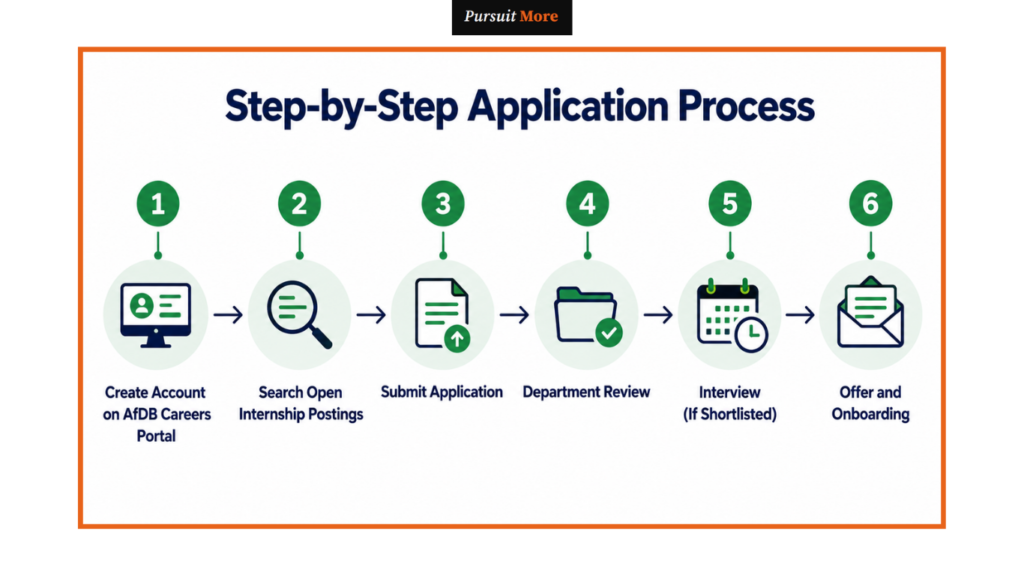
- Always check the Bank’s careers portal for internship updates: Session 1 of the 2026 programme was posted on 31 October 2025 with a 14 November 2025 closing date; this means the window was open for two weeks. Session 2 opened in late March 2026 and closed in early April 2026. The entry window is quite short; your documents should be ready before the next window.
- Make sure you have passed the eligibility criteria: Just been qualified in age, and maybe your school’s letter of recommendation is not enough.
- Prepare your enrolment letter early: Nigerian universities are not always quick with confirmation letters. Request it weeks before you need it.
- Write a concise, comprehensive CV: The Bank asks specifically for a concise curriculum vitae plus any additional documents stated as required.
- You are to submit applications online; you do not need any agent to help you submit.
- Those candidates who have completed and met all of the criteria will be contacted for selection. Session 1 for interns for 2018 will start in January; Session 2 will start in July.
Note: The African Development Bank Group will not request payment from applicants at any stage of the application, from the resume review stage to the interview process, to final processing, nor will the Bank request from applicants their bank account information. If anyone requests to get money, it may be considered an internship scam.
Remote Versus Onsite
Selected interns would work either remotely or on-site, depending on the needs of their hiring unit. The interns do not decide this.
Remote interns: must have a personal computer, a reliable internet connection, and a conducive working environment. Remote Interns are responsible for their data and light supply.
On-site interns are based at the Bank’s location; the headquarters is in Abidjan. On-site interns are responsible for their own air travel to and from the Bank’s location, and for their personal upkeep. The Bank might help with entry and residence visas, but the flight and your living costs in Abidjan are yours. Côte d’Ivoire is not a cheap posting, so check the price before you accept.
Stipend Breakdown
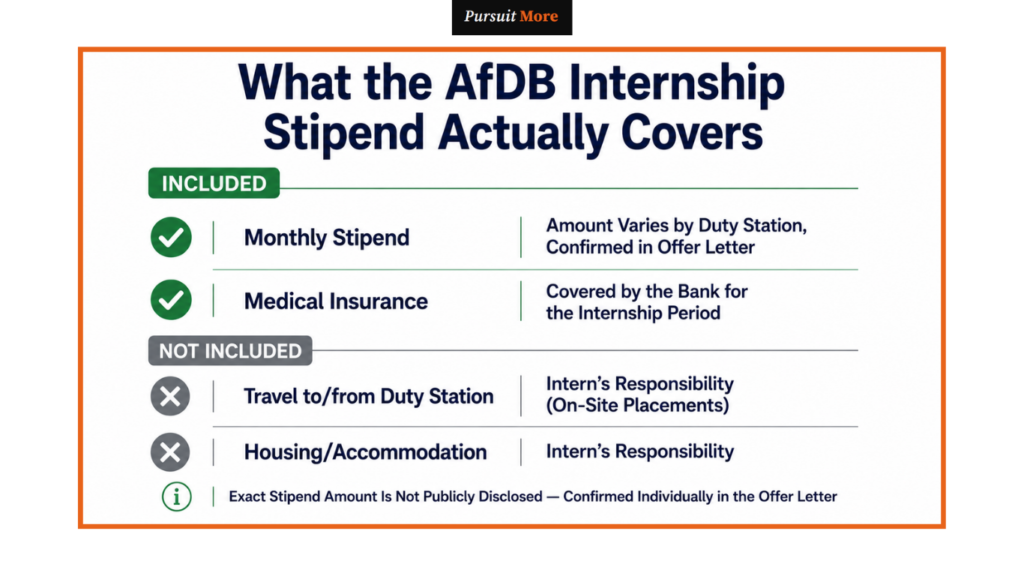
What the African Development Bank commits to in writing is short:
- A monthly stipend for eligible interns. The amount is not published in the internship advert.
- Medical insurance coverage paid by the Bank for the duration of the internship.
What is not committed: flight expenses for on-site interns, accommodation, upkeep, or any relocation package. Some posts you see on Social Media about a dollar stipend or sponsoring your flight expenses are not true; it’s not what is written on their site.
Do not build your expectations around these lies and plan your budget according to what you have or what you will be told during your interview. Since there’s no verified stipend amount on their website, every piece of info you get as regards the stipend should be treated as unverified.
This is a supported internship, not a fully funded placement. From the look of things, a remote placement is financially light; you don’t have to travel or try to survive when you travel, but you get a stipend and insurance at your own convenience. An on-site posting in Abidjan means you will be covering your flight expenses, your accommodation bills, and your upkeep that is almost half of the stipend, if not all.
What To Do
The first two entry sessions for this year, 2026, are officially closed. But based on the pattern of the last two cycles, the next Session 1 advert would be expected around October or November 2026, with a start the following January. Although the Bank has not yet announced that window, we are just in accordance with the pattern; make sure you’re always checking their portal to know when they will be open before the end of this year.
Confirm eligibility and your year of study, finalise declared nationality and ID documents, secure an offer of acceptance from the school, refine your dissertation into two quotable sentences, streamline your CV around one discipline. Those who apply in advance actually gain admission within the two-week open application window.
Meanwhile, while you wait, please check other live development-finance internships and fellowships open to Nigerians in our opportunities available now.