Study in Germany Free in 2026: The DAAD Scholarship Guide Nigerian Applicants Actually Need
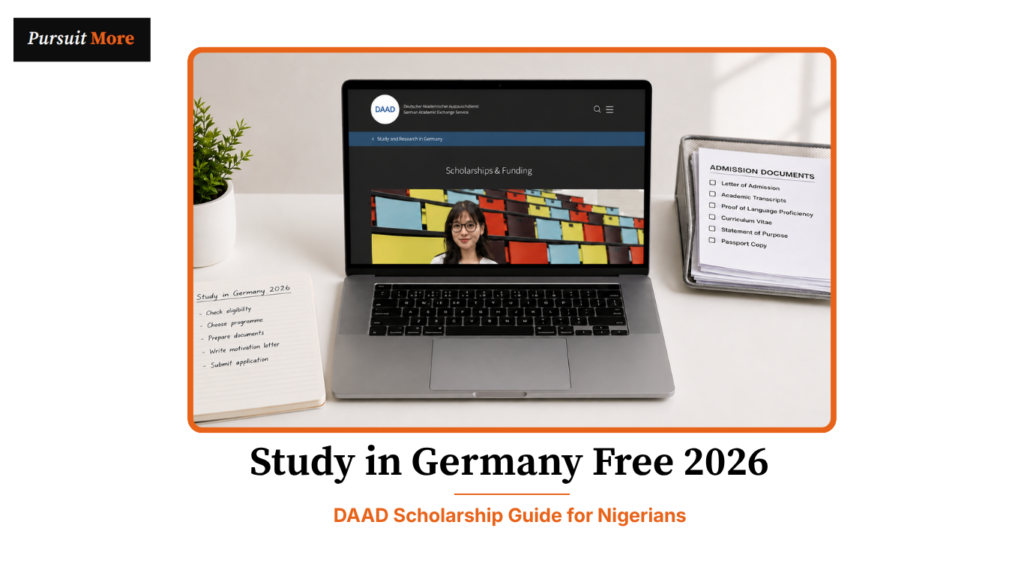
Many German public universities offer tuition-free master’s and PhD programs for international students, making the decision to study in Germany a highly rewarding path for Nigerian applicants.
However, finding clear, actionable advice on how to study in Germany on a budget can be tricky. There are many confusing guides online regarding when and how to apply to a university of your choice, how to secure a DAAD scholarship, how to verify your WAEC and NYSC certificates, and how much money you need to save before relocating.
If your goal is to study in Germany without making costly application mistakes, this guide covers all the necessary steps you’ll need to take — in the exact right order.
Why Study In Germany For Free (And What It Actually Costs)
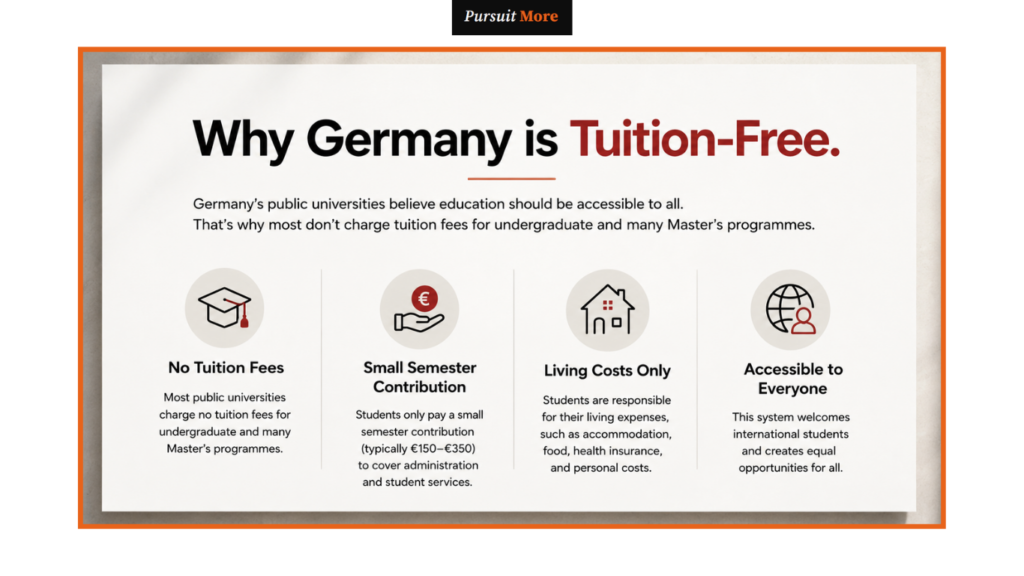
In 2014, all 16 states removed tuition fees for both local and international undergraduates in public universities, making it far more accessible for international candidates to study in Germany.
However, in 2017, the state of Baden-Württemberg, home to the Universities of Heidelberg, Freiburg, and Tübingen, became the exception. The state reintroduced tuition fees for its non-EU/EEA students, meaning anyone planning to study in Germany at a public institution within this state must budget for extra costs.
Students who attend public universities in Baden-Württemberg are required to pay €1,500 every semester, in addition to the standard semester fee. However, there are exemptions for some DAAD-funded students and eligible DAAD EPOS scholarship holders.
It is also important to remember that choosing to study in Germany at “tuition-free” universities doesn’t mean you won’t pay a single euro. Students across all 16 states are required to pay a mandatory semester fee between €100 and €400, depending on the university.
Service Fees
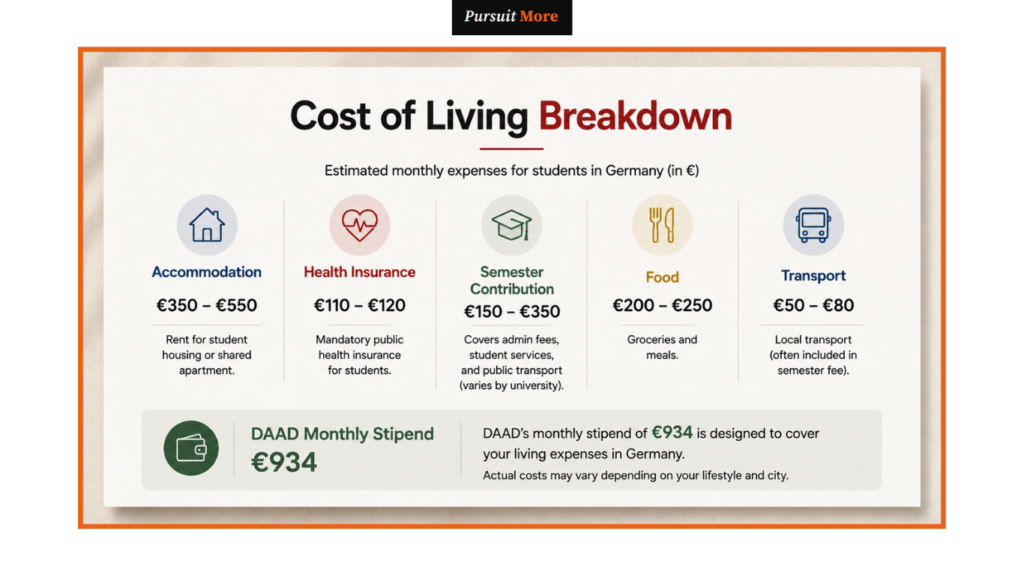
Local and international students attending public universities in Germany have to pay a semester fee between €150 and €350, depending on the university. They also have to pay Student union (Studierendenwerk) fees and health insurance (unless you have proof of health insurance).
Accommodation
International students pay for their accommodation as well. According to the German Academic Exchange Service, also known as the DAAD (Deutscher Akademischer Austausch Dienst), more than 40% of international students live in halls of residence for €250 to €300 monthly. Since the halls cannot cover all students, some students can share a flat, and it usually costs between €250 and €800 per room monthly, depending on what city you live in. Living alone can be more expensive, usually between €450 and €1,000 monthly. Also remember that most flats in Germany aren’t furnished before they’re rented out.
Transportation
In Germany, Deutschlandsemesterticket is a discounted semester public transportation ticket included in semester fees by most German universities for its students.
Proof of Funds
This is a very crucial part of the visa application process that many applicants do not always know about. What this means is that you have to prove that you have enough money to sustain yourself in Germany. You can do this through a blocked account.
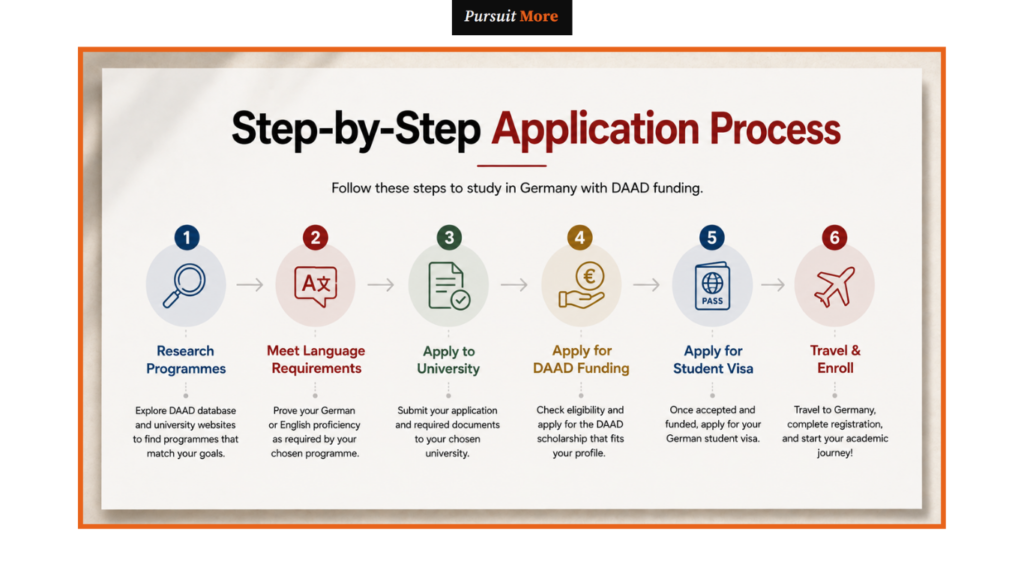
The Two-Stage Application Process
Many first-time applicants get it wrong by applying for DAAD first.
There is a process to follow, and it comes in two stages:
- Apply to the university first: You can apply through the university’s application portal and follow the required steps. After that, a selection committee will go through your application and academic credentials before deciding if you’ll be shortlisted or not.
- Apply for DAAD scholarship after you have been selected: If the university considers you eligible for a scholarship, you’ll be contacted by DAAD to upload your application on its portal.
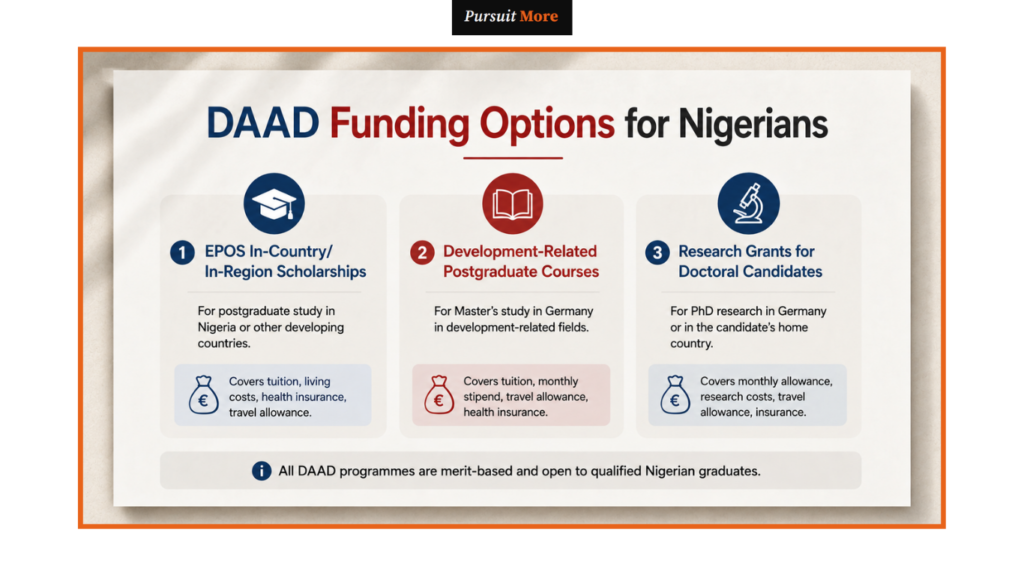
DAAD, also known as Development-Related Postgraduate Courses when translated to English, doesn’t curate the list of eligible applicants itself; the universities involved select the applicants that meet the requirements.
Keep it in mind that you can’t apply for a DAAD scholarship without applying to a university program and getting selected. Also, each program has its own special requirements so confirm that you’re on the right track when processing your application.
German University Selection Matrix
EPOS programs that are development-related and taught in English aren’t available in all German universities.
Some of the options in the DAAD EPOS course catalogue include:
| University | Program / Field | Degree | English-taught | Application Process |
| University of Bonn | Global HealthAgricultural Sciences, Development Economics | MSc | Yes | Apply to the programme first, then submit documents to DAAD if shortlisted |
| University of Hohenheim | Agricultural Economics | MSc | Yes | Apply to the programme first, then submit documents to DAAD if shortlisted |
| University of Leipzig | SEPT — Small Enterprise Promotion & Training | MBA | MBA | Apply to the programme first, then submit documents to DAAD if shortlisted |
| Charité – Universitätsmedizin Berlin | International Health | MSc | Yes | Apply to the programme first, then submit documents to DAAD if shortlisted |
| University of Freiburg | Environmental Governance | MSc | Yes | Apply to the programme first, then submit documents to DAAD if shortlisted |
| TU Berlin | Urban Management | MSc | Yes | Apply to the programme first, then submit documents to DAAD if shortlisted |
DAAD EPOS Application Checklist
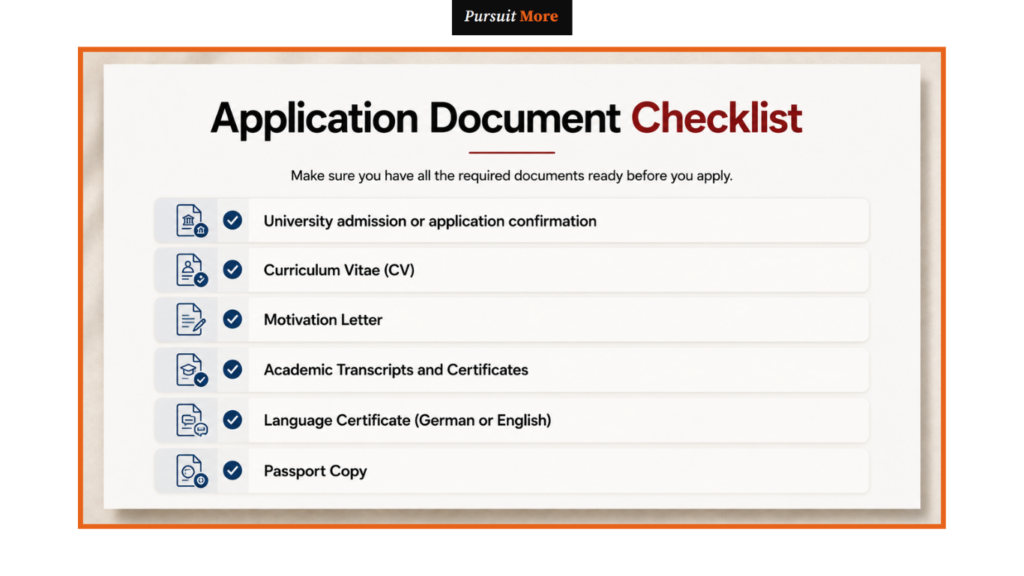
When it is time to upload your documents on the DAAD portal to prepare to study in Germany, you’ll need these documents:
- DAAD EPOS checklist: Printed, signed, and dated by hand, and then scanned.
- DAAD application form: Filled out and submitted online, not handwritten.
- CV: Listing your work experiences starting with the most recent position down to your first. Any gaps in your work experience or education should be properly explained.
- Motivation letter: Explaining why you applied for the program, your academic and career goals, and how your degree will allow you to solve development challenges after you study in Germany.
- Degree certificates and transcripts: Your degree shouldn’t be older than six years at the time of application. You’ll need certified translations if they are not in English or German.
- Work experience: At least two years of professional work experience after completing your first degree.
- Language certificate: Proof of English or German proficiency depending on the requirements from your chosen program.
- Recommendation letter(s): Coming from a university lecturer or an employer, issued as a signed and stamped letter on official letterhead.
- Citizenship & academic prerequisites: A citizenship certificate from an eligible country and a relevant bachelor’s degree.
Regarding funding, the DAAD EPOS scholarship provides a fully funded opportunity to study in Germany, offering a monthly stipend of €992 for master’s candidates alongside health insurance, travel allowances, and study grants. Master’s students get a monthly fund of €992, with insurance coverage on health, accident and personal liability.
WAEC/NECO and NYSC Certificate Verification
Having your credentials verified is an essential part of applying to German universities, and it is equally essential to start this process early.
- WAEC and NECO results: These results may have to be verified through the appropriate examination body’s verification system if requested by the German university. In some cases, some universities ask that documents be submitted through uni-assist — many German universities use this application service to verify applications from international students.
- University certificates and transcripts: Uni-assist will require certified translations if your documents are not written in English or German.
- NYSC certificate: Keep your NYSC discharge or exemption certificate close by; some universities may ask for them. But it shouldn’t be part of your application if not demanded.
Blocked Account Setup
Sperrkonto, also known as a blocked account, is a special type of German bank account where applicants deposit proof of funds. The money is deposited in the account before travelling, and after your arrival, you receive monthly payments from it.
This is part of the visa requirement for most applicants without scholarships. But DAAD scholars do not need this because the scholarship covers this requirement — but to be certain, confirm what requirements a scholarship student needs with the German visa office.
The confirmed fee you need for a blocked account is €11,904. This is €992 monthly for a year. The reported €11,208 figure is outdated.
Expatrio and Fintiba are two of the verified providers for Nigerian applicants applying for a German visa.
To set up a blocked account, first choose between the two providers and log in to the website on your phone or laptop. Fill in your details and pick the blocked-account option. Upload the documents required by the website. After this is completed, you’ll receive the bank details to transfer the money. Transfer from your Nigerian bank account, and once it is deposited and verified, you’ll get a blocked-account confirmation document.
It takes between one to five business days for transfers done on Expatrio to be successfully completed.
After the process and statement of account are completed, submit it along with your student visa application. When you arrive in Germany, complete the extra steps for you to get access to your €992 monthly allowance.
The Motivation Letter and “Development Contribution” Requirement
EPOS is not necessarily just an academic scholarship; it is a long-term investment in your professional development. It acts as a framework to align your work experience, career goals, and future plans while preparing you to study in Germany to solve real-world problems when you return home.
Instead of starting your motivation letter with “you want to give back to your country”, clearly identify the specific sectors where these challenges exist. State the problems directly and explain how the opportunity to study in Germany through the EPOS programme will equip you with the knowledge and expertise to solve them by the time you complete your program.
Make sure that your letter reflects your previous work experiences, your program, and your future plans, avoiding generic templates altogether.
If you want to make sure your letter covers what DAAD reviewers are looking for before you set out to study in Germany, the Full Application Audit specifically covers motivation letter reviews.
It Works: From FUOYE to a DAAD PhD
Bolaji Fakorede’s story is a real-life example that this process works and that it works for Nigerian applicants.
A graduate from the Federal University Oye-Ekiti with an MSc in Soil Science and Land Resources Management, and an Adjunct Lecturer in the same department. Fakorede was awarded with a DAAD doctoral scholarship for the 2026/2027 academic year after following the right sequences accordingly — university-level nomination first, then DAAD scholarship next.
Where to Go From Here
German universities’ tuition-free education is open to interested Nigerian students. The biggest challenge is understanding and knowing how to go about the application the right way. If you submit a strong application, it may increase your chances of getting a DAAD scholarship. If you are looking for additional postgraduate scholarship opportunities, explore our dedicated scholarship section.