Chevening Scholarship 2026: Nigerian Application Tips & Essay Guide
Applicants often make the critical mistake of treating a Chevening award like a standard academic grant, rather than a highly competitive leadership program.
For the Chevening Scholarship Nigeria 2026 selection cycle, unsuccessful candidates usually focus on generic personal statements instead of highlighting the specific influence and leadership criteria reviewers demand.

What Is Chevening? – The UK Government’s Flagship Award.
If you’re working already, you may have gotten experience in either leading a team or supervising a project. What you then need to do is translate these experiences into leadership. This guide explains what the Chevening Scholarship Nigeria 2026 requires and how to turn your working experience into a leadership story.
Eligibility and the 2026 Cycle Timeline
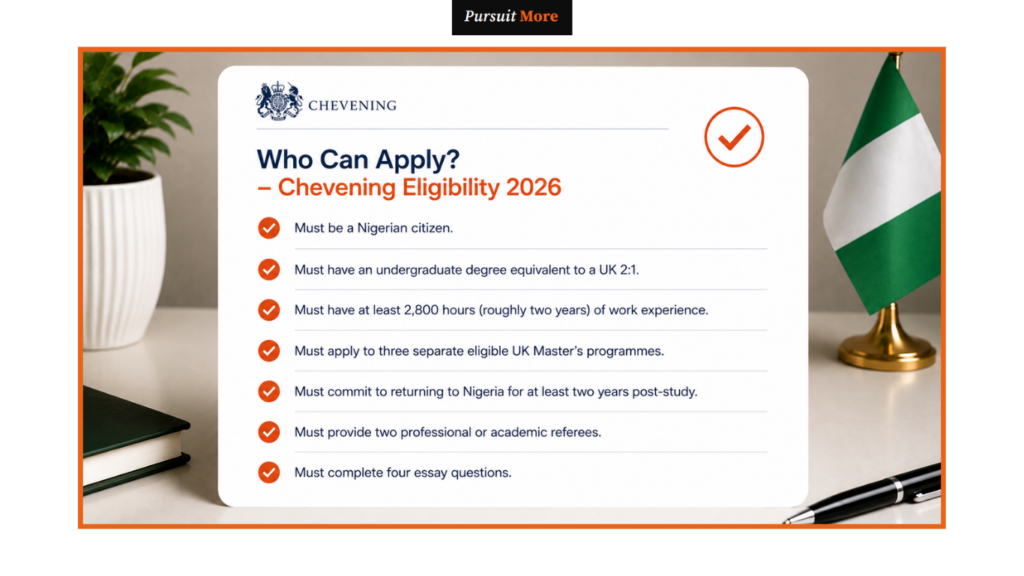
Who Can Apply? – Chevening Eligibility 2026
Chevening’s official criteria require you to:
- Check if you’re a citizen of a country that is part of the eligible countries for a Chevening scholarship — Nigeria is one of these countries
- Have a minimum of two years’work experience — equivalent to 2,800 hours of work — after obtaining your bachelor’s degree
- Have a bachelor’s degree that makes you eligible for a U.K master’s program — you must have completed your university degree at least two years before the application closes
- Apply to three eligible master’s programs at U.K universities and ensure you get an unconditional offer from at least one of the universities
- Accept that you will return to Nigeria and stay for a minimum of two years after your scholarship ends
- Not be an employee, former employee, or a relative to any employee working in His Majesty’s Government, or have worked within the last two years from the opening of Chevening applications.
Note: You’re not eligible for this scholarship if you’re a British citizen or if at any point you’ve gotten U.K government scholarship funding. However, if you’ve received any U.K government scholarship funding and you’ve completed your scholarship, you may be allowed to reapply after five years.
The full Chevening 2026 application timeline:
| Stage | Date |
| Applications open | 4th August, 2026. 11:00 UTC |
| Applications close | 6th October, 2026. 11:00 UTC |
| Eligibility checks | October 2026 |
| Applications reviewed | Mid-October 2026 — January 2027 |
| Interview shortlist announced | Mid-February 2027 |
| Interviews | March 2027 — April 2027 |
| Result announced | Mid-June 2027 |
| Deadline to get an unconditional offer | 8th July, 2027 |
| Studies begin in the U.K | September/October 2027 |
Keep these dates in mind or save them on your calendar. The application is open already, and you may feel comfortable with the October 6th deadline; however, it is important to get it sorted out before it becomes too late.
The Four Chevening Questions, Broken Down
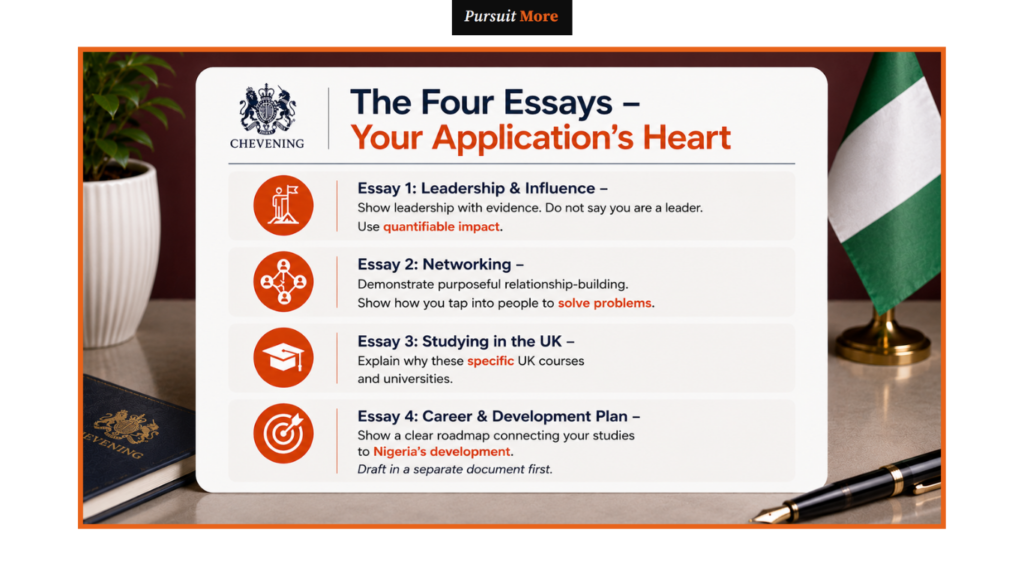
The Four Essays – Your Application’s Heart.
Chevening scholarship application is not one big personal statement. It has four essay questions/criteria, and reviewers read each one while keeping an eye on what stands out in each of them. It is not good enough to write generic essays; your answers need to cover and show everything that Chevening requires from its applicants.
- Leadership and Influencing
Reviewers aren’t interested in reading about your job description and the responsibilities you handle while at it. They’re after instances of when you led a team or when you solved a problem at work. Narrate the problem you were faced with, how you handled it, and the final result.
An example of a weak answer is only explaining your duties and responsibilities at work. A strong answer will show decisions you made, changes you made, and the result of your actions as well.
- Networking
You may assume this section is for writing a list of the famous or established names you know, but it’s not. What Chevening wants to see in this section is if you’re capable of building solid relationships and working with others towards a common goal.
You have to explain how you brought people to work together in a team you led — whether in your place of work or in any other organisation, and also explain the outcome. Writing generic sentences like “I’m a people’s person” or “I’m open to working with new faces” isn’t going to cut it. Chevening wants to see actual, real-life examples of the people you’ve worked with, the problems you faced, and the improvements that originated from your decisions.
- Study Choice
While you’re supposed to apply to three different courses, your answer in this section should mostly focus on your first choice. Reviewers want to be certain that you’ve done your research on the course itself, not just the university. It is important to include certain modules and aspects of the course and relate them to your working experience and the impact you plan on making.
Chevening is also interested in seeing if your first-choice course is linked to any of its priorities — economic growth, climate resilience, security, and inclusive development.
- Career Plan
A lot of candidates struggle in this section, even the strong ones, because they don’t have an idea of how this section should be. What you need is a clear career plan. Just stating “I want to make an impact in my career in whatever position I find myself in” is too vague.
Reviewers want to see how realistic and detailed your plans are, and that there’s a high chance that you’re going to stick to them. Your career goals shouldn’t only focus on your career growth, but also on shared challenges between the U.K and Nigeria in areas such as economic growth, security, and development.
One important rule for all four sections:
Chevening doesn’t permit using AI to write your application. It cross-checks any submitted application with AI-detection software after submission. You can use guides to structure your answers, but they should be written by you.
Any answer that doesn’t sound like it’s written by you can seriously affect your application, even if the achievements you’ve listed are truly yours.
The Leadership Angle — The Tony Elumelu Example
This is the part where most applicants doubt themselves. They believe that because they’ve never owned a company or been in charge of a team, they have zero experience when it comes to leadership. But that isn’t always right. They probably do, but they need to see their work from a different perspective.
Take Tony Elumelu’s early career as an example.
Before he became the Group Chairman of UBA, he had taken major risks and also led others. In 1997, he was the leading member of a consortium that acquired Crystal Bank and revamped it into Standard Trust Bank. In less than a decade, the bank had become the fifth largest bank in Nigeria.
The focus here isn’t how Elumelu became Group Chairman or the other businesses he’s established. It is on the leadership decision he made in 1997. He saw an opportunity to acquire a struggling bank, and he did so, claiming responsibility for whatever the outcome may have been.
That is the kind of story Chevening wants to see. Chevening doesn’t need you to be a Chairman, CEO, or manager. You can simply use how you handled a particular problem, or how you turned a dire situation around, or how you brought different people to work towards a particular goal, as your leadership example.
The most important thing is that you explain what the problem was, the decision and actions you took, and what they resulted in.
You don’t need to acquire a bank like Tony Elumelu before you can have a strong leadership story. What you need is to have a structure that works for your level: a situation that you took control of, provided a solution to a problem, and achieved a good result.
For instance, saying “I was in charge of the team that led the change” only describes what you did. But saying, “We kept lagging behind schedule, so to solve the problem, I proposed a new timetable for the team and within weeks, we were working ahead of schedule” properly describes your leadership story.
Chevening sees a lot of written examples like the first one, but a clear, well-detailed story about a problem that occurred and the solutions you proposed will likely stand out from the rest.
Mr Elumelu has been vocal about having mentors and learning from them early in his career. Your leadership story can be similar to this if you’ve had a mentor that you learnt from and managed to use the lessons to solve a problem. It can prove useful in both your leadership and networking answers.
Chevening is not only interested in people who can lead by themselves. It is also interested in seeing how you can build and use relationships, learn from others, and work as a collective to achieve a goal.
Building Your Application Timeline: Chevening Application Tips for Nigerians

How to Apply & Key Dates – 2026/2027 Timeline.
There’s about a nine-week window from when the application opens to when it closes. The best way to plan for it is to create a plan that covers all areas before the deadline:
- By mid-August: Ensure that you’ve decided on the three courses you’re going to apply for and also verify that they meet the eligibility requirements.
- By early September: Write your answers for each section and keep editing them until you’re satisfied with them. Don’t wait until the deadline is a week or two away before you start.
- By mid-September: Request references and use a professional editor for final editing.
- Last week of September: Carry out your final edits, and submit before the deadline draws too close. Chevening’s system may become overloaded during the last days, and they’re not going to accept your “technical problems” excuse if you don’t submit on time.
References for Chevening
The people you’re getting your references from may not understand what Chevening is all about, but you need to explain to get a strong reference from them:
- Send them the requirements that the leadership and influencing sections need, not just “I’d like you to write me a reference, please.”
- Ask them to include cases of your leadership that they’ve witnessed firsthand.
- Give them enough to come up with a solid reference. Don’t tell them about it a week before the deadline.
- If your referee doesn’t understand your impact, explain the key parts to them or have someone who does write your reference.

Common Mistakes That Cost Nigerians – Avoid These.
You may have a strong application and a poor reference can affect it. But a strong, detailed reference can boost your strong application.
Always keep in mind that Chevening wants references that explain your leadership and influencing skills in detail, not just your character. If you’re an African student looking for fully funded scholarships to study abroad, check our guide on 50+ Fully Funded Scholarships for African Students 2026/2027: Undergraduate, Master’s & PhD Opportunities.