Teach For Nigeria Fellowship 2026: How to Apply
The Teach For Nigeria fellowship application is one of the most demanding and impactful leadership development programs for Nigerian graduates today. This two year, full-time, compensated initiative is for young graduates who are passionate about ensuring educational equity and social impact in underserved communities and are interested in a clear path to acquiring leadership skills that are applicable across a variety of sectors.
Teach For Nigeria is part of the worldwide network Teach For All, which is present in more than 60 countries, and draws from the model which Teach For America and Teach First UK have pioneered in their own countries. The fellowship offers exceptional Nigerian graduates full-time teaching assignments in under-resourced, public and low-income private schools, mainly throughout Lagos & Ogun States. More than 79,000 have applied since its launch and 2,965 fellows are placed. This guide covers the detailed eligibility process, selection process and things that set successful candidates apart from the ones who did not get it right in the Teach For Nigeria application process.
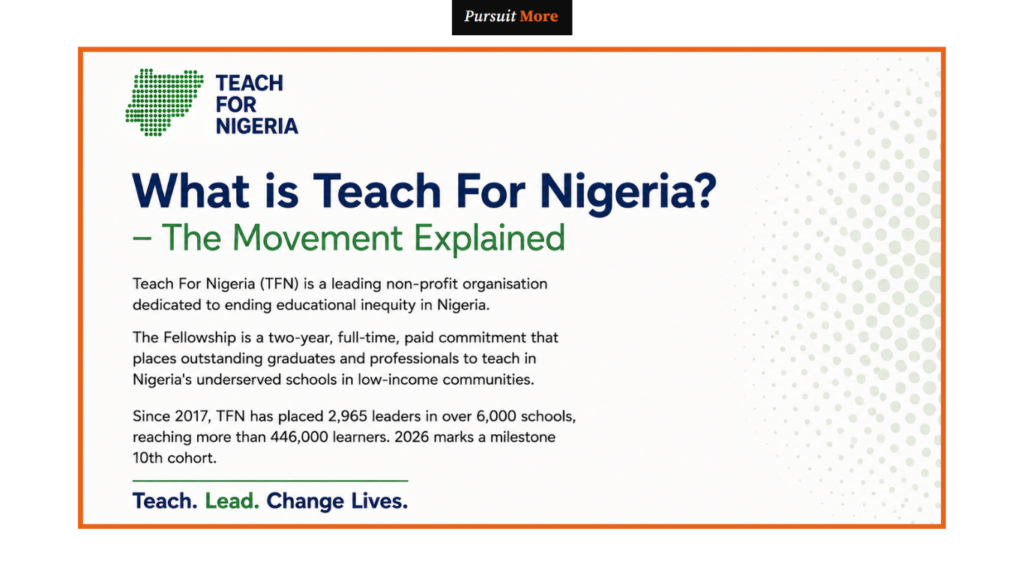
What Is Teach For Nigeria? – The Movement Explained.
Understanding the Fellowship
The essence of Teach For Nigeria fellowship is a leadership development program in the guise of teaching. Fellows are not only teachers, they are change agents and are given real responsibility on day one. The average fellow works with about 140 students as a class teacher teaching their subjects (at primary schools) or as a subject matter specialist teaching English, mathematics or science (at secondary schools).
The program starts with a six-week core residential Pre-Service Training Institute (PS-TI) in which the fellows are given rigorous training on 21st century teaching pedagogy, leadership and project management. This is followed by two years of classroom placement where fellows work to change the outcomes of students, while also gaining hands-on experience of managing stakeholders, planning, execution and reflection.
Teach For Nigeria Fellowship Eligibility Requirements
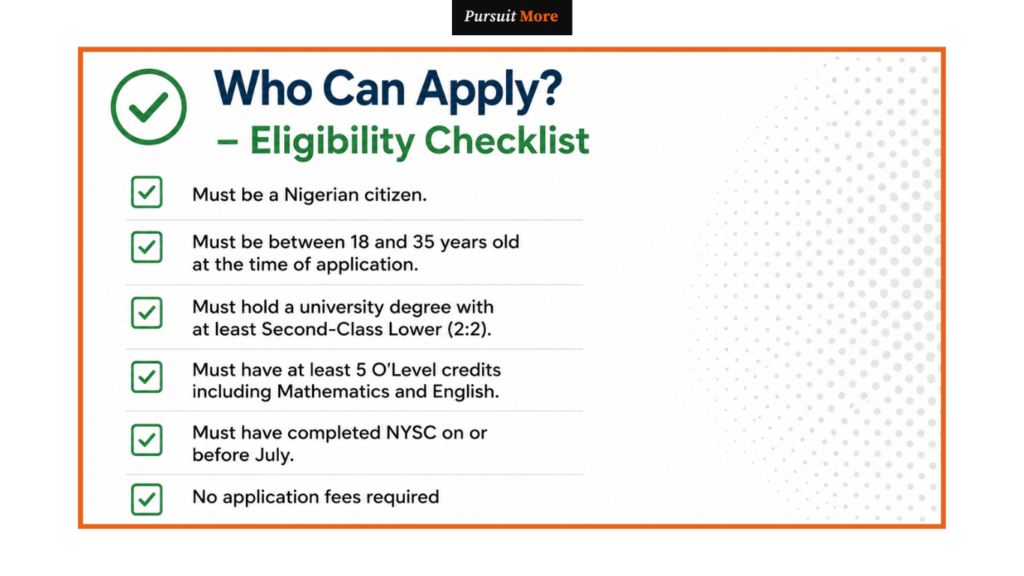
Who Can Apply? – Eligibility Checklist 2026.
Being clear on what is required for the Teach For Nigeria eligibility is essential, as discrepancies in documentation often mean it’s not accepted. The following requirements apply to the applicants for Young Graduate Pathway (YGP) (applicants are not required to be from an education-related background):
Citizenship: Must be a Nigerian citizen
Age: Must be aged 18 years and above
Applicant should be aged between 18-35 years at the time of application
Academic Qualification: Must have at least Second Class Lower (2:2) from a recognised university.
O-Level Credit: Mathematics and English (must have 5 credits in all including Maths and English, O-Level WAEC/NECO or NABTEB is acceptable).
NYSC status :Must be of the National Youth Service Corps (NYSC) or have been exempted by NYSC by July 2026.
The fellowship is very open to students from a variety of academic disciplines, including engineering, the law, medicine, business and the arts. There is no prerequisite for teaching skills, all being trained during the program.
The Step-by-Step Selection Process
The Teach For Nigeria fellowship application is a multi-stage process which evaluates leadership, motivation and suitability to the mission of the organisation. Knowing what to expect for each stage will ensure that you prepare accordingly:
Stage 1: Initial Application
The candidates apply on the application form available online, and they have to submit three prescribed essays. The essays evaluate your experience in leadership, your interest in applying and your aspirations for the future. The essays are given great consideration – they read thousands of applications and general or uninformative ones are unlikely to go far.
Stage 2: Online Test
The candidates who successfully pass the essay review will be invited to take an online test. This stage tests cognitive skills and situational judgement that are relevant to a teaching and leadership scenario.
Stage 3: Assessment Centre
The last step is the Teach For Nigeria assessment centre, which is usually conducted in Lagos. This is an intensive evaluation which consists of three parts:
Teaching a 5-minute lesson: A short lesson (5 minutes) will be taught to assessors that will require evidence of engaging learners and communicating concepts clearly.
Group activity: Collaborate with other candidates to conduct an exercise that will demonstrate teamwork and communication skills
One-on-one interview:One-on-one interview with trained assessors focusing on the motivation, leadership experience and commitment to the purpose of the fellowship.
Required Documentation: Accuracy Is Critical
The following documents will be required when you apply:
BSc certificate or statement of results (statements of results from 2019–2023 are accepted)
SSCE results (WAEC, NECO, or NABTEB)
NYSC certificate or exemption letter**
Birth certificate
Caution: Make sure that there are no errors or inaccuracies on any documents. A common reason for rejection is if your details on the application don’t match up with the supporting documents, such as misspelled names, incorrect dates, wrong grades, etc. Make sure to read all documents before uploading.
Writing Strong Application Essays: The STAR Method
The STAR Method will help you develop strong essays that help you stand out in the crowd.
The essays are the means by which you will showcase your leadership ability in a tangible way. Teach For Nigeria strongly recommends applicants to employ the STAR method (Situation, Task, Action, Result) when answering questions concerning a previous experience.
Rather than giving a general statement about being a passionate leader, tell about a specific situation: the context you faced (Situation), what you had to do (Task), the steps you took (Action), and the measurable outcome as it relates to the specific situation (Result). This method creates specific language that helps to prove leadership.
Also, ensure that the fellowship is tied very closely to your real career goals. Naturally, it will be easier for assessors to determine that someone has carefully considered how the fellowship will help them meet their objectives, rather than just sending in a generic statement of interest. It is important to research the program carefully and express clearly, why the two-year commitment fits with your career path.
What Fellows Actually Receive

What Does the Fellowship Offer? – Full Benefits.
To compare this opportunity with alternatives, you need to have an understanding of the stipend and benefits given to the Teach For Nigeria participants. Fellows receive:
Competitive monthly stipend: Competitive monthly stipend during both 2 year periods including during school holidays.
Rigorous training: Pre-Service Training Institute (residential for 6 weeks) and continuous leadership, pedagogy and project management training during the course
Professional Diploma in Education (PDE): – opportunity to achieve a PDE during the fellowship.
One Alumni Network: Access to Teach For All’s network of alumni from more than 60 countries for lifelong learning opportunities, such as mentorship and coaching, business training, and professional development workshops.
Community project support: Opportunity to develop and execute a project to change a social issue in your placement community
Placement and Commitment: Realistic Expectations:
Be aware of the time commitment prior to applying. Fellows must:
Relocate as assigned: Communities in underserved areas of Lagos and Ogun States. No Selection of School or Community.
Full time commitment for 2 years: Fellowship will be on full-time basis and will run on the Nigerian School Calendar (September to July). Two years is non-negotiable. This is a timeframe to gain students’ trust and buy-in and make significant academic progress.
Teach assigned subjects:Subject assignments are based on previous academic experience (Secondary) and may be flexible where necessary.
Critical Scam Warning
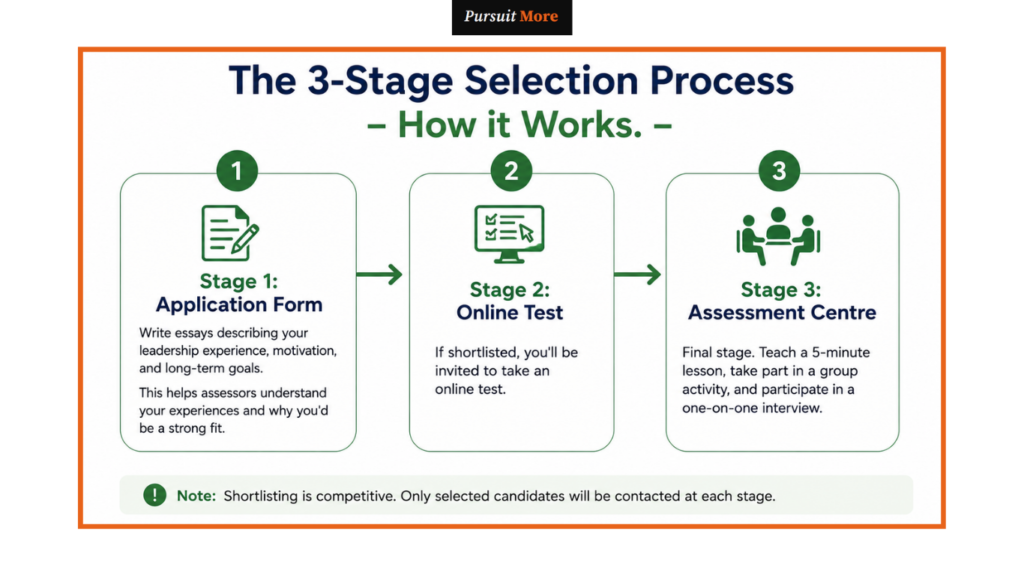
The 3-Stage Selection Process – How It Works.
Teach For Nigeria has specifically stated that they don’t require any money for promising applicants for the Fellowship. No “fast-track” choices, no paid consultation services and no agents that can guarantee placement within the company. Only apply on the official website: teachfornigeria.org If someone asks for payment for their application assistance and/or guaranteed placement, report this immediately to the organization.
Final Takeaway: Prepare Before You Apply

Key Dates & How to Apply – 2026 Intake.
A good applicant doesn’t take the Teach For Nigeria fellowship application lightly. The best advice is to have as much time as possible:
1. Prepare STAR-method essay responses in advance. specific examples of leadership and impact from academic, volunteer, or professional experiences. The following are not examples of responses that should be improvised.
2. Gather and verify all documents before starting the application. ensure that all documents have been obtained and that names are identical on each document, dates are accurate, and that there are no issues with the scans. Errors in the documents are an unnecessary rejection cause.
3. Practice the 5-minute teaching demonstration. The assessment centre lesson is not an improvised lesson. Create a concise and informative mini-lesson on a subject that you have a passion for, time yourself and ask for feedback from someone before the assessment day.
The Teach For Nigeria fellowship is more than a position, it is a calling to be part of a movement of leaders dedicated to achieving educational equity. If you are well-prepared, the right documents in place, and you are the right person for the mission, you can be a strong candidate for the 2026 cohort.
Millions of children in underserved communities are denied quality education. As a Fellow, you are a living example of a child’s circumstances being a poor predictor of his fate. This is a two-year challenge to your resilience, problem solving skills and your network of motivated change makers nationwide.