Remote Jobs in Nigeria 2026: Complete Guide to Platforms, Salaries & How to Get Hired
Remote jobs in Nigeria have created an opportunity for Nigerian professionals to access global income and earn competitively on the world market. The year 2026 is the strongest year yet for remote hiring across Africa, with international companies actively recruiting skilled talent from Nigeria.
However, the remote work market has advanced significantly, and top employers now handsomely reward candidates with specialized skills. Because generic applications are almost always filtered out by automated tracking systems, tailored preparation is essential to stand out.
If you are a young professional, landing legitimate, high-paying remote jobs in Nigeria represents one of the most transformative financial opportunities available today.
As international companies continue to adopt distributed workforce models, the ability to earn in US Dollars and other foreign currencies while living in Lagos or any remote village in Nigeria offers a buffer against local inflation and currency devaluation.
This is a complete guide on the platforms, salaries and remote jobs in Nigeria that are available to Nigerians in 2026 and how they can get hired.
The Opportunity and the 2026 Reality of Remote Jobs in Nigeria

Why Remote Work in 2026? – The Opportunity.
The reality of remote work in 2026 is no longer an idealistic, boundary-free perk but a highly disciplined, tech-driven landscape defined by hybrid dominance and aggressive return-to-office (RTO) mandates. While flexibility remains a core priority for global talent, the days of easy fully remote “work-from-anywhere” jobs have drastically tightened.
The Problems Nigerians Face When Trying to Land Remote Roles
Nigerians and Africans in general face numerous problems while trying to land remote roles with Western companies. The problems are multifaceted and complex, and they require intentional strategy to bypass. The truth is that some international remote job opportunities, despite being listed as fully remote, are strategically set up to sieve out Nigerians from the selection process. The most significant tool that these employers use is geofencing.
Geofencing: The Invisible Wall and How to Bypass It
Geofencing is the single most common reason qualified Nigerian job seekers receive instant, automated rejections. Global employers often post jobs labelled “Remote”, but behind-the-scenes conditions such as legal, tax or operational constraints restrict hiring to specific geographical zones.
Geofencing in the remote work environment is a virtual boundary set up by a company using GPS or IP addresses. It tracks the potential employees’ location and excludes them from applying for certain jobs or automatically filters them out of the selection process even when they have successfully applied for the job.

Why Companies Geo-Fence Roles
There are several reasons why companies geofence their roles and it includes;
- Tax & Corporate Entity: Companies without an established local entity or EOR partner cannot legally process payroll in Nigeria without triggering foreign corporate tax liabilities.
- Timezone Overlap: Roles demanding 8 hours of live overlap with Pacific Standard Time (PST) effectively exclude West Africa Time (WAT) workers unless night shift willingness is proven upfront. Some firms outrightly exclude anyone who is not living in the desired timezone irrespective of their willingness to work overnight shifts.
How to Detect Geo-Fenced Postings Before Applying
Some job postings are outright geo-fenced, and it is stated that the role is only available to individuals residing in some specific locations; however, some brands employ subtle geo-fencing techniques that may not be easy for an inexperienced applicant. Here are some ways to detect some geo-fenced positions
- Pay attention to the Job Descriptions: Some jobs are posted with phrases like “Must be authorised to work in the US without sponsorship”, “W-2 contract position” or “Reside within 4 hours of EST”. As an applicant seeking remote work from Nigeria, if you see such phrases, just understand that the role is strictly geo-fenced. Applying for such roles even when you are qualified will most likely not be successful.
- Inspect Form Dropdown: If the application country dropdown excludes Nigeria or only lists US States, then it is safe to assume that the role has been geofenced. Do not try to submit any fake addresses as the system will auto-reject your submission upon IP verification.
As interest in remote work in Nigeria has surged, sophisticated international scam networks have targeted vulnerable African job seekers. These scammers post fake remote jobs to steal money, personal data or free labour from job seekers. By taking advantage of people looking for flexible work or promising high remote job salaries, fraudsters use these listings to commit financial theft and identity fraud.
The best remote job platforms in Nigeria in 2026

Top Remote Job Platforms – Where to Look in 2026.
Not all global job boards treat African talent equally. Many platforms gladly accept profile creation from Nigeria but quietly filter those candidates out from 80% of active employer searches. Below is an honest, verified breakdown of the top platforms, their actual Nigeria accessibility, typical role quality, and hiring timelines.
Toptal
Toptal is an exclusive global freelancing platform that connects businesses with the top 3% of freelance talent across software engineering, design, finance, product management and project management. Toptal was founded in 2010 and operates as a fully remote organisation with no physical headquarters, making it a major destination for tech professionals pursuing remote jobs in Nigeria. Some important facts to know about Toptal if you are planning to explore this platform for securing remote jobs in Nigeria are outlined below.
This platform is open, and anyone can apply, but the roles are highly competitive for anyone hunting for remote jobs in Nigeria. Most job postings on the platform are for high performers and senior executives. The initial screening process accepts roughly the top 3% of global applicants. It has a 5-stage vetting process including language/communication checks, timed algorithmic tests, live coding/design exercises and a test project.
Toptal is highly lucrative and is worth the significant screening effort if you have 4+ years of solid experience and want to dominate the market for remote jobs in Nigeria.
Andela (Andela Talent Cloud)
Andela is a premier global talent marketplace that connects companies with vetted technical talent, opening up high-paying remote jobs in Nigeria across more than 135 countries. Founded in Lagos in 2014 on the core philosophy that “brilliance is evenly distributed, but opportunity is not,” the company has become a primary launchpad for securing remote jobs in Nigeria in a competitive global market. Over the past decade, it has evolved from a local tech training program into a multi-billion-dollar, AI-driven global network supporting massive enterprise AI transformations.
For developers and engineers seeking stable remote jobs in Nigeria, Andela is an excellent choice for long-term contract stability and competitive dollar-based compensation ($2,500–$7,500/month). It remains highly recommended for mid-to-senior tech talent looking to land premier remote jobs in Nigeria without leaving home.
Turing
The Turing Platform is an AI-powered tech services company that connects companies with pre-vetted remote software developers and AI training experts globally. Originally founded as an Intelligent Talent Cloud for software engineers, Turing has evolved into an AI research accelerator that assists frontier AI labs such as OpenAI, Anthropic, Meta and Google as well as other Fortune 500 enterprises in training, evaluating and deploying advanced AI models.
The Turing platform is open to people from all locations, but it uses automated vetting tests to create a standardised talent score that is independent of geographic origin. The job roles that are mostly seen on Turing include Fullstack, Backend, Frontend and Mobile Developers. Systems Engineers are also welcome on the platform.
Turing’s hiring process is interactive, and it includes automated coding tests, system design evaluations and AI matching tests.
The platform is a great option for full-time, long-term remote software development contracts with firms in Silicon Valley.
Upwork & Fiverr Pro
Upwork is the world’s largest online freelance marketplace that connects independent professionals with businesses globally. It is also one of the most popular remote work platforms in Nigeria. The platform operates on a client-initiated system where businesses post projects and freelancers bid for the work. Upwork is ideal for the following categories of Nigerians
- For Freelancers: Independent talent creates a professional profile showcasing their skills, portfolio, and rates. They use virtual tokens called Connects to submit applications (proposals) to relevant job ads.
- For Clients: Businesses sign up for a client account to post public job details for free, review incoming freelancer bids, or directly invite top talent to interview.
- Project Formats: Work is structured either via Hourly Contracts (tracked securely using Upwork’s desktop app) or Fixed-Price Contracts (divided into budget milestones funded in escrow)
Fiverr is a leading global online marketplace that connects businesses and individual clients (buyers) with freelance talent (sellers) offering digital services. The platform hosts freelancers spanning over 600 categories, including graphic design, digital marketing, programming, copywriting, and video editing. Unlike traditional freelance platforms like Upwork, which rely heavily on clients posting jobs and freelancers submitting proposals, Fiverr reverses the dynamic using a productized service model.
- The Gig Economy Structure: On Fiverr, freelancers create specific listings called “Gigs”. A Gig outlines exactly what the freelancer will deliver, how long it will take, and how much it will cost.
- Tiered Packaging: Fiverr also offers sellers the opportunity to bundle their offerings into three distinct packages: Basic, Standard, and Premium. This lets buyers choose a budget and scope that fits their project specifications
- Order Placement: Buyers browse the marketplace, review past client ratings, and purchase a Gig directly. The freelancer receives the order details, fulfils the task, and submits the finished file through the platform.
Both platforms are open to Nigerians, but client-side filters sometimes restrict job visibility to “US Only” or “UK Only”. Proposal submission on Upwork or gig packaging on Fiverr can bring in a successful contract ranging from immediate to up to 2 weeks. Gigs on Fiverr can still result in a successful contract after a long time
Both platforms are highly competitive, and the best approach to use is to specialise while building long-term hourly contracts that can transition into permanent roles.
Home Office Infrastructure & Real Cost Budgeting
To succeed in a remote role for an overseas firm, your work setup must match Western expectations. The frequent power drops and lagging internet connection we experience in Nigeria will jeopardise your contract within weeks. Here is how to budget for a resilient setup in Nigeria.
There is some equipment needed to set up a functional home office for a Nigerian remote worker. For the starter, there is a need for power and internet equipment and a reliable laptop.
For power and internet, you need at least a 500W–1kVA Portable Power Station and a 5G Router Mobile Hotspot Backup. The cost of this set-up could get up to N350,000.
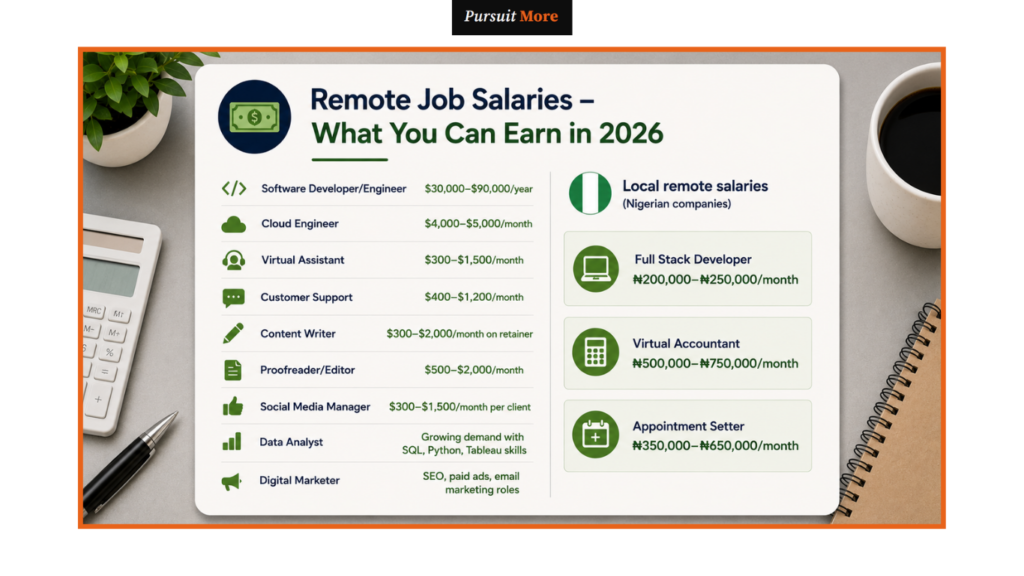
Remote Job Salaries – What You Can Earn in 2026.
The 2026 Remote-Ready Checklist
In your next job hunting technique, you can use this checklist to ensure that you are well prepared and ready to commence your hunt for remote jobs Nigeria in 2026.
- Portfolio & Proof of Work: Make sure you have 3 clean case studies hosted on a public link such as GitHub, Figma Community, Personal Web Domain or Notion Site. Your portfolio should highlight measurable business outcomes.
- LinkedIn Profile Optimisation: Another important thing to do is to set up and optimise your LinkedIn profile. Optimise your headline to your specific niche, e.g., “Senior Fintech React Engineer”. Turn on “Open to Work” visible to recruiters only, and set remote target locations to “Worldwide”; these will help the algorithm to bring up roles that match your profile.
- Payment & Compliance Preparedness: It is advisable to register an account on platforms such as Geepay, Grey or Payoneer. Ensure you verify identity using documents such as Government ID, International Passport, or Driver’s license upfront so you can supply payment details immediately upon offer letter receipt.
- Application Cadence (Quality Over Quantity): In a bid to land a remote job, it is easy for people to presume that quantity wins, but that can not be further from the truth. Do not send 100 generic “Easy Apply” submissions; instead, submit 5 hyper-tailored applications per week with customised Loom walkthrough videos or specialised cover notes addressing the company’s specific product challenges.
- Fix the number one Nigerian Remote Applicant Mistake: Stop hiding your geographic location or trying to fake a US/UK address. Be explicit that you are a world-class professional based in West Africa Timezone (WAT) who works flexible overlapping hours and operates with complete power and internet redundancy.

Government & Free Training – Get Skills for Free in 2026.
Landing high-paying remote jobs in Nigeria is an enviable thing that every young Nigerian will love to have. However, there are myriads of problems that Nigerian job seekers face when they try to land a high-paying remote job. Without proper knowledge of the platforms that can help you land these roles, facing a problem of subtle or outright geofencing, seeking remote jobs in Nigeria is not only competitive but also exhausting for those who do not do it in the right way. Understanding the nuances to remote jobs in Nigeria is vital to your success in this quest.
Essential Strategy for Landing Remote Jobs in Nigeria
Securing remote jobs in Nigeria requires targeting specialized fields where employers frequently hire local talent for international distributed teams. When searching for legitimate remote jobs in Nigeria, professionals should optimize profiles specifically for remote jobs in Nigeria keywords on platforms like Upwork, Toptal, and LinkedIn. Because competition for remote jobs in Nigeria is fierce, candidates tracking open remote jobs in Nigeria must maintain an updated portfolio, bypass regional geofencing barriers, and tailor every application to land high-paying remote jobs in Nigeria. If you are an African undergraduate seeking opportunities for education abroad, check our guide for finding fully funded scholarships abroad.
.